Ambrosius Francken I
1540 – 1618
In short
Ambrosius Francken I (1540–1618) was a Flemish painter from the Southern Netherlands, noted for his late‑Mannerist religious and historical works. He worked in Antwerp, where he also traded in stone and possibly art, and was a key figure in the influential Francken family of artists.
Notable works
.jpg)
_-_Christ_blessing_the_Children.jpg)
_-_Martyrdom_of_Saint_James_Triptych_(Saint_James_Church,_Antwerp).jpg)
_-_The_Last_Supper.jpg)
Early life Ambrosius Francken I was born in 1540 in the town of Herentals, in what is now the province of Antwerp. He was the eldest son of a modest family that, while not aristocratic, was connected to the burgeoning artistic community of the Southern Netherlands. The Francken household was steeped in the visual arts; several members of the extended family would later become prominent painters. From a young age Ambrosius showed an aptitude for drawing, and local tradition suggests that he received his first instruction from a master in Herentals before moving to the larger artistic centre of Antwerp to complete his apprenticeship.
Career and style By the early 1560s Ambrosius had established himself in Antwerp, a city that was then the commercial and cultural hub of the Low Countries. He entered the guild of Saint Luke, the professional association for painters, where he came into contact with the leading artists of the day. His style evolved in the context of the late Renaissance, absorbing the heightened artificiality and elongated forms of Mannerism while retaining a strong narrative drive inherited from earlier Flemish masters.
Francken’s oeuvre is characterised by a meticulous attention to religious iconography and a penchant for historical allegory. His compositions often feature crowded interiors, dramatic gestures, and a vivid palette that accentuates the emotional intensity of the scene. Though he never aligned himself with a formal movement, his work exemplifies the late‑Mannerist tendencies that dominated Flemish painting in the latter half of the sixteenth century.
In addition to his painting practice, Ambrosius was active as a stone dealer, a trade that provided him with a reliable income and a network of patrons among Antwerp’s mercantile elite. Some contemporary records hint that he may also have acted as an art dealer, facilitating the sale of works by his relatives and fellow artists.
Signature techniques Francken’s signature techniques include: - **Elongated figuration**: Figures often possess exaggerated proportions, especially in the neck and torso, a hallmark of Mannerist aesthetics. - **Complex compositional arrangements**: He favoured densely populated scenes where multiple narrative strands intertwine, guiding the viewer’s eye through a series of focal points. - **Rich, saturated colour**: A palette dominated by deep reds, luminous blues, and warm ochres reinforces the spiritual and emotional tenor of his religious subjects. - **Chiaroscuro modelling**: Strategic use of light and shadow creates a three‑dimensional effect that enhances the drama of the moment. - **Intricate detail**: Even in peripheral elements—such as textiles, architectural features, or background foliage—Francken rendered fine details that reward close inspection.
These techniques together produce works that are both visually arresting and intellectually engaging, inviting contemplation of the theological or historical narrative being depicted.
Major works Ambrosius Francken I’s surviving corpus is modest, yet several pieces have become reference points for scholars of late‑Mannerist Flemish art.
- Death of Sapphira (1590) – This painting portrays the biblical episode in which Sapphira, after lying about the proceeds of a sale, meets a sudden death. Francken renders the moment with a stark contrast between the illuminated figure of Sapphira and the shadowed onlookers, underscoring the moral gravity of the story. The work’s compositional balance and the tension between light and dark exemplify his late‑Mannerist sensibility.
- Christ blessing the Children (1600) – In this tender yet dynamically staged composition, the infant Christ is shown extending a benediction to a group of children. The painting is notable for its delicate handling of infantile gestures and the soft modelling of flesh, while the surrounding architecture displays the intricate perspective that Francken favoured.
- Martyrdom of Saint James Triptych (c. 1500) – Attribution of this triptych to Ambrosius is debated, as the date precedes his birth. Scholars generally regard the work as a later copy or a workshop piece produced under his supervision. The central panel depicts Saint James on the brink of martyrdom, surrounded by a crowded scene of onlookers. The elongated figures and dramatic gestures align with Francken’s known style, supporting a possible connection to his workshop.
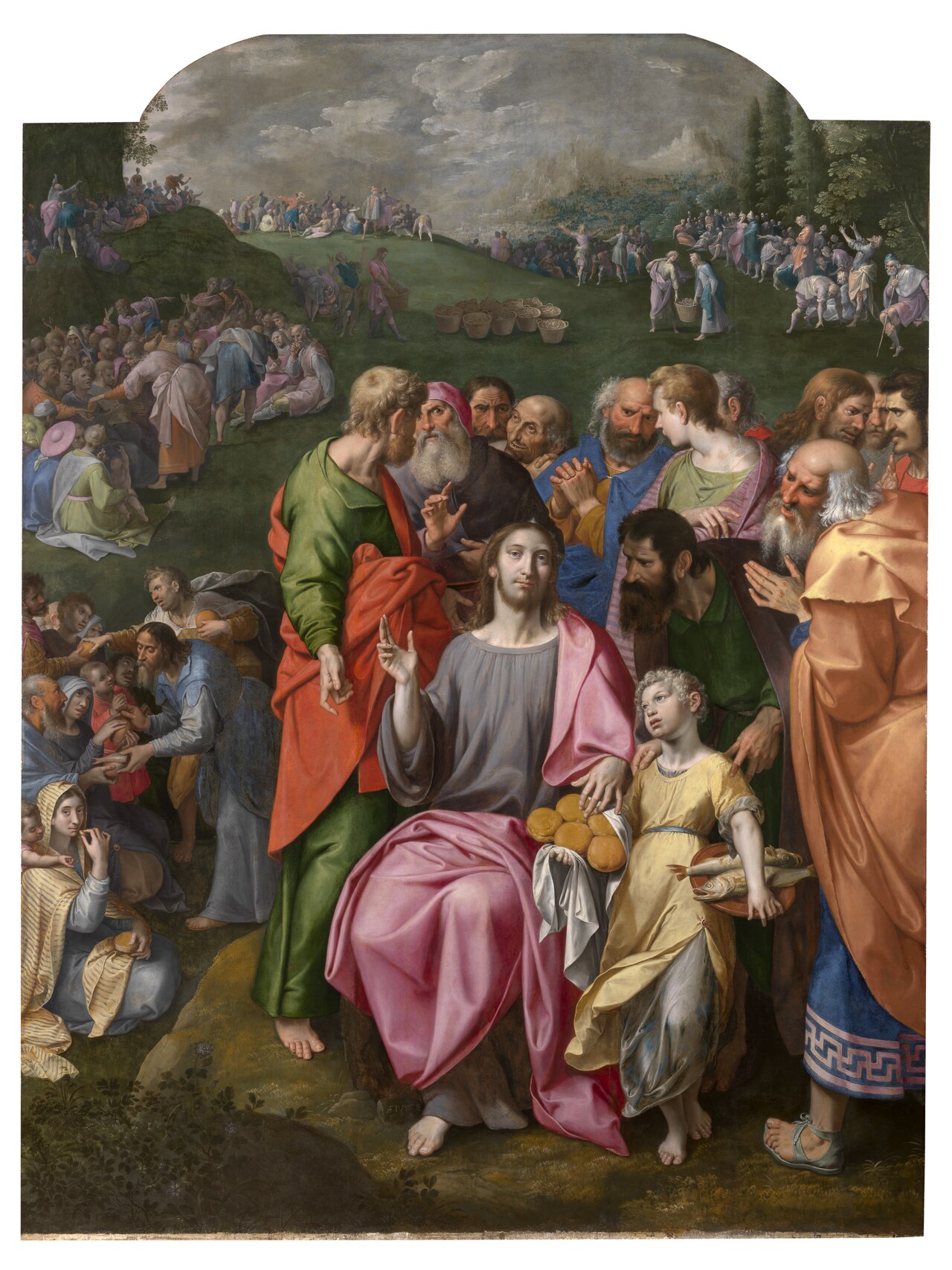
- The Multiplication of Loaves and Fishes (1598) – This large altarpiece illustrates the miracle of the loaves, with a focus on the abundance of food and the astonishment of the crowd. Francken employs a rich colour scheme and a carefully constructed spatial layout that draws the viewer’s eye toward the central miracle, while secondary figures are arranged in dynamic poses that convey movement.
- The Last Supper (1550) – Though the date suggests an earlier origin, the work is often linked to the Francken family workshop rather than to Ambrosius personally. The composition follows the traditional arrangement of Christ and the Apostles, yet the figures are rendered with the characteristic elongation and expressive gesturing that would later become hallmarks of Ambrosius’s own hand. The piece’s provenance indicates it may have been produced for a private chapel in Antwerp.
These works collectively illustrate Francken’s command of religious narrative, his adaptability to commission requirements, and his consistent visual language across decades.
Influence and legacy Ambrosius Francken I occupied a pivotal position within the Francken dynasty, a family that dominated Flemish painting from the late sixteenth to the mid‑seventeenth century. His artistic approach helped shape the visual vocabulary of his younger relatives, notably his brother Frans Francken the Elder, who would go on to develop the distinctive Francken genre scenes.
Beyond family ties, Ambrosius’s paintings contributed to the diffusion of late‑Mannerist aesthetics throughout the Southern Netherlands. His works were widely reproduced in prints, allowing a broader audience to encounter the dramatic, colour‑rich style that he championed. Moreover, his dual role as a dealer in stone and possibly artworks positioned him as a conduit between the material culture of Antwerp’s mercantile class and the artistic production of the city.
In modern scholarship, Francken is regarded as a transitional figure—one who retained the compositional vigor of the Renaissance while embracing the heightened expressiveness of Mannerism. His paintings continue to be displayed in major European collections, and their study provides insight into the complex interplay of religion, commerce, and artistic innovation in early modern Flanders.
Overall, Ambrosius Francken I’s legacy endures through the sustained relevance of his works, the influence he exerted on subsequent generations of Flemish painters, and his contribution to the rich tapestry of Northern European art history.
Frequently asked questions
Who was Ambrosius Francken I?
Ambrosius Francken I (1540–1618) was a Flemish painter from the Southern Netherlands, known for his late‑Mannerist religious and historical works and for his involvement in the art market of Antwerp.
What style or movement is his work associated with?
His paintings are characteristic of the late Mannerist style, featuring elongated figures, complex compositions and vivid colour, without affiliation to a formal movement.
What are his most famous works?
Among his best‑known pieces are *Death of Sapphira* (1590), *Christ blessing the Children* (1600), *The Multiplication of Loaves and Fishes* (1598), and the *Martyrdom of Saint James* triptych, traditionally linked to his workshop.
Why does he matter in art history?
He played a central role in the influential Francken family, helped spread late‑Mannerist aesthetics in the Southern Netherlands, and bridged artistic production with Antwerp’s commercial networks.
How can I recognise an Ambrosius Francken I painting?
Look for elongated, expressive figures, densely packed narrative scenes, a rich palette of reds and blues, and careful chiaroscuro that highlights dramatic moments within religious subjects.