Adelsteen Normann
1848 – 1918
In short
Adelsteen Normann (1848–1918) was a Norwegian landscape painter best known for his dramatic fjord scenes, which he created while based in Berlin. His work helped popularise Norway’s fjords as tourist destinations and he played a role in introducing Edvard Munch to the German art scene.
Notable works


Early life Adelsteen Normann was born in 1848 in the rural municipality of Bodin, situated in the Nordland county of Norway. He grew up amid the stark natural scenery of the Norwegian coast, an environment that would later become the central subject of his artistic output. Details of his formal education are scarce, but it is known that he pursued artistic training in Norway before moving abroad to further his career. In the early 1870s, Normann relocated to Berlin, a major European cultural hub, where he would spend the majority of his professional life.
Career and style In Berlin, Normann quickly established himself as a specialist in landscape painting, focusing almost exclusively on the dramatic fjords of his native Norway. His work reflects a blend of Romantic sensibility and a realist attention to detail, capturing both the sublime scale of the Norwegian coastline and the subtle play of light on water and rock. While he did not belong to a formally defined art movement, his paintings resonated with the broader 19th‑century European fascination with exotic natural scenery. Normann exhibited regularly at the Berlin Academy of Arts and secured commissions from both private collectors and public institutions, gaining a reputation as a reliable interpreter of Norway’s rugged beauty.
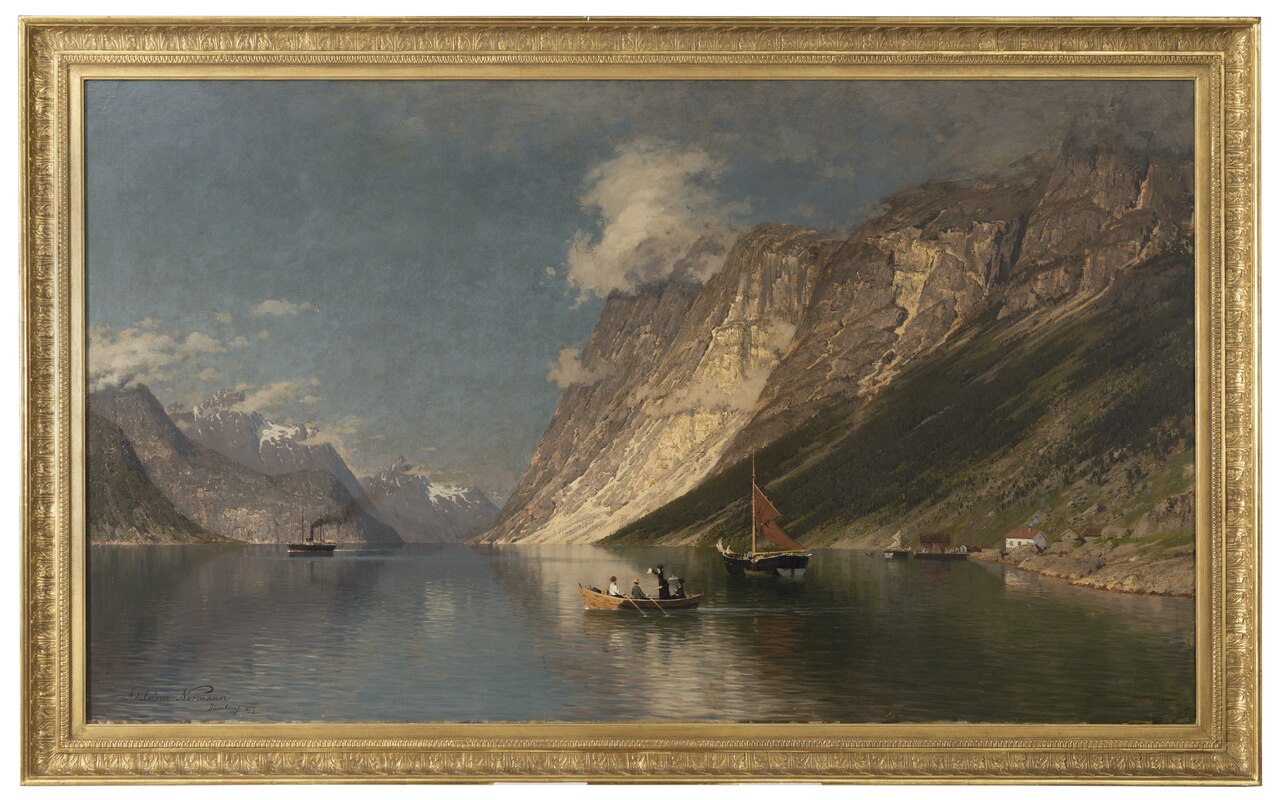
Signature techniques Normann’s canvases are characterised by a few recurring technical approaches. He employed a panoramic format that allowed him to convey the sweeping expanse of fjords, often placing the viewer’s eye at a low horizon line to emphasise depth. His handling of atmospheric perspective—softening distant mountains and water with cooler, muted tones—creates a sense of distance and mist that is a hallmark of his work. Light is rendered with a particular emphasis on the golden hour, where the sun’s low angle highlights the water’s surface and accentuates the texture of cliffs. Brushwork varies from fine, detailed strokes in foreground elements to broader, more fluid applications in sky and water, reinforcing the contrast between solid land and ethereal atmosphere.
Major works Normann’s most celebrated pieces include several fjord scenes that have become iconic representations of Norwegian nature. *Romsdalsfjord* (1877) captures the rugged cliffs and winding waterway of the Romsdal region, showcasing his skill in rendering both geological structure and reflective water. *From the Romsdal Fjord, 1875* (1875) predates the former and offers a complementary perspective, highlighting the interplay of light and shadow across the fjord’s surface. *Norwegian Fiord*—though undated—continues this theme, presenting a serene yet imposing vista that exemplifies his romantic‑realist approach. Later in his career, Normann produced *Sognefjord* (1918), a large‑scale work that reflects a mature synthesis of his earlier techniques, with a more subdued palette and a heightened sense of atmospheric depth. *Summer in Fjord* (1918), painted in the same year, portrays a tranquil summer scene, where the calm water and soft sky evoke a peaceful, almost idyllic mood. Together, these works demonstrate his lifelong dedication to depicting Norway’s fjords with both accuracy and emotive power.
Influence and legacy Adelsteen Normann’s impact extends beyond his canvases. By circulating vivid images of Norway’s fjords throughout Europe, particularly in Germany, he helped stimulate interest among travellers and contributed to the early development of Norwegian tourism. His reputation as a bridge between Norwegian and German artistic circles is underscored by his role in inviting the younger Edvard Munch to Berlin, where Munch would produce his groundbreaking work *The Scream*. Although Normann’s name is less widely recognised today than some of his contemporaries, his paintings remain valuable historical documents of Norway’s natural landscape in the late 19th and early 20th centuries. Collections of his work are held in several European museums, and his influence persists in the way contemporary landscape artists approach the depiction of light, atmosphere, and the sublime.
Frequently asked questions
Who was Adelsteen Normann?
Adelsteen Normann (1848–1918) was a Norwegian painter known for his landscape paintings of Norwegian fjords, most of which he created while living in Berlin.
What artistic style or movement is he associated with?
Normann is not linked to a specific movement, but his work blends Romantic naturalism with a realist attention to detail, reflecting the 19th‑century fascination with dramatic natural scenery.
What are his most famous works?
His best‑known paintings include *Romsdalsfjord* (1877), *From the Romsdal Fjord, 1875* (1875), *Norwegian Fiord*, *Sognefjord* (1918) and *Summer in Fjord* (1918).
Why is Adelsteen Normann important in art history?
He helped popularise Norway’s fjords as tourist attractions, introduced Edvard Munch to the Berlin art scene, and provided a lasting visual record of Norway’s landscape during a period of rapid change.
How can I recognise an Adelsteen Normann painting?
Look for panoramic fjord vistas, a low horizon line, meticulous detail in foreground rock, atmospheric perspective that softens distant elements, and a luminous golden‑hour light that highlights water and cliffs.