Abraham Govaerts
1589 – 1626
In short
Abraham Govaerts (1589–1626) was a Flemish Baroque painter from Antwerp, best known for his small, cabinet-sized forest landscapes rendered in the detailed manner of Jan Brueghel the Elder and Gillis van Coninxloo. He collaborated frequently with specialists for figures and still‑life elements, creating works that combined meticulous natural settings with narrative motifs.
Notable works


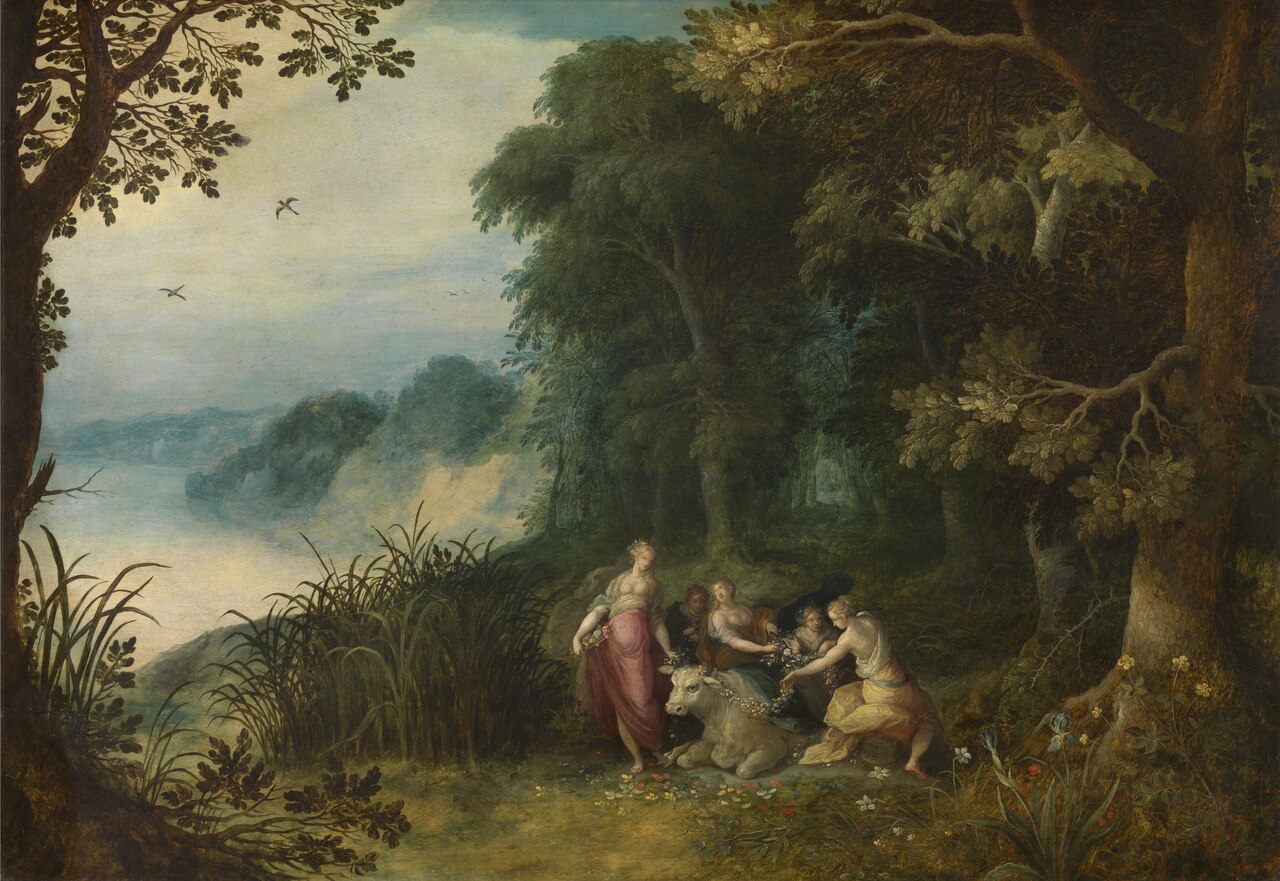

Early life Abraham Govaerts was born in 1589 in Antwerp, a bustling commercial hub of the Southern Netherlands. Little is recorded about his family background or early education, but the city’s vibrant artistic community provided a fertile environment for budding painters. Antwerp’s guild system, dominated by the Guild of Saint Luke, offered formal training pathways, and it is probable that Govaerts entered an apprenticeship in his teenage years, absorbing the techniques of established masters who were redefining landscape painting.
Career and style Govaerts established himself as a specialist in small‑scale forest landscapes during the early decades of the 17th century. His works echo the compositional precision of Jan Brueghel the Elder, whose miniature landscapes combined delicate brushwork with a keen eye for botanical detail. At the same time, Govaerts drew inspiration from Gillis van Coninxloo, whose dense, atmospheric woods set a precedent for the dramatic yet intimate forest scenes that became Govaerts’s hallmark. Operating within the Baroque idiom, he infused his canvases with a subtle dynamism: light filters through foliage, creating chiaroscuro effects that guide the viewer’s eye across the composition.
Govaerts’s career was marked by frequent collaborations. In the Antwerp workshop model, it was common for a landscape painter to hand over the scenery to a figure specialist, who would add mythological or genre characters, animals, or still‑life objects. This division of labour allowed Govaerts to focus on his strength—rendering realistic, intricately detailed woods—while benefitting from the narrative depth supplied by his collaborators. Such partnerships also facilitated the production of larger, multi‑genre compositions for the city’s affluent patrons.
Signature techniques The artist’s technique is characterised by several recurring elements. First, his brushwork in foliage is fine and layered, producing a textured canopy that suggests both the variety of tree species and the play of wind. Second, Govaerts employed a limited yet harmonious palette of greens, browns, and muted earth tones, punctuated by occasional bright accents—such as the red of a garment or the golden hue of a distant sunrise—to create focal points. Third, his handling of light is nuanced; he often positioned the light source at a low angle, allowing shafts of illumination to pierce the undergrowth, thereby enhancing depth and atmosphere.
Govaerts also demonstrated a meticulous approach to compositional balance. He frequently placed a winding path or a stream as a visual conduit, leading the viewer from the foreground into the middle ground, where figures or narrative episodes might be introduced. This compositional device not only adds narrative potential but also reinforces the intimate scale of his cabinet paintings, inviting close inspection.
Major works Among Govaerts’s extant oeuvre, several works illustrate his range and collaborative practice. *Wooded Landscape with Gipsy Women* (1612) presents a dense forest scene populated by a small group of itinerant women, whose figures were likely added by a specialist. The composition showcases Govaerts’s skill in rendering a tangled woodland while maintaining a clear spatial hierarchy.
*Resting Diana* (1614) demonstrates the artist’s ability to integrate mythological subjects. A serene depiction of the goddess amid a sylvan setting, the painting combines Govaerts’s meticulous foliage with the delicate, idealised form of Diana, presumably contributed by a figure painter.
In *John the Baptist in the Wilderness* (1615), the saint is placed within a stark, rocky landscape that contrasts with Govaerts’s usual verdant environments, indicating his flexibility in adapting to varied narrative demands. The companion pieces *St. John Preaching* and *The Baptism of Christ* (both 1615) further exemplify his collaborative approach, as the dramatic biblical scenes are set against his characteristic forested backdrops.
*The Feast of Gods* (1620) expands the scale of his work, depicting a mythological banquet within an expansive, lush garden. The painting’s intricate foliage, combined with a plethora of figures and decorative elements, underscores the collaborative nature of Antwerp workshops.
Finally, *The Rape of Europa* (1621) illustrates Govaerts’s capacity to handle grand mythological narratives. While the central action—Europa’s abduction by Zeus in the form of a bull—is executed by a figure specialist, the surrounding landscape bears Govaerts’s signature atmospheric depth, creating a harmonious synthesis of narrative and environment.
Influence and legacy Abraham Govaerts occupies a distinct niche within Flemish Baroque painting, bridging the meticulous landscape tradition of the early 17th century with the collaborative workshop practices that defined Antwerp’s artistic production. His small‑scale forest landscapes influenced contemporaries and successors who sought to balance detailed naturalism with narrative content. Though he did not achieve the fame of Jan Brueghel the Elder, Govaerts’s works were collected by discerning patrons who appreciated the intimacy and technical refinement of his cabinet paintings.
His legacy persists in the way art historians recognise the collaborative nature of Baroque workshops: Govaerts serves as a case study of a specialist who contributed a foundational visual layer that other artists could embellish. Modern exhibitions of Flemish landscape painting frequently include his pieces to illustrate the evolution of forest scenery from the late Renaissance into the high Baroque, highlighting his role in shaping the visual language of nature in Northern European art.
--- References: Guild of Saint Luke records, Antwerp museum catalogues, scholarly analyses of Flemish Baroque landscape painting, and comparative studies of Jan Brueghel the Elder and Gillis van Coninxloo’s influence on contemporaries.
Frequently asked questions
Who was Abraham Govaerts?
Abraham Govaerts (1589–1626) was a Flemish Baroque painter from Antwerp, renowned for his small, detailed forest landscapes and frequent collaborations with figure specialists.
What style or movement did he belong to?
He worked within the Baroque period, adopting a meticulous, miniature landscape style influenced by Jan Brueghel the Elder and Gillis van Coninxloo.
What are his most famous works?
Key works include *Wooded Landscape with Gipsy Women* (1612), *Resting Diana* (1614), *John the Baptist in the Wilderness* (1615), *The Rape of Europa* (1621), and *The Feast of Gods* (1620).
Why does he matter in art history?
Govaerts exemplifies the collaborative workshop model of Antwerp and helped define the intimate, detailed forest landscape genre that influenced later Flemish painters.
How can I recognise a Govaerts painting?
Look for small‑scale cabinet paintings with densely rendered foliage, subtle light filtering through trees, and a balanced composition often featuring a winding path; figures, when present, are typically added by another specialist.