Wu Bin
1543 – 1620
In short
Wu Bin (1543–1620) was a Ming‑dynasty Chinese painter from Putian, known for his landscape and Buddhist subjects. He worked during the Wanli reign, producing notable series such as Ten Views of a Lingbi Stone and The Sixteen Luohans.
Notable works


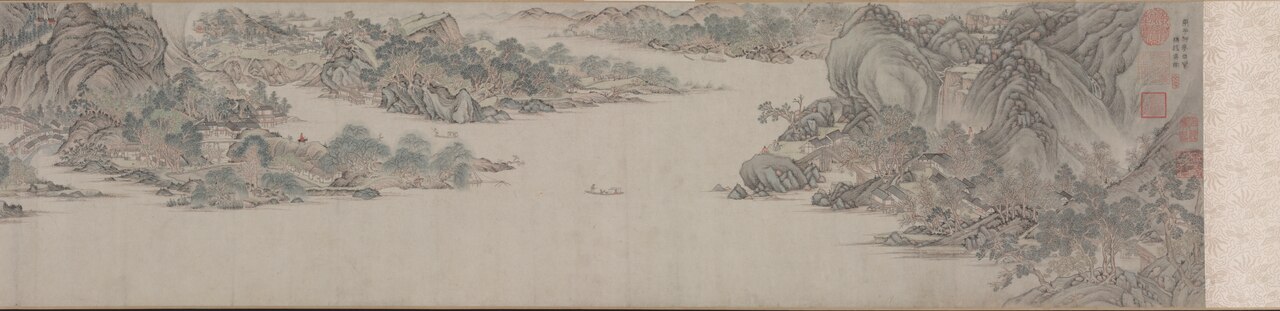


Early life Wu Bin was born in 1543 in Putian, a coastal town in Fujian province. Little is recorded about his family, but contemporary accounts suggest he was raised in a scholarly environment that valued classical education and the arts. He received a traditional Confucian schooling before turning to painting, a path common among literati of the period. Wu adopted the courtesy name *Wenzhong* and the art name *Zhiyin Toutuo*—"Mendicant monk at the temple hidden by tree branches"—reflecting a personal affinity for Buddhist practice. By his early twenties he had become associated with the Ōbaku sect, an offshoot of Chan Buddhism that was gaining influence in southeastern China.
Career and style Wu Bin’s professional career unfolded under the long reign of the Wanli Emperor (1573–1620). He was not a court official, but his reputation as a landscape painter attracted the attention of regional patrons and monastic communities. His oeuvre bridges secular and religious themes, a duality that mirrors the broader Ming trend of integrating literati aesthetics with Buddhist iconography. Wu’s landscapes are characterised by a measured balance between atmospheric ink washes and precise brush strokes, creating a sense of depth without excessive detail. He favoured a muted palette of black ink, occasional touches of colour, and a compositional rhythm that guides the viewer’s eye across mountains, water, and foliage.
Signature techniques Wu Bin’s technique rests on a disciplined use of the brush. He employed the "dry‑brush" method to render rock faces and tree bark, allowing the underlying paper texture to suggest weathered surfaces. For clouds and mist he layered translucent ink washes, achieving a lyrical, almost ethereal ambience. His figures—monks, arhats, and laypersons—are rendered with a restrained line, often using the "bone‑like" (gufa) stroke that conveys both solidity and spiritual presence. Wu also experimented with the "double‑layered" approach, first outlining forms in light ink and then deepening them with darker tones, a process that adds dimensionality while preserving spontaneity.
Major works - **Ten Views of a Lingbi Stone (1610)** – This series depicts the famed limestone sculpture from Anhui province from ten imaginative viewpoints. Each panel combines exacting topographical detail with poetic inscriptions, reflecting Wu’s fascination with the interplay of natural form and human contemplation. - **The Sixteen Luohans (1591)** – Executed for a Buddhist monastery, the work presents a group of enlightened disciples in varied poses of meditation and teaching. Wu’s subtle use of colour—mostly muted reds and greens—highlights the individuality of each luohan while maintaining a cohesive visual narrative. - **Greeting the Spring (1600)** – A seasonal landscape where blossoming apricot trees frame a winding river. The piece is celebrated for its delicate handling of light, achieved through thin ink washes that suggest early morning mist. - **The Five Hundred Arhats (1608)** – Perhaps Wu’s most ambitious religious commission, this massive scroll portrays a multitude of arhats gathered around a central Buddha figure. The composition balances crowd density with clear spatial organization, allowing each figure to retain a distinct character. - **Green Cliff with Red Maples (1603)** – In this landscape the dominant green rock face is punctuated by striking red maples, a colour contrast that underscores Wu’s skill in integrating bold accents within a largely monochrome setting.
Influence and legacy Wu Bin’s work occupies a distinct niche in late‑Ming painting. His synthesis of literati landscape techniques with Buddhist subject matter anticipated the early‑Qing revival of spiritual themes. Later artists such as Wang Qiao and the early Shandong school cited Wu’s brushwork as a model for achieving both expressive vigor and contemplative subtlety. Several of his scrolls survive in private collections and museum holdings in Shanghai and Beijing, where they continue to be studied for their technical mastery and cultural significance. Though his exact death place remains unknown, Wu Bin is remembered as a bridge between the scholarly traditions of the Ming elite and the devotional art of Chinese Buddhism, a legacy that endures in both academic scholarship and the visual vocabulary of East Asian art.
Frequently asked questions
Who was Wu Bin?
Wu Bin (1543–1620) was a Ming‑dynasty Chinese painter from Putian, known for his landscape and Buddhist-themed works.
What artistic style or movement is Wu Bin associated with?
He worked within the literati painting tradition while incorporating Buddhist iconography, a blend typical of late‑Ming art.
What are Wu Bin’s most famous works?
His best‑known pieces include Ten Views of a Lingbi Stone (1610), The Sixteen Luohans (1591), Greeting the Spring (1600), The Five Hundred Arhats (1608) and Green Cliff with Red Maples (1603).
Why is Wu Bin important in art history?
Wu’s integration of scholarly brush techniques with religious subjects helped shape the transition from Ming to early‑Qing artistic sensibilities, influencing later painters who sought a spiritual dimension in landscape art.
How can I recognise a painting by Wu Bin?
Look for a balanced composition of misty ink washes, dry‑brush rock textures, restrained figure lines, and occasional selective colour—especially red accents against a predominantly monochrome background.