Wen Boren
1502 – 1575
In short
Wen Boren (1502–1575) was a Chinese painter of the Ming dynasty, best known for his literati landscapes and figures. A native of Suzhou and a grandson of the celebrated Wen Zhengming, he worked within the Wu School tradition and produced works such as Landscape (1545) and Water Village (1570).
Notable works


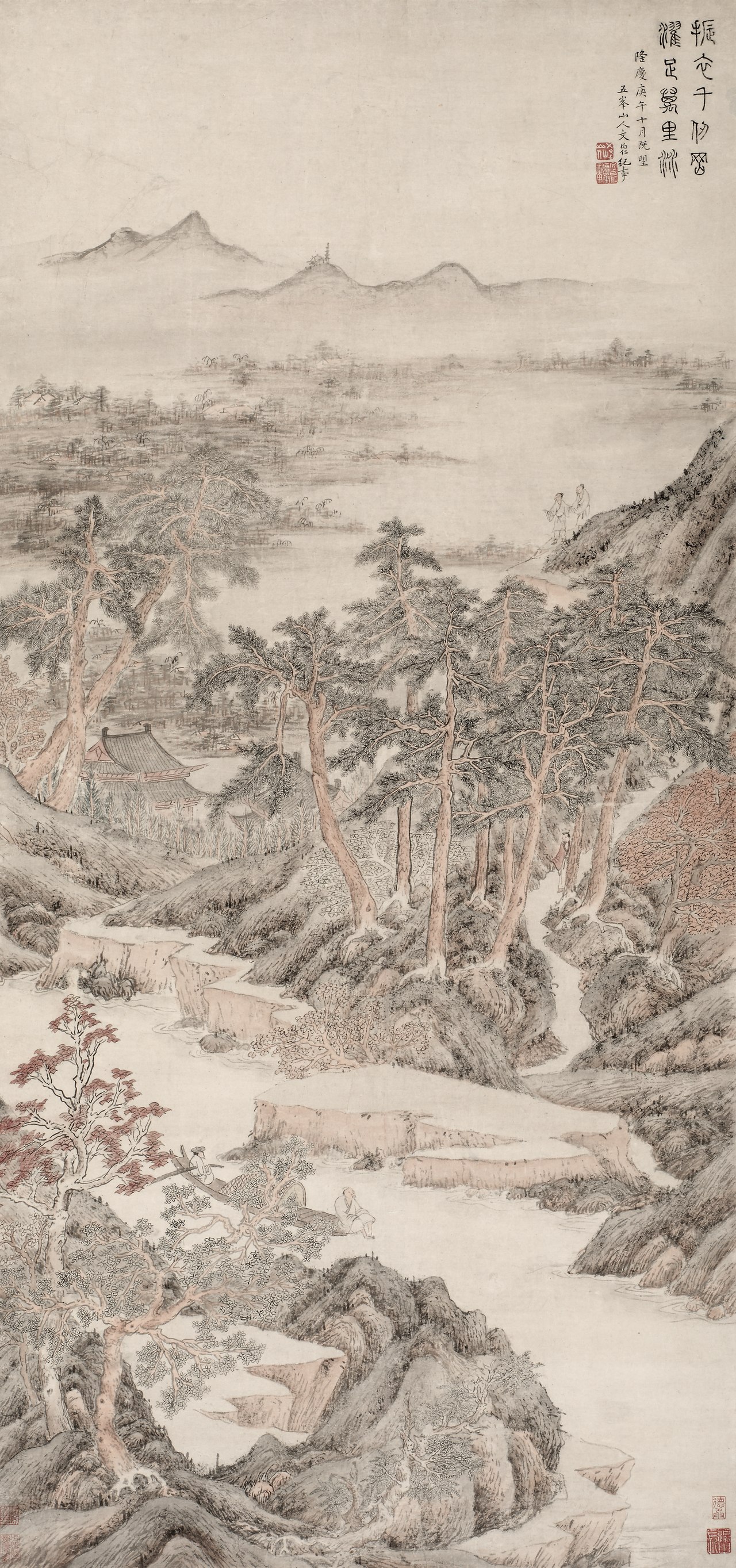

Early life Wen Boren was born in 1502 in Suzhou, a cultural hub of the Jiangsu province that was the heart of the Wu School of painting. He came from an illustrious artistic lineage; his grandfather was the renowned painter‑scholar Wen Zhengming, a leading figure of the Wu School. Growing up in a family that combined scholarly pursuits with artistic practice, Wen Boren received a classical education in the Confucian classics as well as informal training in calligraphy and brushwork. The environment of Suzhou, with its canals, gardens and literati gatherings, shaped his aesthetic sensibilities and provided a repertoire of motifs that would recur throughout his career.
Career and style Wen Boren began his professional life as a scholar‑official, a common path for artists of his class. By the mid‑16th century he had established a reputation as a landscape painter whose work embodied the literati ideal of expressing personal feeling through brush rather than precise representation. His style reflects the Wu School’s emphasis on spontaneity, modest colour, and a deep appreciation for the natural world. He favoured ink wash techniques, often employing monochrome palettes punctuated by subtle washes of light blue or green to suggest atmospheric depth. While his work aligns with the broader Ming literati movement, Wen Boren is distinguished by a more intimate, almost poetic treatment of village scenes and human figures, integrating narrative elements without sacrificing the meditative quality of traditional landscape painting.
Signature techniques Wen Boren’s brushwork is characterised by several recurring techniques:
* Dry‑brush texture – He often used a partially dried brush to render rock formations and tree trunks, creating a stippled, almost tactile surface that suggests weathered stone. * Negative space – Large swathes of empty paper allow mist and distance to be implied, a hallmark of Chinese landscape composition that Wen employed to great effect. * Calligraphic strokes – Influenced by his grandfather’s calligraphy, Wen’s lines are fluid and rhythmic, merging the disciplines of painting and script. * Layered washes – Subtle layers of diluted pigment build atmospheric perspective, giving his scenes a sense of depth that extends beyond the two‑dimensional plane. * Figure integration – In works that include human activity, he positions figures with a light, almost sketch‑like quality, ensuring they enhance rather than dominate the landscape.
These techniques combine to produce paintings that feel both scholarly and accessible, inviting viewers to contemplate the harmony between humanity and nature.
Major works ### Landscape (1545) Created in 1545, *Landscape* exemplifies Wen Boren’s mature ink‑wash approach. The composition is anchored by towering peaks rendered with dry‑brush strokes, while misty valleys recede through layered washes of grey‑blue. The piece is signed and dated, confirming its place in his mid‑career output. Critics note the balanced asymmetry of the composition, a principle derived from classical Chinese landscape theory.
### Water Village (1570) *Water Village* (1570) shifts focus to a more populated scene, depicting a tranquil riverside settlement. Wen employs delicate ink lines to outline thatched roofs and boats, while the water’s surface is suggested through soft, horizontal brush marks. The work demonstrates his ability to blend narrative content with the contemplative atmosphere of his landscapes, a hallmark of late‑Ming literati painting.
### Washing the Feet (from the Dusty World) (1570) Also dated 1570, *Washing the Feet (from the Dusty World)* portrays a modest domestic ritual. The painting is notable for its restrained colour—only a faint wash of brown pigment accents the figures—while the surrounding environment is rendered in sparse ink, emphasizing the act’s spiritual humility. This work reflects Wen’s interest in moral themes and the integration of Confucian values within visual art.
### Saying Farewell at Xunyang (Song of the Pipa) (1547) In *Saying Farewell at Xunyang (Song of the Pipa)*, painted in 1547, Wen captures a lyrical moment of parting. A lone scholar, clutching a pipa, stands before a riverbank, his silhouette rendered with a swift, calligraphic stroke. The composition’s emotional resonance is heightened by the use of empty space to suggest distance and longing, illustrating Wen’s capacity to convey narrative depth through minimal means.
Influence and legacy Wen Boren’s contribution to Ming art lies in his synthesis of the Wu School’s scholarly tradition with a more personal, narrative sensibility. His works were collected by contemporary officials and later by early Qing collectors, ensuring his style continued to be studied. Later painters, particularly those of the early Qing period, drew on his dry‑brush textures and his subtle use of colour to develop their own interpretations of literati landscape. Academic references to Wen Boren appear in several Ming‑era painting manuals, where his techniques are cited as exemplary models for aspiring scholars. Though his death place remains unknown, his artistic legacy endures through the continued exhibition of his paintings in major Chinese museums and the ongoing scholarly interest in his role as a bridge between the high‑culture of the Wu School and the more populist depictions of everyday life.
Overall, Wen Boren remains a pivotal figure in the evolution of Chinese landscape painting, embodying the intellectual rigor of the literati while opening space for narrative and emotive expression within the genre.
Frequently asked questions
Who was Wen Boren?
Wen Boren (1502–1575) was a Ming‑dynasty Chinese painter from Suzhou, known for his literati landscapes and a member of the Wu School tradition.
What artistic style or movement is Wen Boren associated with?
He worked within the Wu School of painting, a literati movement that valued brushwork, scholarly subjects and understated colour.
What are Wen Boren’s most famous works?
His most cited works include *Landscape* (1545), *Saying Farewell at Xunyang (Song of the Pipa)* (1547), *Water Village* (1570) and *Washing the Feet (from the Dusty World)* (1570).
Why is Wen Boren important in art history?
He blended the Wu School’s scholarly aesthetics with narrative elements, influencing later Ming and early Qing painters and helping to expand the expressive range of Chinese landscape painting.
How can I recognise a painting by Wen Boren?
Look for dry‑brush rock textures, generous use of negative space, subtle layered washes, and a calligraphic quality to the lines that often accompany modest, narrative scenes of villages or solitary figures.