Théobald Michau
1676 – 1765
In short
Théobald Michau (1676–1765) was a Walloon landscape painter from the Southern Netherlands, born in Tournai and active mainly in Antwerp, known for his conservative depictions of rural scenes such as Landscape with Figures, Landscape with river + flock (1750) and A Farmyard (1728).
Notable works
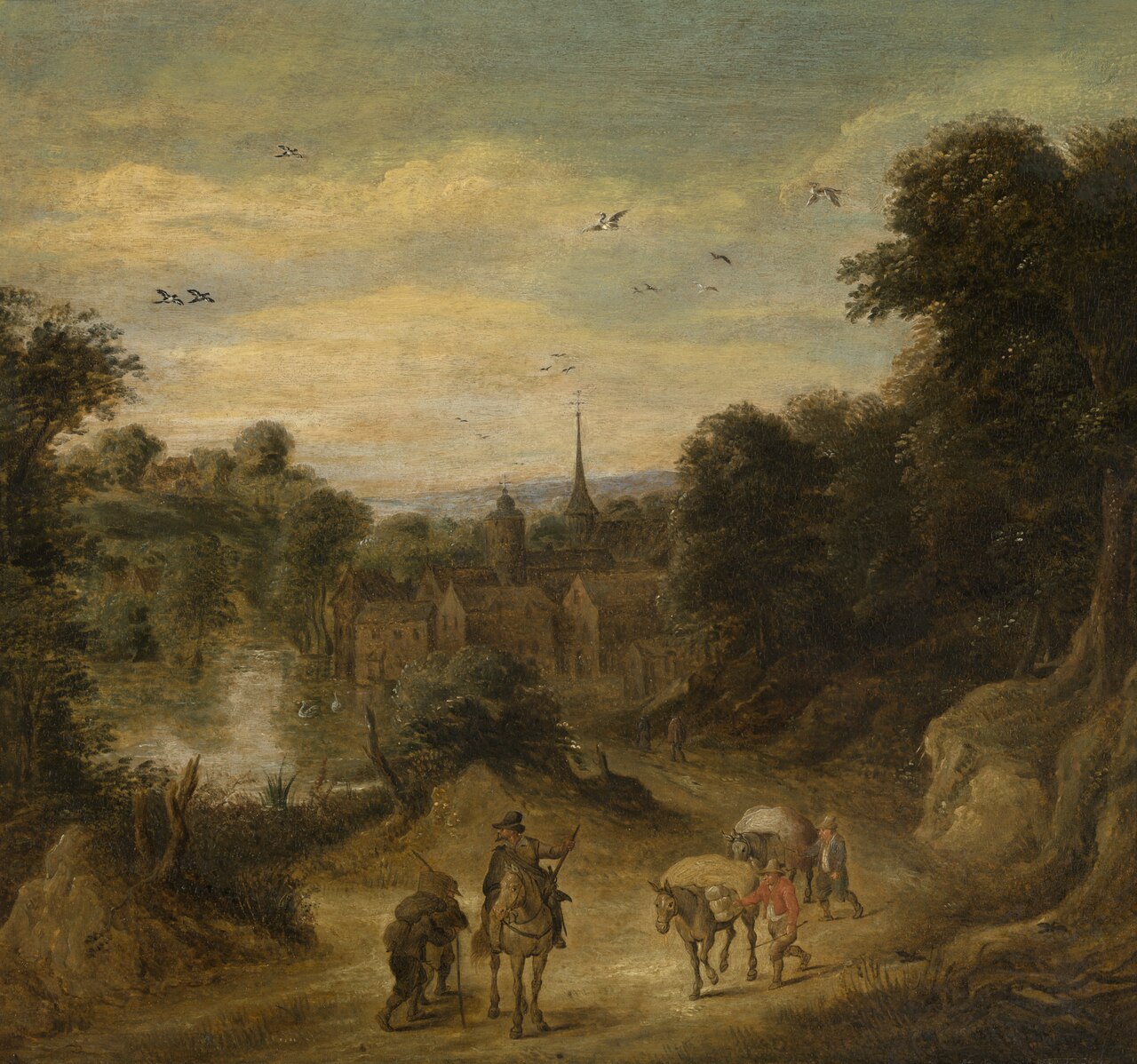

_-_Museum_Boijmans_Van_Beuningen.jpg)
Early life
Théobald Michau was born in 1676 in Tournai, a historic town in the Southern Netherlands that lay at the crossroads of French and Flemish cultural influences. His family belonged to the Walloon community, and he grew up in an environment where religious art and local guilds played a prominent role. Little is recorded about his formal training, but the proximity of Tournai to Antwerp—a major artistic hub—suggests that he may have apprenticed with a workshop that specialised in landscape painting, a genre that enjoyed steady demand among both aristocratic patrons and the emerging bourgeois class.
Career and style
By the early 1700s Michau had established himself in Antwerp, where he spent the majority of his professional life. The city’s market for decorative and narrative works provided ample opportunities for a painter whose style was firmly rooted in the established Flemish landscape tradition. Michau’s canvases are marked by a restrained, conservative aesthetic that favoured balanced compositions over dramatic chiaroscuro. Unlike the more experimental contemporaries who began to explore Rococo lightness or emerging Enlightenment themes, Michau maintained a steady visual vocabulary that echoed the late‑Baroque sensibility of his predecessors. His scenes are typically populated with modest human figures that serve to animate the countryside rather than dominate it.
Signature techniques
Michau’s technique hinges on a meticulous handling of foliage and terrain. He employed a limited palette of earth tones—ochres, umbers and muted greens—that allowed him to render the subtle variations of light across fields, trees and water surfaces. Brushwork is generally smooth, with careful blending that eliminates the visible strokes often associated with more expressive painters. In the treatment of sky, he favoured a soft gradation that creates a sense of atmospheric depth without resorting to stark contrasts. The inclusion of small, well‑observed details—such as a shepherd’s staff, a distant windmill blade or a flock of birds in flight—adds narrative interest while preserving the overall composure of the work.
Major works
Among Michau’s surviving oeuvre, three paintings illustrate his mature style. *Landscape with Figures* presents a bucolic vista where a handful of peasants engage in everyday tasks beneath a gently rolling horizon. The figures are rendered with modest scale, reinforcing the primacy of the surrounding environment. *Landscape with river + flock* (dated 1750) depicts a tranquil river winding through a meadow, while a dispersed flock of sheep grazes nearby. The composition demonstrates Michau’s skill in balancing water, land and animal movement within a harmonious frame. Finally, *A Farmyard* (1728) offers an interior glimpse of rural labour, with a cluster of farm buildings, livestock, and workers arranged in a orderly layout. The painting’s subdued colour scheme and precise rendering of architectural elements exemplify the artist’s commitment to realism tempered by a calm, almost idealised vision of country life.
Influence and legacy
During his lifetime Michau enjoyed a respectable reputation, securing commissions from local patrons who appreciated his dependable craftsmanship. However, his adherence to conventional motifs meant that he was soon eclipsed by more avant‑garde figures as artistic tastes shifted toward Rococo elegance and, later, Neoclassical restraint. Modern scholarship has begun to reassess his contribution as a representative of the conservative strand of 18th‑century Flemish landscape painting. By preserving the visual language of the late Baroque, Michau offers contemporary historians a valuable benchmark for understanding how rural imagery functioned within the commercial art market of the Southern Netherlands. Though his name is less prominent today, his works remain important reference points for the study of genre painting and the continuity of landscape traditions across the early modern period.
Frequently asked questions
Who was Théobald Michau?
Théobald Michau (1676–1765) was a Walloon painter of the Southern Netherlands who specialised in landscape scenes, working primarily in Antwerp after being born in Tournai.
What style or movement is he associated with?
He is generally regarded as a conservative artist who adhered to the late Baroque Flemish landscape tradition rather than aligning with any avant‑garde movement.
What are his most famous works?
His best‑known paintings include Landscape with Figures, Landscape with river + flock (1750) and A Farmyard (1728).
Why does he matter in art history?
Michau exemplifies the continuation of the Flemish countryside genre in the early‑18th century, providing valuable insight into the tastes and rural visual culture of his period.
How can one recognise a Théobald Michau painting?
Typical clues are the calm, orderly composition, muted earth tones, modest human presence, and a meticulous rendering of foliage that reflects the artist’s conservative approach.