Peter Angellis
1685 – 1734
In short
Peter Angellis (1685–1734) was a Southern‑Netherlandish painter who worked across Flanders, Germany, Italy, England and France. He is best known for his Rococo genre scenes such as Scene in the Courtyard of an Inn (1724) and his depictions of market life in London.
Notable works



Early life Peter Angellis was born in 1685 in Dunkirk, a coastal town that lay on the border of the Southern Netherlands and French territory. Little is recorded about his family background, but archival sources indicate that he received his first artistic training locally, likely within the workshop tradition that dominated Flemish towns at the turn of the 18th century. Dunkirk’s proximity to both Dutch and French cultural currents provided Angellis with a bilingual environment and early exposure to the vibrant trade of paintings that moved through the region’s ports.
Career and style Around the first decade of the 1700s Angellis embarked on a peripatetic career that took him to several artistic centres. He spent formative periods in the German states, where the lingering influence of the Baroque still dominated court commissions, and later in Italy, where the lighter, decorative tendencies of the emerging Rococo were taking hold. By the 1710s he had arrived in England, a market eager for continental genre scenes that combined technical finesse with a taste for everyday subjects. Angellis settled briefly in London before moving to France, where he continued to produce works for private collectors.
Stylistically, Angellis occupies a transitional position between the robust realism of Flemish Baroque and the airy elegance of Rococo. His palette softens the deep, earthy tones of his Netherlandish heritage with pastel blues, pinks and ivory that are characteristic of the early Rococo. The compositions often feature intimate interior or street settings populated by figures engaged in quotidian activities—vendors, artisans, and patrons—rendered with a gentle humor and a keen eye for texture. This blend of Northern realism and Southern decorative flair made his paintings popular among patrons who sought both narrative depth and visual charm.
Signature techniques Angellis is distinguished by a few recurring technical approaches. First, his handling of light is subtle yet decisive; he frequently employs a diffused daylight that filters through windows or open doors, creating a soft illumination that envelopes the figures without harsh contrasts. Second, his brushwork balances precision and fluidity: the architectural elements and objects are rendered with careful, almost stippled detail, while the flesh tones and fabrics are suggested with looser, more gestural strokes, giving his figures a sense of movement. Third, he demonstrates a mastery of texture, especially in the depiction of materials such as wood, metal and textiles, which he achieves through layered glazes and delicate scumbling. These methods combine to produce a visual harmony that feels both naturalistic and decorative.
Major works Among Angellis’ surviving oeuvre, several paintings illustrate his mature Rococo style. **Scene in the Courtyard of an Inn (1724)** captures a bustling tavern courtyard where travelers, musicians and servants mingle beneath an open sky. The composition is anchored by a central archway, and the play of light on the stone paving and the figures’ clothing highlights Angellis’ skill in rendering varied textures.
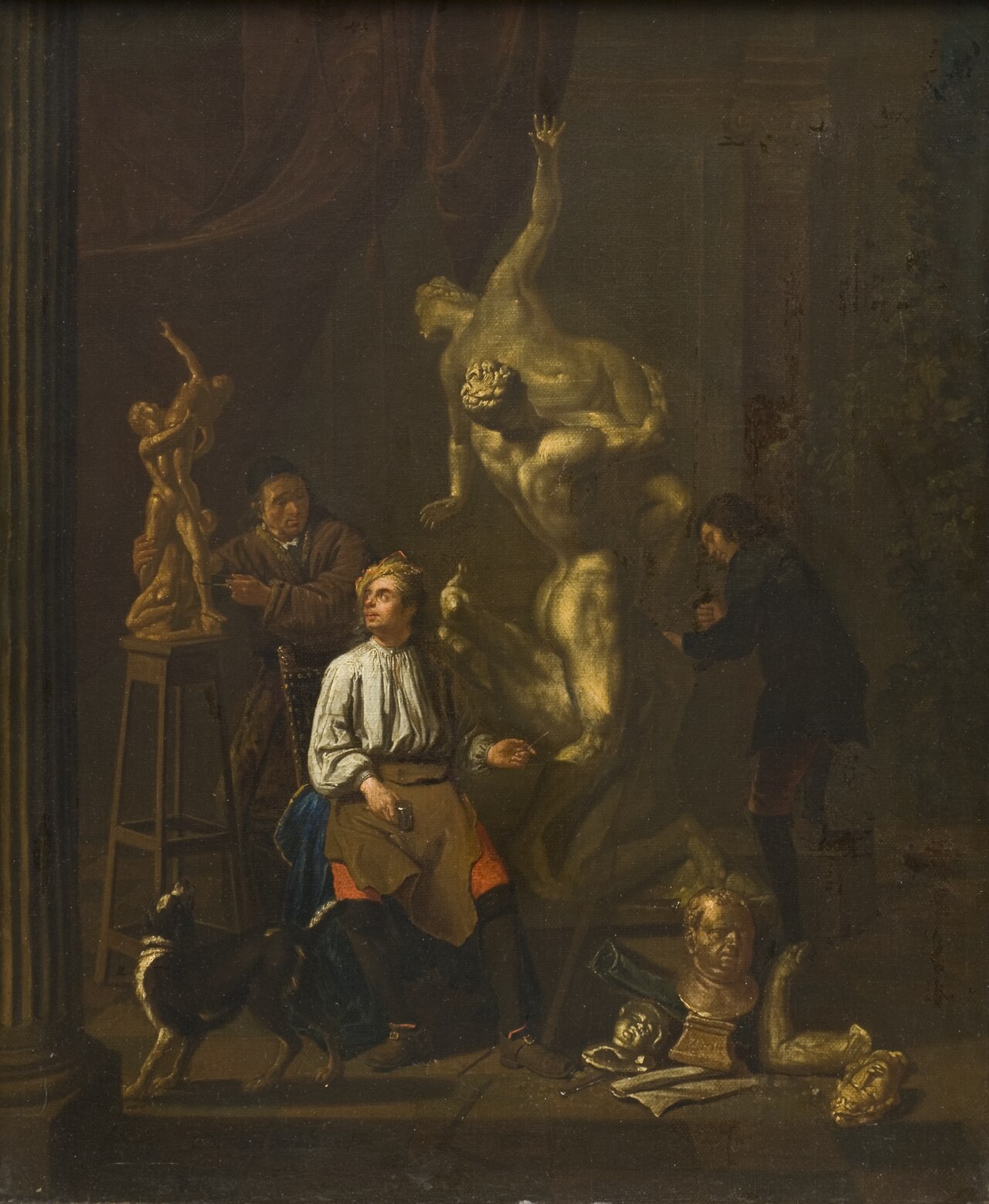
A Sculptor’s Studio (1716) offers a glimpse into an artist’s workspace, populated with unfinished statues, tools, and a patron examining a work‑in‑progress. The painting is notable for its careful observation of the studio’s cluttered environment, and for the subtle chiaroscuro that models the sculptor’s muscular form against the surrounding shadows.
In England, Angellis produced several works that reflect his interest in market life. The Vegetable Seller (1725) and its later variant Vegetable Seller, Covent Garden (1726) depict a lone vendor arranging produce on a stall in London’s bustling Covent Garden. The figures are rendered with a gentle humour, and the background architecture is softened by a pastel sky that hints at the early morning light. The companion piece Covent Garden (1726) expands the scene to include additional shoppers and street performers, providing a richer tableau of urban activity.
These works collectively demonstrate Angellis’ ability to blend narrative content with a decorative aesthetic, making ordinary scenes appear both dignified and appealing.
Influence and legacy Peter Angellis’ career exemplifies the fluid movement of artistic ideas across European borders in the early 18th century. By integrating Flemish realism with the lighter Rococo vocabulary, he helped introduce a more relaxed, genre‑focused approach to painting in regions that had previously emphasized grand historical or religious subjects. His market and interior scenes influenced later British genre painters, who adopted his soft lighting and attention to everyday detail. Although Angellis died in Rennes in 1734, his works continued to circulate in private collections throughout France and England, contributing to the diffusion of Rococo tastes beyond its French heartland. Modern scholarship recognises him as a bridge between the Baroque tradition of the Low Countries and the decorative exuberance of the Rococo, underscoring his role in the evolution of European genre painting.
Frequently asked questions
Who was Peter Angellis?
Peter Angellis (1685–1734) was a Southern‑Netherlandish painter known for his Rococo genre scenes, active in Flanders, Germany, Italy, England and France.
What artistic movement is he associated with?
He worked in the Rococo style, blending the realism of Flemish Baroque with the light, decorative qualities of early Rococo.
What are his most famous works?
Key paintings include Scene in the Courtyard of an Inn (1724), A Sculptor’s Studio (1716), The Vegetable Seller (1725) and its variations set in Covent Garden (1726).
Why is Peter Angellis important in art history?
He helped transmit Rococo aesthetics to Northern Europe, influencing later British genre painters and expanding the visual vocabulary for everyday subjects.
How can I recognise an authentic Peter Angellis painting?
Look for soft pastel palettes, diffused daylight, meticulous texture in objects, and a mix of precise brushwork for architecture with looser strokes for figures—often depicting market or studio scenes.