Niels Skovgaard
1858 – 1938
In short
Niels Skovgaard (1858–1938) was a Danish painter and sculptor renowned for his contributions to late‑19th‑century Danish art, most famously the 1931 statue of N.F.S. Grundtvig. Working across painting and sculpture, he blended naturalist observation with a subtle Symbolist sensibility, producing works that remain central to Denmark’s cultural heritage.
Notable works




Early life Niels Kristian Skovgaard was born in Copenhagen on 22 April 1858 into a family already steeped in the arts. His father, P.C. Skovgaard, was a leading landscape painter of the Danish Golden Age, and his mother, Georgia Skovgaard, was a noted textile artist. Growing up surrounded by canvases, easels and the Danish countryside, Niels received early instruction in drawing and composition at home. He later enrolled at the Royal Danish Academy of Fine Arts, where he studied under both traditional academic teachers and progressive contemporaries. The Academy provided a rigorous grounding in drawing, anatomy and the technical processes of both painting and sculpture, laying the foundation for his dual‑medium practice.
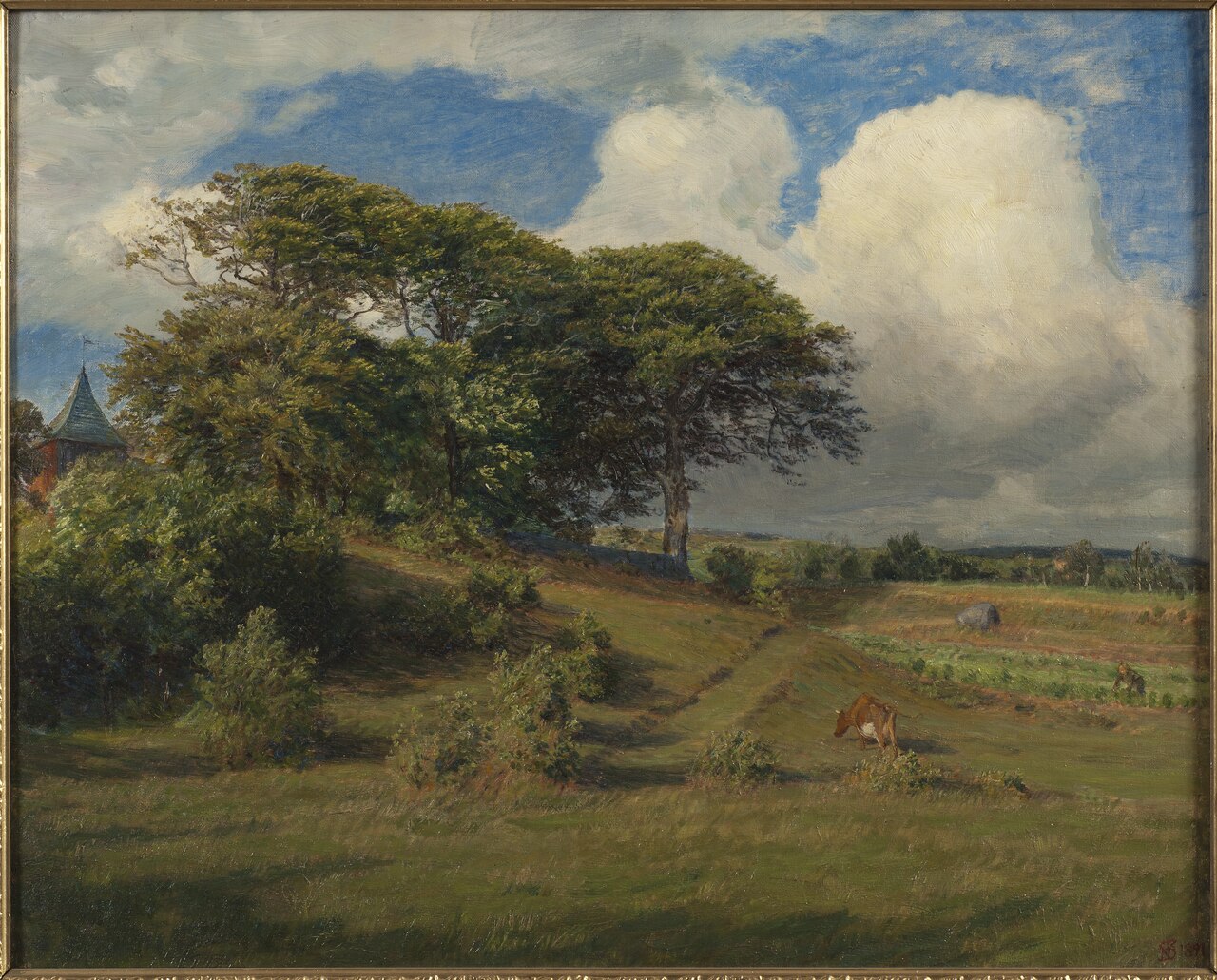
Career and style After completing his formal training in the early 1880s, Skovgaard embarked on a career that straddled two disciplines. In painting, he was drawn to the naturalist tradition of his father, yet his work increasingly reflected an interest in the atmospheric qualities championed by the Symbolist movement. This hybrid style manifested in landscapes that combined precise observation of light and foliage with an emotive, almost poetic mood. As a sculptor, Skovgaard’s oeuvre evolved from small figurative studies to monumental public commissions. His sculptural language was characterised by a restrained realism; he eschewed excessive ornamentation in favour of clean lines and a focus on the psychological presence of his subjects.
Throughout the 1880s and 1890s, Skovgaard travelled extensively across Europe, visiting Italy, France and Greece. These trips exposed him to classical statuary, Renaissance proportions and the burgeoning Art Nouveau style. While he never aligned himself formally with any avant‑garde group, the exposure enriched his visual vocabulary, allowing him to integrate classical balance with contemporary sensibilities. By the turn of the century, his reputation as a versatile artist was solidified, and he received commissions for both decorative pieces and major public monuments.
Signature techniques Skovgaard’s technique in painting relied heavily on layered glazing to achieve depth of colour. He would begin with a thin underpainting to map out tonal relationships, then apply successive translucent layers of oil to build atmospheric effects. This method produced a luminous quality especially evident in his depictions of woodland scenes. In sculpture, his preferred material was bronze, though he also worked in marble and stone. He employed a direct carving approach for stone works, allowing the grain and texture of the material to inform the final form. For bronze pieces, he used the lost‑wax casting process, which afforded him fine control over surface detail while preserving the vitality of his original clay models.
Major works - **Statue of N. F. S. Grundtvig (1931)** – Situated in Copenhagen, this bronze monument is widely regarded as Skovgaard’s masterpiece. The figure of Grundtvig, the influential Danish theologian and educator, is rendered with dignified poise, the sculptor’s restrained realism emphasizing the intellectual gravitas of his subject. The statue’s base incorporates subtle reliefs that echo motifs from Grundtvig’s writings, creating a harmonious dialogue between form and content. - **Magnus stone (1898)** – Carved from locally sourced Danish granite, the Magnus stone is a commemorative piece that blends classical iconography with a distinctly Scandinavian aesthetic. Its surface treatment showcases Skovgaard’s skillful use of natural stone texture to evoke both strength and serenity. - **Beeches at the Dagsås Church, Halland (1891)** – This landscape painting captures the dappled light filtering through a stand of beech trees near the Swedish church of Dagsås. Skovgaard’s nuanced handling of colour and his delicate brushwork convey a sense of quiet contemplation, reflecting his affinity for sacred spaces and natural environments. - **Dragtstudier og studie af et kvindehovede. Megara (1896)** and **Dragtstudier. Megara (1896)** – These two studies, produced during a sojourn in the Greek city of Megara, reveal Skovgaard’s fascination with the human figure amidst classical settings. The works depict clothed female models in poses that echo ancient sculpture, yet the artist’s handling of fabric and posture remains modern, highlighting his ability to bridge historical reference with contemporary observation.
Influence and legacy Niels Skovgaard’s contribution to Danish art lies in his synthesis of naturalist observation, Symbolist mood and classical sculptural discipline. Though he never spearheaded a formal movement, his works influenced a generation of artists who sought to reconcile realism with emerging modernist tendencies. The Grundtvig statue, in particular, cemented his reputation as a sculptor capable of translating intellectual gravitas into public art, a model later emulated in Danish civic monuments.
Beyond his own creations, Skovgaard’s legacy continued through his teaching and mentorship at the Royal Academy, where he encouraged students to explore both two‑dimensional and three‑dimensional media. His emphasis on careful observation, layered technique and respect for material integrity remains a touchstone in Danish art curricula. Today, his paintings and sculptures are held in major Danish museums, and the Grundtvig statue remains a focal point for cultural tours, ensuring that Niels Skovgaard’s artistic voice endures within Denmark’s visual heritage.
Frequently asked questions
Who was Niels Skovgaard?
Niels Skovgaard (1858–1938) was a Danish painter and sculptor known for his naturalist‑symbolist landscapes and restrained, realistic public monuments, most famously the 1931 statue of N.F.S. Grundtvig.
What style or movement is he associated with?
He worked across naturalism, Symbolism and classical sculpture, blending precise observation with poetic mood without belonging to a single formal movement.
What are his most famous works?
His best‑known pieces include the bronze statue of N.F.S. Grundtvig (1931), the Magnus stone (1898), the painting Beeches at the Dagsås Church (1891), and his 1896 figure studies from Megara.
Why is Niels Skovgaard important in art history?
He helped bridge 19th‑century naturalism and early‑20th‑century modernism in Denmark, influencing both public monument design and academic teaching of mixed media.
How can I recognise a work by Niels Skovgaard?
Look for a calm, realistic treatment of subjects, layered glazing in paintings, clean lines in sculptures, and a subtle symbolic atmosphere that links nature or historic themes with a restrained, almost meditative tone.