Joakim Skovgaard
1856 – 1933
In short
Joakim Skovgaard (1856–1933) was a Danish painter best known for his monumental frescoes in Viborg Cathedral and a series of narrative paintings that blend naturalistic detail with Symbolist imagination.
Notable works



Early life Joakim Frederik Skovgaard was born on 21 March 1856 in Copenhagen, the capital of the Kingdom of Denmark. He came from an artistic family; his father, Peder Skovgaard, was a respected landscape painter who encouraged Joakim’s early interest in drawing. After completing his primary education, Skovgaard entered the Royal Danish Academy of Fine Arts in 1874, where he received formal training in drawing, anatomy, and composition. The Academy’s curriculum, steeped in classical techniques, provided a solid foundation for his later work, while exposure to contemporary European art movements sparked an enduring curiosity about narrative and religious themes.
Career and style Skovgaard’s professional career began in the late 1870s with a series of genre paintings that captured everyday life in Denmark. By the 1880s, however, he had shifted his focus toward larger, more ambitious projects, particularly those with biblical or mythological subjects. Although he never aligned himself with a single avant‑garde movement, his style can be described as a synthesis of naturalistic detail and Symbolist atmosphere. He employed a restrained palette dominated by earth tones, yet he was not averse to the occasional burst of vivid colour to highlight spiritual or emotional moments. The compositional balance of his works often reflects the influence of the Danish Golden Age, while his narrative sensibility hints at the broader European Symbolist trend.
Signature techniques Skovgaard’s most celebrated technical achievement lies in his mastery of fresco painting. Working on the walls of Viborg Cathedral from 1901 to 1906, he revived a technique that had fallen out of favour in Denmark. He applied pigments onto freshly laid lime plaster, a method that demands swift execution and an intimate knowledge of colour chemistry. This approach gave his frescoes a luminous quality that has endured for more than a century. In his easel paintings, Skovgaard favoured a layered oil technique, building thin glazes to achieve depth and subtle tonal shifts. His handling of light often creates a soft, almost ethereal glow that enhances the narrative content of his subjects.
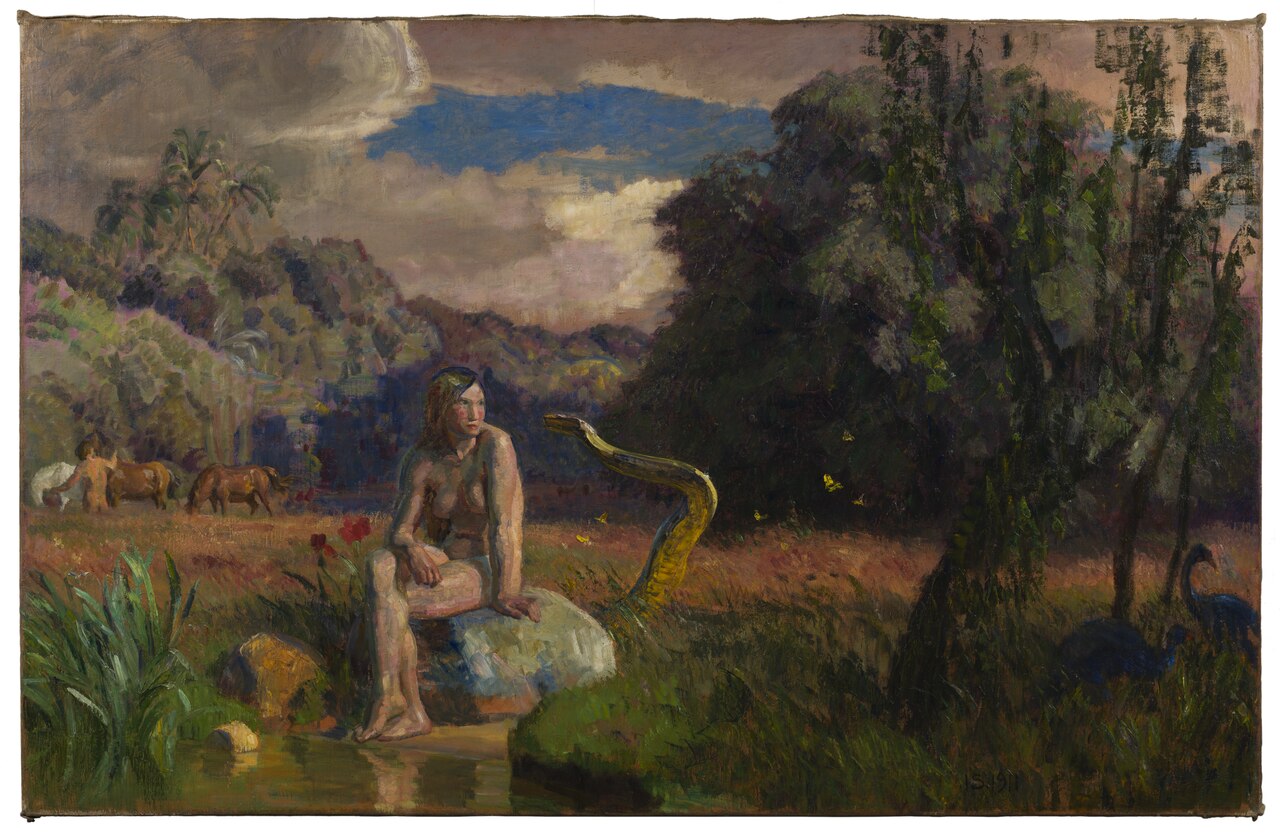
Major works - **Dragon Fountain** – Designed in the early 1900s, the Dragon Fountain exemplifies Skovgaard’s ability to translate mythic motifs into public sculpture. The work features a serpentine dragon coiled around a central basin, with water spouting from its open mouth. Although primarily a decorative piece, the fountain reflects his fascination with the interplay between natural forms and symbolic meaning. - **Eva in the Paradise (The Serpent Speaks) (1911)** – This painting presents the biblical Eve at the moment of temptation. Skovgaard renders the garden with lush, verdant foliage while the serpent is depicted as a sinuous, almost human figure, emphasizing the psychological tension of the scene. The work’s muted palette and careful modelling of flesh convey both innocence and impending loss. - **Kunstnerens søn, Peter (1894)** – Translating to “The Artist’s Son, Peter,” this portrait captures Skovgaard’s own child in a moment of quiet contemplation. The composition is simple yet intimate, with the boy seated against a plain background, allowing the viewer to focus on his expression and the subtle play of light across his features. - **Marie gets some food (1906)** – A genre scene that shows a young girl named Marie being offered sustenance, the painting is notable for its warm colour scheme and the tender interaction between the figures. Skovgaard’s attention to the texture of fabrics and the softness of the child's skin demonstrates his skill in rendering everyday moments with dignity. - **Salome (1899)** – In this dramatic work, Skovgaard depicts the biblical figure Salome holding the head of John the Baptist. The composition is bold, with deep shadows and striking contrasts that heighten the sense of moral ambiguity. The painting’s dramatic lighting and the careful rendering of Salome’s expression reveal Skovgaard’s interest in exploring complex emotional states.
In addition to these works, Skovgaard’s fresco cycle in Viborg Cathedral remains his magnum opus. The series of biblical narratives, spanning the walls of the nave and choir, showcases his capacity to work on a monumental scale while maintaining a cohesive visual language.
Influence and legacy Joakim Skovgaard’s contribution to Danish art lies chiefly in his revival of fresco painting and his nuanced treatment of narrative subjects. His cathedral frescoes set a precedent for large‑scale religious art in Scandinavia, influencing later artists such as Niels Skovgaard (his brother) and later 20th‑century muralists. Moreover, his ability to blend realistic detail with symbolic content helped bridge the gap between the naturalistic traditions of the 19th century and the more expressive tendencies of modernism. Today, his works are preserved in Danish museums and churches, and the Viborg Cathedral frescoes attract scholars and tourists alike, attesting to his lasting impact on both artistic practice and cultural heritage.
Frequently asked questions
Who was Joakim Skovgaard?
Joakim Skovgaard was a Danish painter (1856–1933) renowned for his frescoes in Viborg Cathedral and a series of narrative paintings that merge naturalistic detail with Symbolist imagination.
What artistic style or movement is he associated with?
He did not belong to a single movement, but his work blends naturalism with Symbolist elements, characterised by restrained colour, narrative focus, and a revival of fresco technique.
What are his most famous works?
His most celebrated works include the fresco cycle in Viborg Cathedral, the paintings "Eva in the Paradise (The Serpent Speaks)" (1911), "Salome" (1899), "Kunstnerens søn, Peter" (1894), "Marie gets some food" (1906), and the public sculpture "Dragon Fountain".
Why is Joakim Skovgaard important in art history?
Skovgaard revived fresco painting in Denmark, set a high standard for monumental religious art, and his synthesis of realistic and symbolic approaches influenced subsequent generations of Scandinavian artists.
How can I recognise a Joakim Skovgaard painting?
Look for a balanced composition, muted earth tones punctuated by subtle colour highlights, meticulous rendering of light, and a narrative focus that often draws on biblical or mythological subjects.