Nicolas Neufchatel
1527 – 1590
In short
Nicolas Neufchatel (1527–1590) was a Flemish painter and draughtsman from Mons who worked mainly in Germany, becoming one of the leading portrait painters of the 1560s.
Notable works


_and_his_9-year_old_son_Elisius_the_Younger_-_DEP8_-_Statens_Museum_for_Kunst.jpg)

Early life Nicolas Neufchatel was born in 1527 in the town of Mons, in the Southern Netherlands. Little is recorded about his family background, but the artistic climate of the Low Countries in the early sixteenth century provided a fertile environment for a budding talent. It is probable that he received his initial training in the workshops of the Flemish centres—perhaps in Brussels or Antwerp—where the Northern Renaissance style, characterised by meticulous observation and a keen interest in realistic detail, was firmly established. The name "Lucidel" appears in contemporary documents as a nickname for Neufchatel, suggesting a familiarity among his peers and patrons.
Career and style By the mid‑1550s Neufchatel had relocated to the German city of Nuremberg, a major hub for trade, printing and the visual arts. The city offered a ready market for portrait commissions from merchants, goldsmiths, scholars and members of the emerging civic elite. Neufchatel quickly gained a reputation for his ability to capture both the likeness and the social standing of his sitters. His style combined the precise draftsmanship of Flemish painting with a subtle use of chiaroscuro that hinted at the influence of Italian portraiture, which was beginning to circulate in northern courts. The resulting works are noted for their calm composure, fine rendering of textiles and a restrained colour palette that foregrounds the sitter’s facial features.
Signature techniques Neufchatel’s technical hallmarks centre on his drawing skill. He often began a portrait with a detailed silverpoint or charcoal sketch, allowing him to map out the anatomy of the head and the intricate folds of clothing before laying down paint. In the finished works, the brushwork is typically fine and controlled, especially in the treatment of hair and flesh tones, which achieve a convincing sense of volume through layered glazes. Light is employed sparingly but effectively, creating a gentle modelling that accentuates the three‑dimensionality of the figure without overwhelming the subtle tonal relationships. Another distinctive element is his attention to the objects that accompany his sitters—books, tools, jewellery—rendered with a level of detail that transforms them into symbols of the sitter’s profession or status.
Major works Neufchatel’s surviving oeuvre is modest but includes several documented portraits that illuminate his career. The **Portrait of Nuremberg Master Johann Neudörffer and a Student (1561)** displays a master artist alongside his apprentice, a composition that underscores the workshop culture of the period. The two figures are rendered with a calm dignity; Neudörffer’s hands rest on a pair of drawing implements, while the student’s attentive gaze reflects the transmission of knowledge.
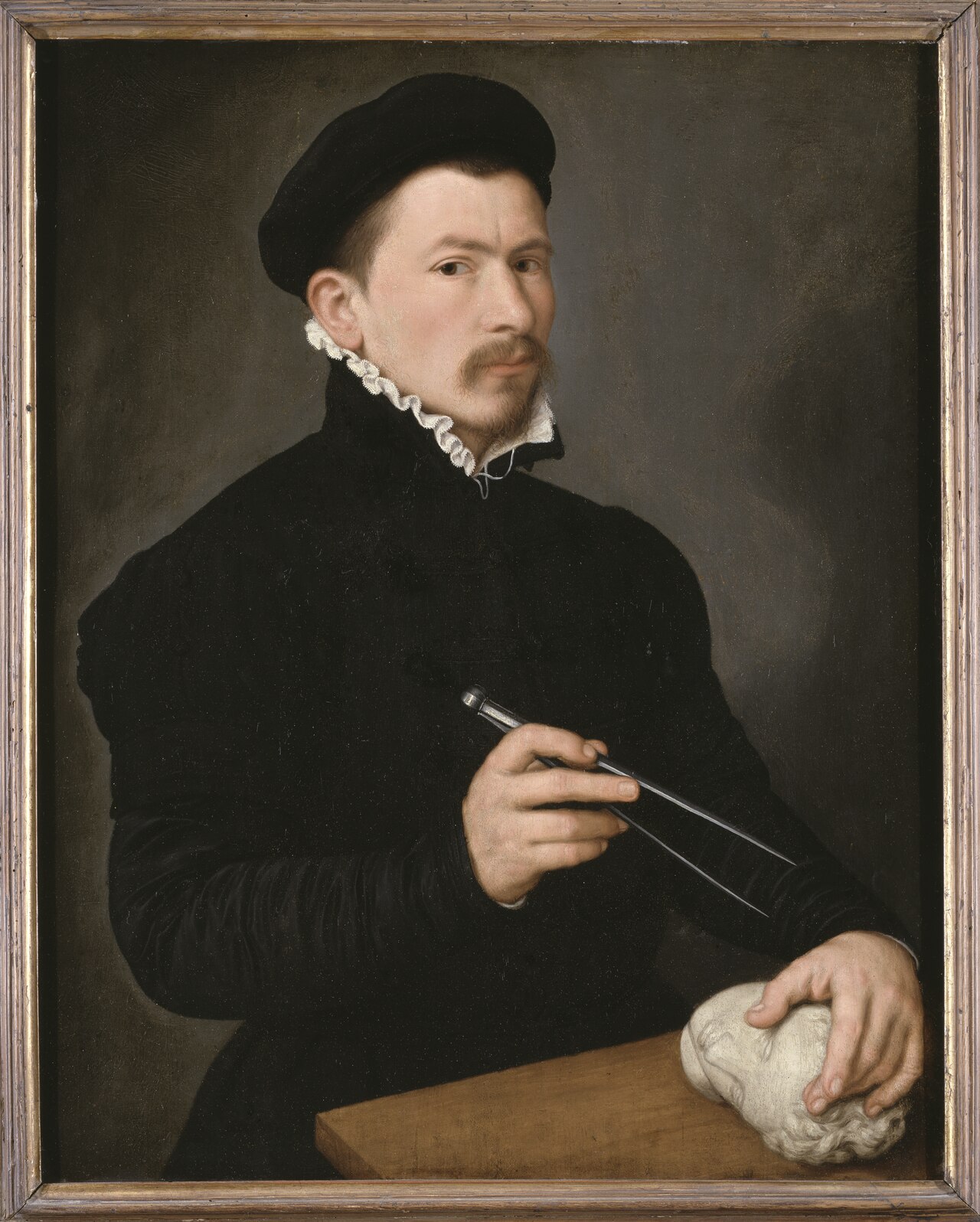
The Portrait of a Sculptor, possibly Johan Gregor van der Schardt (1575) is another notable example. Though the identification of the sitter remains tentative, the painting’s emphasis on the sculptor’s tools—a mallet and a partially finished marble figure—offers insight into the artist’s self‑presentation. The portrait’s careful rendering of texture, from the gleam of metal to the softness of the sitter’s skin, exemplifies Neufchatel’s command of materiality.
In Young Lady (1561), Neufchatel turns his attention to a private individual, possibly a member of the Nuremberg bourgeoisie. The sitter is depicted in a modest dress, her gaze directed slightly away from the viewer, a pose that conveys both modesty and introspection. The work is valued for its delicate treatment of fabric and the subtle play of light across the face.
The Portrait of the Nuremberg Goldsmith Hans Lencker (1523‑1585) and his 9‑year‑old son Elisius the Younger (1570) pairs a master craftsman with his child. While Hans Lencker’s life dates are recorded as 1523‑1585, the portrait itself dates to the 1560s, situating it firmly within Neufchatel’s productive period. The goldsmith is shown holding a pair of tweezers, a clear reference to his trade, while his son clutches a small toy, a detail that adds a humanising touch to the composition.
Finally, the Portrait of Lady de Haerlefels of the Buzelaer Castle (1545), though earlier than the artist’s documented activity, is traditionally attributed to Neufchatel on stylistic grounds. The portrait presents a noblewoman in an elaborate gown, her jewellery rendered with meticulous care. The work demonstrates Neufchatel’s ability to adapt his approach to higher‑status patrons, employing richer colours and more elaborate background elements while retaining his hallmark precision.
These works collectively illustrate Neufchatel’s versatility: he could portray scholars, artisans, merchants and aristocrats with equal skill, always foregrounding the individuality of his subjects.
Influence and legacy Nicolas Neufchatel’s portraiture contributed to the development of a distinctly northern German style in the second half of the sixteenth century. By blending Flemish attention to detail with the emerging tastes of German patrons, he helped shape a visual language that would be taken up by later artists such as Hans Mielich and Albrecht Dürer’s own portrait circle. Although his name fell into relative obscurity after his death in 1590, 20th‑century scholarship has revived interest in his work, recognising him as a pivotal figure in the transmission of Netherlandish techniques to the German lands. Today, his paintings are valued not only for their aesthetic qualities but also as documentary records of the social and professional networks that defined the early modern urban milieu.
Frequently asked questions
Who was Nicolas Neufchatel?
Nicolas Neufchatel (1527–1590) was a Flemish painter and draughtsman from Mons who worked primarily in Nuremberg, becoming a leading portraitist of the 1560s.
What artistic style or movement is he associated with?
He is linked to the Northern Renaissance, combining Flemish detailed observation with subtle chiaroscuro influences from Italian portraiture.
What are his most famous works?
Key works include the Portrait of Johann Neudörffer and a Student (1561), Portrait of a Sculptor (c. 1575), Young Lady (1561), the portrait of goldsmith Hans Lencker and his son (1570), and the Portrait of Lady de Haerlefels (1545).
Why is Nicolas Neufchatel important in art history?
He helped transmit Flemish techniques to Germany, shaping the development of northern German portraiture and influencing later artists such as Hans Mielich.
How can I recognise a Neufchatel painting?
Look for finely drawn faces, meticulous rendering of fabrics and objects, a restrained colour palette, and a subtle modelling of light that gives a calm, three‑dimensional presence to the sitter.