Laurits Andersen Ring
1854 – 1933
In short
Laurits Andersen Ring (1854–1933) was a Danish painter renowned for pioneering symbolism and social realism in Denmark. His work, such as "Summer Day by Roskilde Fjord," is celebrated as a cornerstone of Danish cultural heritage.
Notable works


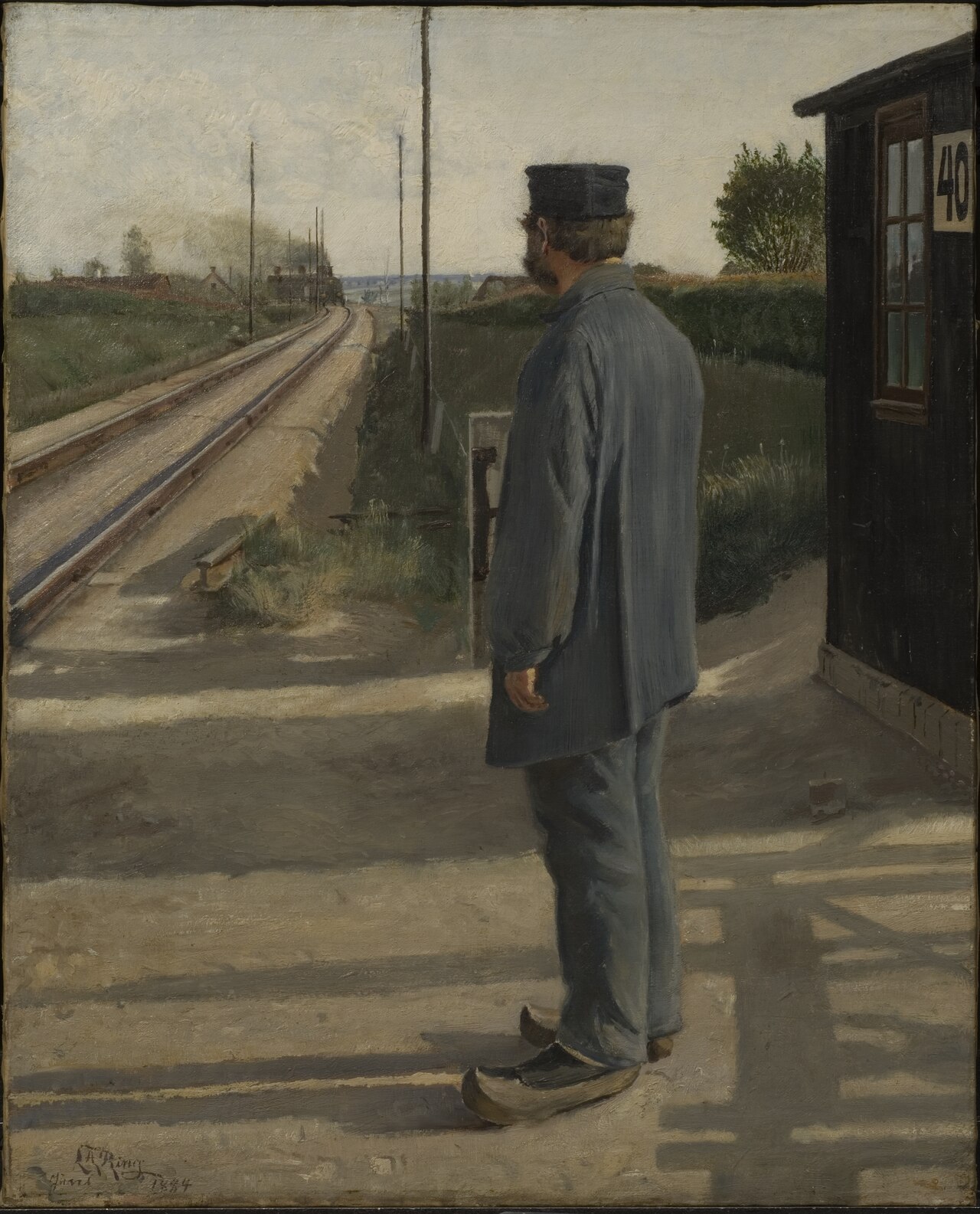

Early life Laurits Andersen Ring was born on 15 May 1854 in the small town of Ring, situated in the Kingdom of Denmark. He was the son of a modest farming family, which gave him an early familiarity with rural landscapes and the rhythms of agrarian life. Ring displayed artistic talent from a young age, sketching scenes of the surrounding countryside and the people who worked the land. After completing his basic education, he moved to Copenhagen to pursue formal training, enrolling at the Royal Danish Academy of Fine Arts in the early 1870s. The Academy exposed him to the prevailing academic traditions while also introducing him to contemporary European artistic currents that would later shape his own practice.
Career and style Ring’s early career was marked by a tension between the academic expectations of the Academy and his own emerging interest in more expressive, narrative-driven art. Influenced by the Symbolist movement in France and the Realist traditions of Danish painters such as P.S. Krøyer, Ring began to develop a style that combined a muted, atmospheric palette with a focus on everyday subjects. By the 1880s he had become associated with a circle of progressive artists who sought to depict the social realities of the working class, leading to his identification with social realism.
Throughout the 1890s Ring’s work increasingly incorporated symbolic elements, using light, colour, and compositional motifs to convey emotional and moral content beyond the literal scene. This dual approach—symbolic depth coupled with realist observation—made his output distinctive within Danish art. He continued to work in Copenhagen, but maintained strong ties to the countryside, often returning to his native region for inspiration. By the turn of the century his reputation had solidified, and he was recognised as one of Denmark’s leading modern painters.
Signature techniques Ring’s paintings are characterised by a restrained colour scheme dominated by earth tones, greys, and muted blues. He employed subtle variations of light to create a sense of quiet introspection, often rendering his subjects in soft, diffused illumination that suggests early morning or twilight. Compositionally, Ring favoured balanced, often symmetrical arrangements that draw the viewer’s eye toward a central figure or focal point, while still allowing peripheral details to enrich the narrative context.
A hallmark of his technique was the careful rendering of texture, whether in the roughness of a thatched roof, the delicate folds of a garment, or the weathered skin of a labourer. He frequently used thin, layered brushstrokes to build atmospheric depth, allowing the background to recede gradually and enhancing the three‑dimensionality of the scene. Symbolic motifs—such as open windows, solitary figures, or solitary tools—appear recurrently, serving as visual metaphors for isolation, hope, or the passage of time.
Major works **At the French Windows. The Artist's Wife (1897)** – This intimate portrait captures Ring’s wife, Sigrid, standing before a set of French windows that flood the interior with soft daylight. The work exemplifies Ring’s synthesis of Symbolist mood and realist detail, with the windows acting as a metaphor for openness and contemplation.
Sommerdag ved Roskilde Fjord (1900) – Often translated as "Summer Day by Roskilde Fjord," this landscape is celebrated for its serene depiction of the Danish shoreline under a clear sky. The painting’s calm atmosphere and subtle tonal gradations earned it a place in the 2006 Danish Culture Canon, underscoring Ring’s status as a national artistic icon.
At Breakfast (1898) – In this domestic scene, a family shares a modest meal, illuminated by a single lamp. The composition highlights everyday ritual while the subdued palette conveys a quiet dignity. Ring’s attention to the textures of the tableware and the expressions of the figures reflects his commitment to social realism.
The Lineman (1884) – This early work portrays a solitary railway worker perched on a wooden post, his figure silhouetted against a bleak sky. The painting’s starkness and focus on an industrial labourer illustrate Ring’s early interest in the lives of the working class and his ability to imbue ordinary labour with a sense of gravitas.
Harvest (1885) – Depicting peasants engaged in the annual harvest, the canvas combines a broad, sweeping view of the fields with detailed study of individual workers. The balanced composition and muted colour scheme convey both the collective effort of agricultural labour and the quiet endurance of rural communities.
Influence and legacy Laurits Andersen Ring’s contribution to Danish art lies in his successful melding of Symbolist introspection with the social concerns of Realism. By portraying the dignity of everyday labour and the emotional resonance of ordinary moments, he expanded the thematic range of Danish painting at a time when many contemporaries focused on elite portraiture or decorative subjects.
Ring’s influence extended to subsequent generations of Danish artists who embraced his commitment to truthful representation and his nuanced use of symbolic language. His works are held in major Danish institutions, including the Statens Museum for Kunst in Copenhagen, and continue to be exhibited internationally. The inclusion of "Summer Day by Roskilde Fjord" in the Danish Culture Canon attests to his enduring relevance, positioning him not only as a historical figure but also as a benchmark for contemporary explorations of national identity and landscape.
Beyond museum walls, Ring’s paintings have informed scholarly discourse on the intersection of art and social history, offering visual insight into the lived experiences of Denmark’s rural population at the turn of the twentieth century. His legacy persists in the continued appreciation of artworks that balance aesthetic refinement with compassionate observation of everyday life.
Frequently asked questions
Who was Laurits Andersen Ring?
Laurits Andersen Ring (1854–1933) was a Danish painter known for pioneering symbolism and social realism in Denmark.
What style or movement is Ring associated with?
Ring is associated with social realism, often integrating Symbolist elements to give his realistic scenes deeper emotional resonance.
What are his most famous works?
His most celebrated works include "At the French Windows. The Artist's Wife" (1897), "Summer Day by Roskilde Fjord" (1900), "At Breakfast" (1898), "The Lineman" (1884) and "Harvest" (1885).
Why does Ring matter in art history?
Ring matters because he expanded Danish art beyond decorative subjects, portraying the dignity of everyday life while introducing symbolic depth, and his work is recognised as a cornerstone of Danish cultural heritage.
How can I recognise a painting by Laurits Andersen Ring?
Look for a muted palette, soft diffused light, balanced compositions, and subtle symbolic motifs such as solitary figures, open windows, or everyday tools rendered with careful texture.