Gustave Léonard de Jonghe
1829 – 1893
In short
Gustave Léonard de Jonghe (1829–1893) was a Belgian painter who specialised in elegant society portraits and genre scenes, working chiefly in Paris. He combined a realist approach with a taste for richly detailed interiors, producing works such as Young Mother and Her Children in a Living Room and Collection of Alms.
Notable works

.jpg)


Early life
Gustave Léonard de Jonghe was born in 1829 in the Flemish city of Kortrijk, then part of the United Kingdom of the Netherlands. His family belonged to the middle class, and his early education included a solid grounding in the humanities, which later informed his interest in narrative painting. De Jonghe moved to Brussels as a teenager to pursue formal artistic training, enrolling at the Royal Academy of Fine Arts where he was instructed in the academic traditions of drawing, composition and colour.
Career and style
After completing his studies, de Jonghe initially worked in Brussels producing historical and religious subjects in a Realist style. His early output reflects the influence of Belgian masters such as Charles-Guillaume Van den Heuvel and the broader European trend toward depicting everyday life with fidelity. In the early 1850s he relocated to Paris, the centre of the art world, where he encountered a vibrant market for portraiture and genre scenes. The capital’s affluent clientele prized paintings that combined technical skill with a polished, decorative finish, and de Jonghe quickly adapted his approach to meet this demand.
In Paris he became known for his glamorous society portraits, often set in opulent interiors that showcase the fashions and furnishings of the upper class. While his subjects are elegant, his technique retains a realist sensibility: he rendered fabrics, textures and light with careful observation, avoiding the idealised excess of academic classicism. This blend of realism and decorative richness placed him within the broader social‑realist movement, which sought to document contemporary life while preserving a degree of aesthetic refinement.
Signature techniques
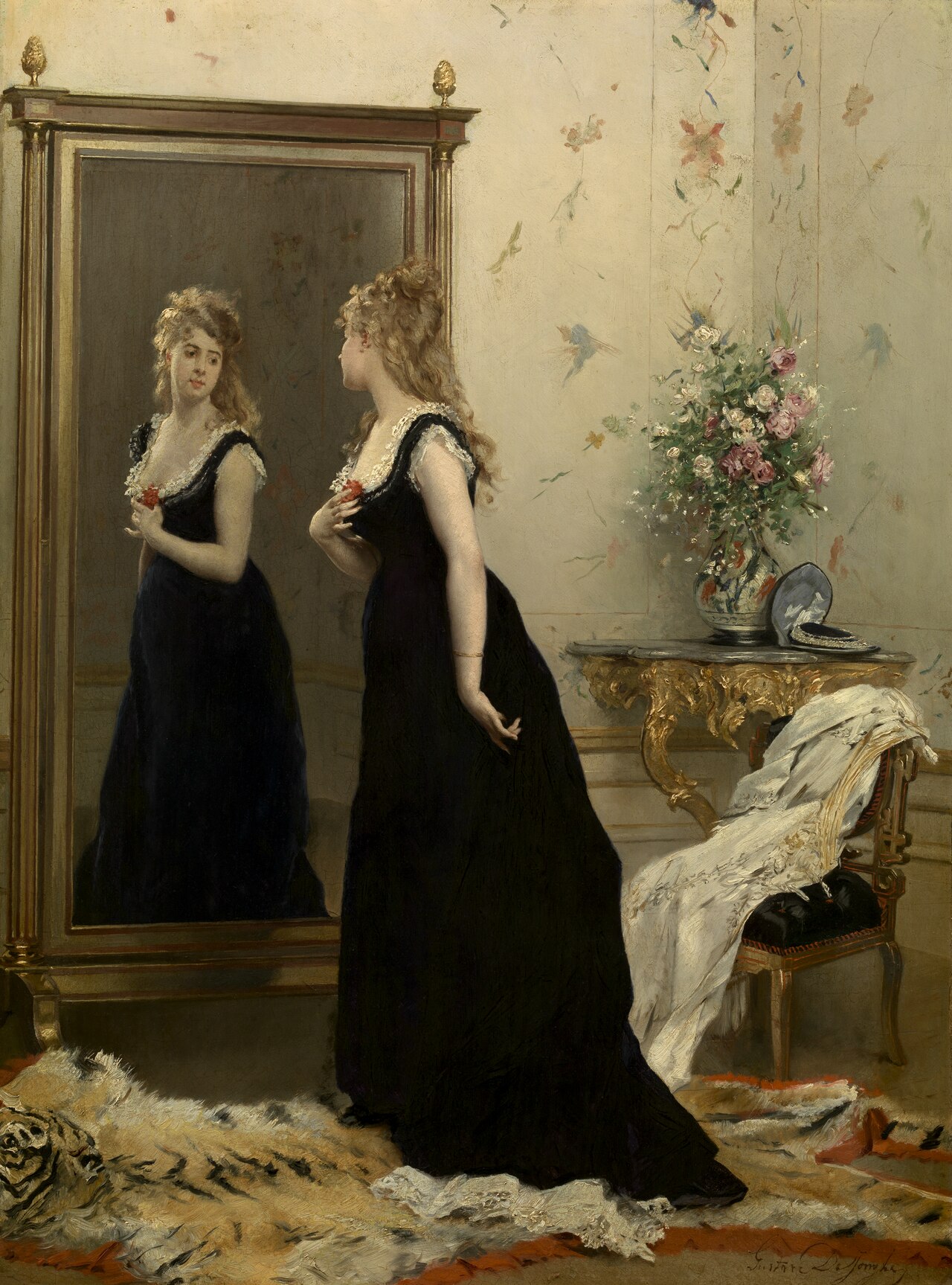
De Jonghe’s paintings are characterised by several recurring technical choices. First, he employed a finely drawn under‑drawing that established precise contours before applying colour, a habit inherited from his academic training. Second, he used a layered glazing method, building thin translucent layers of oil over a muted base to achieve depth and luminous skin tones. Third, his handling of light often involved a soft, diffused illumination that falls across the interior space, highlighting the sheen of silk, the glint of polished wood and the subtle shadows cast by curtains. Finally, his compositions frequently incorporate a mirror or reflective surface, which not only expands the spatial illusion but also adds a narrative element, inviting the viewer to consider the private world behind the visible scene.
Major works
- Young Mother and Her Children in a Living Room (1850) – One of de Jonghe’s earliest genre pieces, this painting depicts a tender domestic scene with a mother seated beside a young child while another child plays on the rug. The work demonstrates his early mastery of colour harmony and his ability to convey intimacy within a modest interior.
- In Front of the Mirror – Although the exact date is uncertain, this composition is emblematic of de Jonghe’s later Parisian output. A fashionable woman is shown adjusting her attire before a large gilt‑framed mirror, the reflection revealing a secondary angle of the room. The piece highlights his skill in rendering reflective surfaces and the subtle interplay of light on fabrics.
- Collection of Alms (1868) – This socially charged work departs from the purely decorative, presenting a group of charitable women distributing alms to the poor. While still rendered with refined technique, the subject matter aligns with the social‑realist concern for contemporary moral issues.
- After a Walk (1871) – Here de Jonghe captures a couple returning from an outdoor promenade, pausing on a terrace that overlooks a landscaped garden. The painting juxtaposes the airy, breezy atmosphere of the exterior with the controlled interior space, showcasing his ability to blend genre narrative with atmospheric effect.
- Changeable Weather (1875) – In this later piece de Jonghe experiments with atmospheric conditions, portraying a garden scene where clouds shift across a sky reflected in a water feature. The work underscores his continued interest in the effects of light and weather on everyday settings.
These works collectively illustrate the evolution of his style from domestic genre scenes to sophisticated society portraiture, while retaining a consistent attention to detail and a realist foundation.
Influence and legacy
Gustave Léonard de Jonghe remained a popular painter among the Parisian bourgeoisie throughout his career, and his works were regularly exhibited at the Salon. Although he never achieved the revolutionary fame of contemporaries such as Manet or Courbet, his paintings provide valuable insight into the visual culture of mid‑nineteenth‑century Europe, especially the tastes of the affluent class.
His influence can be traced in the subsequent generation of Belgian and French portraitists who continued to blend realism with decorative elegance. Moreover, his genre scenes have been used by art historians as reference points for studying the social dynamics of the period, particularly the representation of women in domestic and public spaces. De Jonghe’s oeuvre, preserved in museums and private collections across Europe, continues to be exhibited for its technical proficiency and its nuanced portrayal of a society in transition.
De Jonghe died in Antwerp in 1893, returning to his native Belgium after a long career abroad. Today, his paintings are appreciated both for their aesthetic charm and for the documentary quality they lend to an era marked by rapid social change.
Frequently asked questions
Who was Gustave Léonard de Jonghe?
He was a Belgian painter (1829–1893) known for elegant society portraits and genre scenes, active mainly in Paris.
What artistic style or movement is he associated with?
De Jonghe worked within a social‑realist framework, combining realistic observation with decorative, fashionable interiors.
What are his most famous works?
Key paintings include Young Mother and Her Children in a Living Room (1850), In Front of the Mirror, Collection of Alms (1868), After a Walk (1871) and Changeable Weather (1875).
Why does he matter in art history?
His work documents mid‑19th‑century bourgeois life, bridges academic realism and decorative portraiture, and influenced later Belgian and French painters.
How can I recognise a de Jonghe painting?
Look for finely drawn figures, polished interiors, subtle glazing, and a characteristic use of mirrors or reflective surfaces that create depth and narrative intrigue.