Kun Can
1612 – 1673
In short
Kun Can (1612–1673) was a Chinese Buddhist monk and landscape painter of the late Ming and early Qing periods, noted for his association with the Four Monk Masters and for a small but influential body of work that blends classical brushwork with Chan Buddhist sensibility.
Notable works


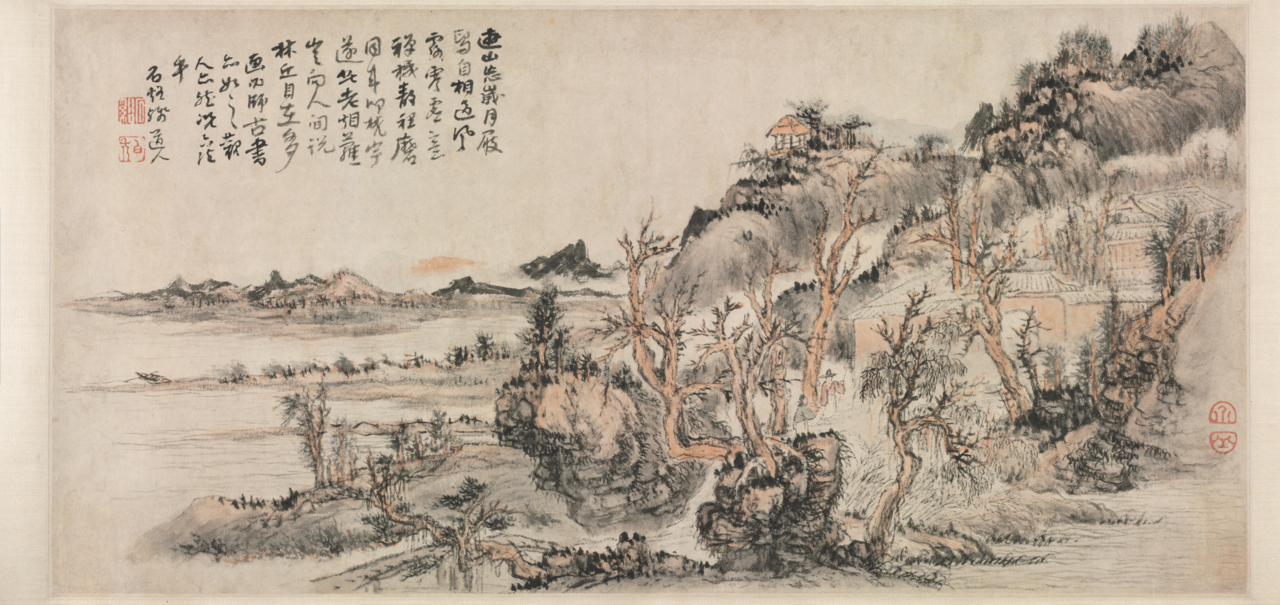

Early life Kun Can was born in 1612, most likely in the province of Hunan, though precise details of his birthplace remain undocumented. He entered the Chan Buddhist order at a young age, taking monastic vows and adopting the religious name Shi Xi. His early training combined the rigorous study of Buddhist doctrine with the traditional literati arts, a combination that would shape his later artistic output.
Career and style After his ordination, Kun Can relocated to Nanjing, a cultural hub that offered access to a vibrant community of scholars and painters. There he rose to the position of abbot at a monastery situated on Niushou Shan, a mountain celebrated for its natural scenery and spiritual significance. Kun Can’s painting style was heavily informed by the Yuan‑dynasty master Wang Meng, whose dense, layered brushwork and complex compositions resonated with the monk’s contemplative outlook. While his oeuvre is modest, it reflects a synthesis of classical literati techniques and the introspective ethos of Chan Buddhism, situating him among the early‑Qing “Four Monk Masters” alongside Zhu Da, Hong Ren and Shitao.
Signature techniques Kun Can’s landscapes are characterised by a few recurring technical hallmarks:
- Layered ink washes: He employed multiple layers of diluted ink to suggest atmospheric depth, a method reminiscent of Wang Meng’s approach to mist and foliage. - Monochrome emphasis: Though occasionally incorporating subtle colour washes, Kun Can favoured a restrained palette, allowing the interplay of light and shadow to dominate the composition. - Brush‑stroke variation: His works juxtapose vigorous, calligraphic strokes for rock formations with softer, more fluid lines for trees and water, creating a dynamic contrast that mirrors the balance of stillness and movement central to Chan practice. - Spatial ambiguity: By compressing foreground and background elements, Kun Can generated a sense of timelessness, inviting viewers to contemplate the spiritual rather than the strictly visual.
Major works Although only a handful of his paintings survive, they provide insight into his artistic concerns.
- Rural Album: This collection of small-scale scenes depicts agrarian life with a contemplative eye, blending human activity with the surrounding landscape in a manner that underscores the Buddhist principle of impermanence. - A Deep Valley Conceals a Monk’s Home: The composition presents a secluded valley, its winding paths and hidden dwellings evoking the monk’s own retreat from worldly distractions. The muted ink tones reinforce a sense of solitude. - Landscape with waterfalls and trees (1636): Dated early in his career, the painting showcases cascading water rendered through delicate, broken strokes, set against a backdrop of tangled trees that echo Wang Meng’s dense foliage. - Spring Landscape (1666): Executed in the later stage of his life, this work captures the renewal of spring through subtle colour washes of green and pink, while maintaining his signature ink‑focused technique. - Wooded Mountains at Dusk (1666): Also dated 1666, the piece portrays a twilight scene where silhouetted peaks dissolve into a misty horizon, illustrating Kun Can’s mastery of atmospheric perspective.
Influence and legacy Kun Can’s contribution to Chinese art lies less in the volume of his surviving works and more in his role within the network of monk‑artists who reinterpreted literati traditions for a new era. By integrating Chan Buddhist philosophy with the technical rigor of classical landscape painting, he helped to define a spiritual aesthetic that influenced subsequent generations of painter‑monks. His association with the Four Monk Masters cemented his place in art‑historical narratives, and modern scholars often cite his works as exemplars of the contemplative turn in early Qing painting. While many of his pieces have been lost, the extant examples continue to be studied for their subtle brushwork and meditative atmosphere, ensuring Kun Can’s enduring relevance in both academic and collector circles.
Frequently asked questions
Who was Kun Can?
Kun Can was a Chinese Buddhist monk and landscape painter who lived from 1612 to 1673, active during the late Ming and early Qing dynasties.
What style or movement is Kun Can associated with?
He is linked to the Four Monk Masters of the early Qing period, blending classical literati painting techniques with Chan Buddhist sensibility.
What are Kun Can’s most famous works?
His most recognised pieces include the Rural Album, A Deep Valley Conceals a Monk’s Home, Landscape with waterfalls and trees (1636), Spring Landscape (1666) and Wooded Mountains at Dusk (1666).
Why is Kun Can important in art history?
Kun Can exemplifies the integration of Buddhist philosophy with traditional landscape painting, influencing later monk‑artists and contributing to the spiritual dimension of early Qing art.
How can I recognise a Kun Can painting?
Look for layered ink washes, a restrained colour palette, dense brushwork reminiscent of Wang Meng, and compositions that convey quiet, contemplative spaces often featuring secluded valleys or mist‑filled mountains.