Karel Breydel
1678 – 1733
In short
Karel Breydel (1678–1733) was a Flemish painter from Antwerp known for vivid battle scenes, equestrian subjects and landscapes. He worked in the early 18th century, producing works such as Cavalry Skirmish at a Fortress and Cavalry Encounter, and is remembered for his energetic compositions of military action.
Notable works


Early life Karel Breydel was born in Antwerp in 1678, a city that had long been a centre of artistic production in the Southern Netherlands. Little is recorded about his family background, but the artistic environment of Antwerp—home to the Guild of Saint Luke and a thriving market for paintings—provided ample opportunity for a young talent to develop. Breydel likely received his initial training within the city's workshop system, where apprentices learned drawing, composition and the handling of oil paint under the guidance of established masters. The vibrant artistic community, which included painters of history, genre and landscape, shaped his early exposure to a variety of subjects.
Career and style By the turn of the 18th century Breydel had established himself as a specialist in battle and equestrian subjects, a niche that enjoyed considerable demand among both local patrons and foreign collectors. His work reflects the late Baroque taste for dynamic movement, dramatic lighting and vivid colour, yet it also shows a measured restraint that distinguishes it from the more theatrical extravagance of some contemporaries. Breydel’s compositions frequently centre on cavalry engagements, where he captures the tension of conflict through the interplay of horse and rider. In addition to martial scenes, he produced landscapes that often featured figures engaged in everyday activity, indicating a versatility that allowed him to appeal to a broader market.
Signature techniques Breydel’s paintings are characterised by a brisk, confident brushstroke that conveys the kinetic energy of his subjects. He employed a relatively limited palette of earth tones, ochres and muted greens for landscape elements, reserving brighter reds and blues for the uniforms and banners of soldiers, thereby ensuring that the focal points stand out against the background. Light is often rendered in a manner that suggests early morning or late afternoon, casting long shadows that enhance the sense of depth. His handling of horses demonstrates a keen observation of anatomy; the musculature is rendered with enough detail to be convincing without overwhelming the overall composition. In many works Breydel used a compositional device of a diagonal thrust—usually a line of cavalry or a road—that guides the viewer’s eye across the canvas.
Major works Among Breydel’s most documented pieces are two paintings dated 1713: *Cavalry Skirmish at a Fortress* and *Cavalry Encounter*. Both works exemplify his skill in depicting the chaos and order of military action. In *Cavalry Skirmish at a Fortress*, a fortified wall serves as a backdrop for a clash between opposing mounted troops, with the fortress’s stonework rendered in subdued tones that contrast with the vivid uniforms of the cavalry. The painting captures a moment of intense combat, with horses rearing and soldiers brandishing weapons, while a plume of smoke hints at the broader conflict.
*Cavalry Encounter* presents a more controlled engagement, with two groups of riders meeting on an open field. The composition is balanced by the placement of the opposing forces on either side of a central vanishing point, creating a sense of imminent confrontation. Both paintings demonstrate Breydel’s ability to organise complex scenes without sacrificing clarity.
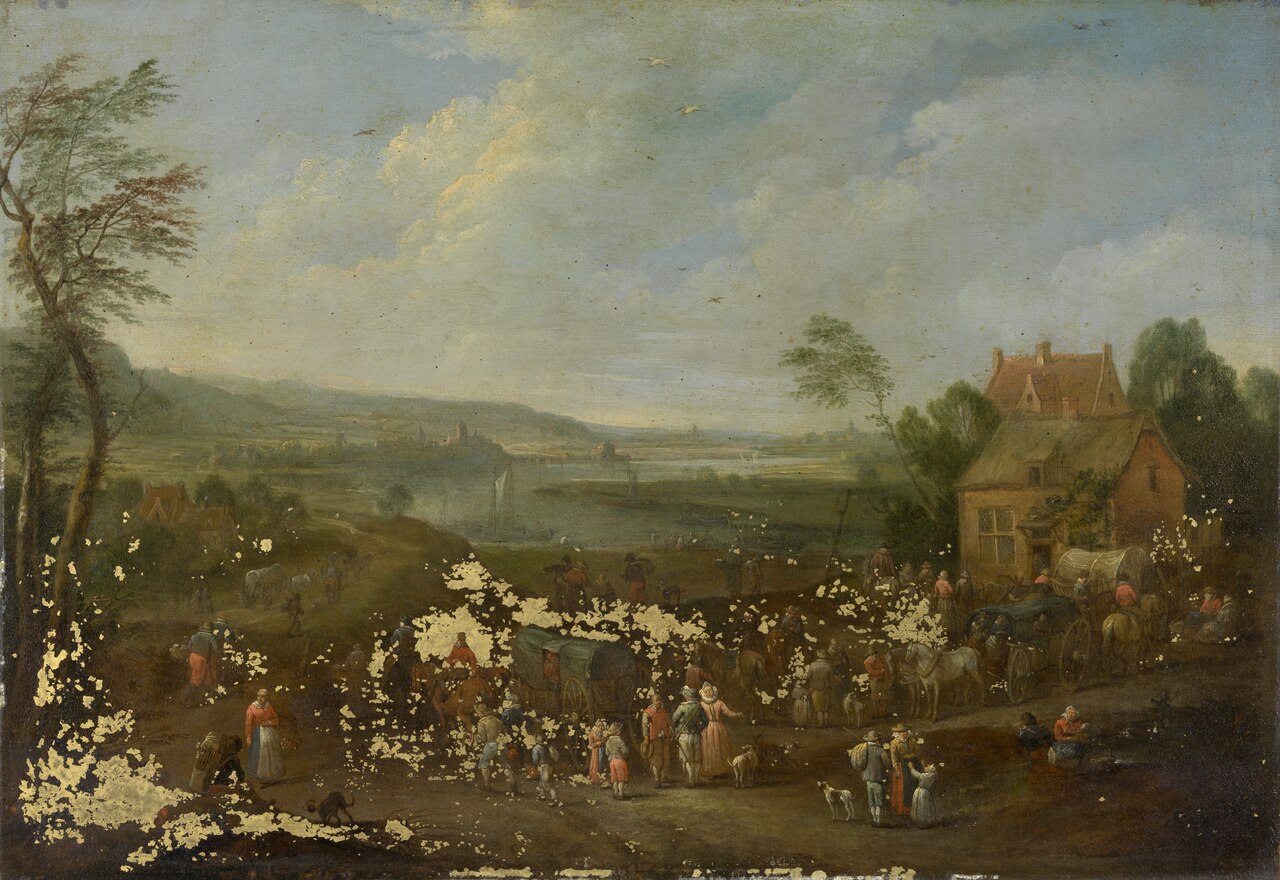
A third work, *Landscape with Figures*, showcases his capability beyond battlefield subjects. The painting depicts a tranquil countryside populated by shepherds and travellers, set against a gently rolling horizon. Though less dramatic than his battle scenes, the piece retains Breydel’s characteristic attention to light and atmosphere, and it hints at his broader interest in the relationship between human activity and the natural world.
Influence and legacy Karel Breydel worked at a time when Flemish battle painting was undergoing a transition, moving away from the highly detailed, narrative-driven works of the 17th century toward a more impressionistic treatment of movement. While he did not found a distinct school, his paintings contributed to the evolving visual language of military art in the Southern Netherlands. Contemporary collectors prized his works for their immediacy and the skill with which he rendered horse and rider, and his paintings continued to circulate in the art market after his death in 1733. Modern scholars regard Breydel as an illustrative figure of early‑18th‑century Flemish painting, helping to bridge the gap between the Baroque exuberance of earlier masters and the more restrained classicism that would dominate later in the century. His surviving works, though relatively few, are valuable for understanding the aesthetic preferences of his era and for appreciating the technical proficiency required to depict complex, action‑filled scenes.
Frequently asked questions
Who was Karel Breydel?
Karel Breydel (1678–1733) was a Flemish painter from Antwerp known for his battle, equestrian and landscape paintings.
What artistic style or movement is he associated with?
He worked in a late Baroque style, combining dynamic composition with a restrained colour palette, and is often linked to the tradition of Flemish battle painting.
What are his most famous works?
His best‑known paintings are *Cavalry Skirmish at a Fortress* (1713), *Cavalry Encounter* (1713) and the landscape piece *Landscape with Figures*.
Why is Karel Breydel important in art history?
Breydel illustrates the transition in Flemish art from highly detailed Baroque narratives to a more kinetic, impressionistic approach to military subjects, influencing later depictions of battle scenes.
How can I recognise a painting by Karel Breydel?
Look for energetic cavalry scenes with bright uniform colours against muted backgrounds, crisp brushwork on horses, and diagonal compositions that convey movement.