Jan Verhas
1834 – 1896
In short
Jan Verhas (1834–1896) was a Belgian painter of the Realist school, renowned for his portraits and genre scenes of middle‑class children, as well as history paintings, coastal landscapes and occasional still lifes.
Notable works
_Optocht_van_de_scholen_in_1878_-_Old_Masters_Museum_Brussel_30-4-2017_11-18-20.JPG)
.jpg)
.jpg)
Early life Jan Frans Verhas was born in 1834 in Dendermonde, a town in the province of East Flanders, Belgium. Little is recorded about his family background, but the artistic milieu of the region was vibrant in the mid‑nineteenth century, offering opportunities for young talent. Verhas received his initial training at the Royal Academy of Fine Arts in Ghent, where he was exposed to the prevailing academic traditions and the emerging realist tendencies that were reshaping Belgian art. By the early 1850s he had moved to Brussels, the cultural heart of Belgium, to continue his studies and to seek patronage.
Career and style In Brussels Verhas established himself as a painter who combined rigorous academic technique with a keen observation of contemporary life. He became associated with the Realist movement that had taken hold in Belgium after the 1848 revolutions, a movement characterised by an unidealised depiction of everyday subjects. Verhas’s oeuvre reflects this ethos: his portraits capture the individuality of his sitters, while his genre paintings render domestic and social scenes with a narrative clarity that appealed to the burgeoning bourgeois class.
The core of Verhas’s style lies in his ability to balance meticulous detail with a warm, often luminous palette. He favoured natural lighting, employing subtle chiaroscuro to model forms and to give his figures a three‑dimensional presence. His compositions are typically straightforward, allowing the viewer to focus on the interaction between characters and their environment. Although primarily a realist, Verhas occasionally incorporated elements of sentimentality, especially in works that portray children at play or in study, thereby creating a gentle emotional resonance without abandoning his commitment to truthful representation.
Signature techniques Verhas’s technical hallmarks include:
1. Precise draftsmanship – He began most works with a careful underdrawing, ensuring correct proportions and perspective before building up colour. 2. Fine brushwork – In rendering fabrics, hair and skin, he employed a tight brushstroke that produced smooth surfaces, while broader strokes were reserved for background elements such as foliage or sea‑scapes. 3. Controlled colour harmony – His palette often juxtaposes warm earth tones with cool blues or greens, a contrast that heightens the realism of interior and exterior scenes alike. 4. Narrative framing – Verhas frequently used architectural or natural elements to frame his subjects, creating a sense of depth and guiding the eye toward focal points, such as a child’s face or a historical tableau. 5. Attention to material culture – Whether depicting a school uniform, a painter’s tools, or the intricate pattern of a kimono, Verhas paid close attention to the texture and pattern of objects, which serves both as a visual interest and as documentation of contemporary Belgian attire.
Major works Among Verhas’s most celebrated paintings are several that illustrate his range:
- The Procession of the Schools in 1878 (1880) – This large‑scale genre piece records a civic ceremony in which schoolchildren march through a town square. Verhas captures the pomp of the event, the varied expressions of the youngsters, and the detailed architecture of the surrounding buildings. The work demonstrates his skill in handling crowd scenes while maintaining individual characterisation.
- The Master Painter (1877) – A portrait of an artist at work, this painting showcases Verhas’s interest in the creative process itself. The composition places the painter within a well‑lit studio, surrounded by tools and unfinished canvases, offering a glimpse into the quotidian reality of artistic labour.
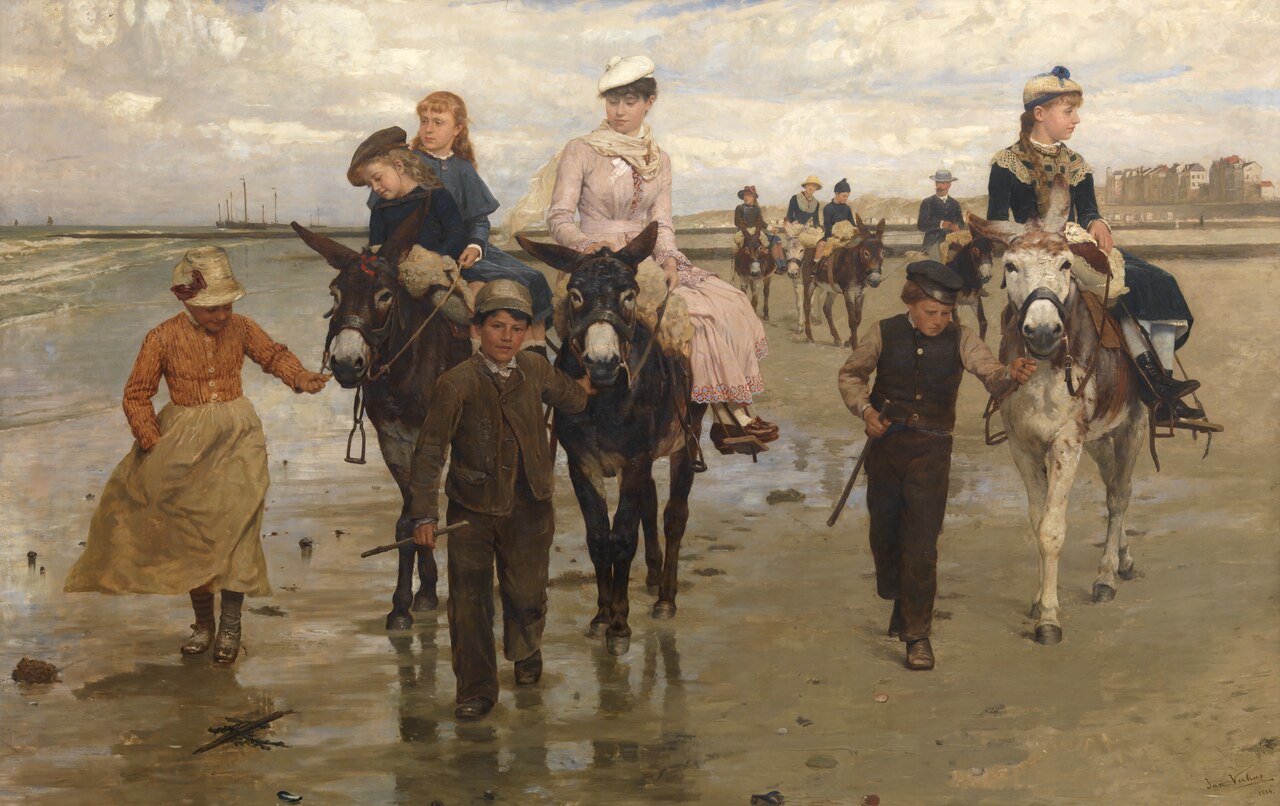
- Promenade on the Beach – Heist‑aan‑Zee (1884) – In this coastal landscape, Verhas turns his realist eye to the sea‑side, depicting families strolling along the shore, their silhouettes outlined against a bright sky. The work highlights his ability to render atmospheric effects—light on water, the texture of sand—and to convey a leisurely, middle‑class pastime.
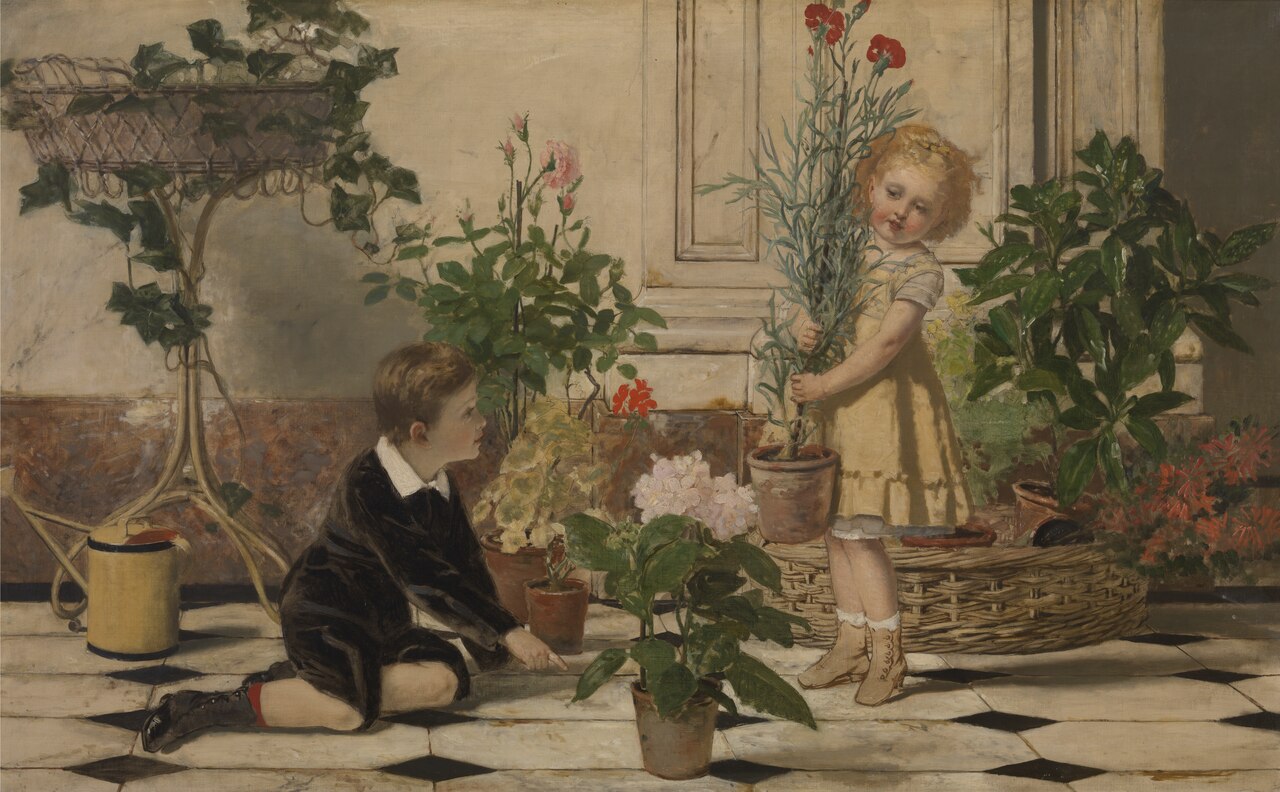
- Two Children (1873) – An intimate portrait of a brother and sister, this painting exemplifies Verhas’s talent for capturing the innocence and spontaneity of youth. The children are rendered with delicate attention to facial expression and posture, set against a simple interior that emphasises their presence.
- The Green Kimono Collector – Though the exact date is not recorded, this work features a figure examining a striking green kimono, an object that reflects the growing fascination with Orientalist motifs in late‑nineteenth‑century Europe. The painting underscores Verhas’s willingness to incorporate exotic elements while maintaining his realist approach.
These works collectively illustrate Verhas’s versatility: from bustling public ceremonies to quiet domestic interiors, from the studios of artists to the breezy beaches of the Belgian coast.
Influence and legacy Jan Verhas occupies an important position within Belgian Realism. By focusing on the lives of the burgeoning middle class, he helped to define a visual language that resonated with contemporary patrons and set a precedent for later genre painters. His meticulous rendering of clothing and interiors provides valuable visual documentation of Belgian bourgeois culture in the second half of the nineteenth century.
Verhas’s influence extended to younger artists who admired his combination of academic skill and narrative clarity. His beach scenes anticipated the later popularity of seaside leisure subjects in the works of artists such as Eugène Boudin and the early Impressionists, albeit without abandoning realism. Moreover, his portraiture of children contributed to a tradition that would be further developed by painters like Henri de Braekeleer and later by the Symbolist movement.
After his death in Brussels in 1896, Verhas’s paintings continued to be exhibited in Belgian salons and were acquired by private collectors. Modern scholarship recognises him as a key figure who bridged the strict academic traditions of the early nineteenth century and the more socially engaged realism that characterised the latter decades of the century. His works remain in museum collections across Belgium and are frequently cited in studies of nineteenth‑century European genre painting.
In summary, Jan Verhas’s legacy lies in his faithful depiction of everyday life, his technical proficiency, and his contribution to the visual narrative of Belgian society during a period of rapid social change.
Frequently asked questions
Who was Jan Verhas?
Jan Verhas (1834–1896) was a Belgian painter of the Realist school, known for portraits, genre scenes of bourgeois children, history paintings, and coastal landscapes.
What artistic style or movement is he associated with?
He is associated with Belgian Realism, a movement that sought to depict everyday life with truthful detail and without idealisation.
What are his most famous works?
His most celebrated paintings include *The Procession of the Schools in 1878* (1880), *The Master Painter* (1877), *Promenade on the Beach – Heist‑aan‑Zee* (1884), *Two Children* (1873), and the later work *The Green Kimono Collector*.
Why is Jan Verhas important in art history?
Verhas exemplifies the Realist approach in Belgium, documenting bourgeois life and influencing later genre painters; his technically skilled works bridge academic tradition and socially aware realism.
How can I recognise a painting by Jan Verhas?
Look for meticulous draftsmanship, a balanced colour palette, natural lighting, and subjects drawn from middle‑class domestic or public scenes—often children, detailed clothing, and a clear narrative focus.