Frans Verhas
1827 – 1897
In short
Frans Verhas (1827–1897) was a Belgian painter renowned for his elegant portraits and genre scenes of women and children in richly appointed bourgeois interiors. His work is distinguished by meticulous rendering of textures and occasional subjects such as animals, history scenes and still lifes.
Notable works
.jpg)


Early life Frans Verhas was born in 1827 in Dendermonde, a town in the Flemish region of Belgium. Little is recorded about his family background, but he grew up during a period when Belgium was establishing its own artistic institutions following independence in 1830. As a young man he pursued formal artistic training in Belgium, likely at one of the country’s established academies, which provided a foundation in drawing, composition and the techniques of the academic tradition.
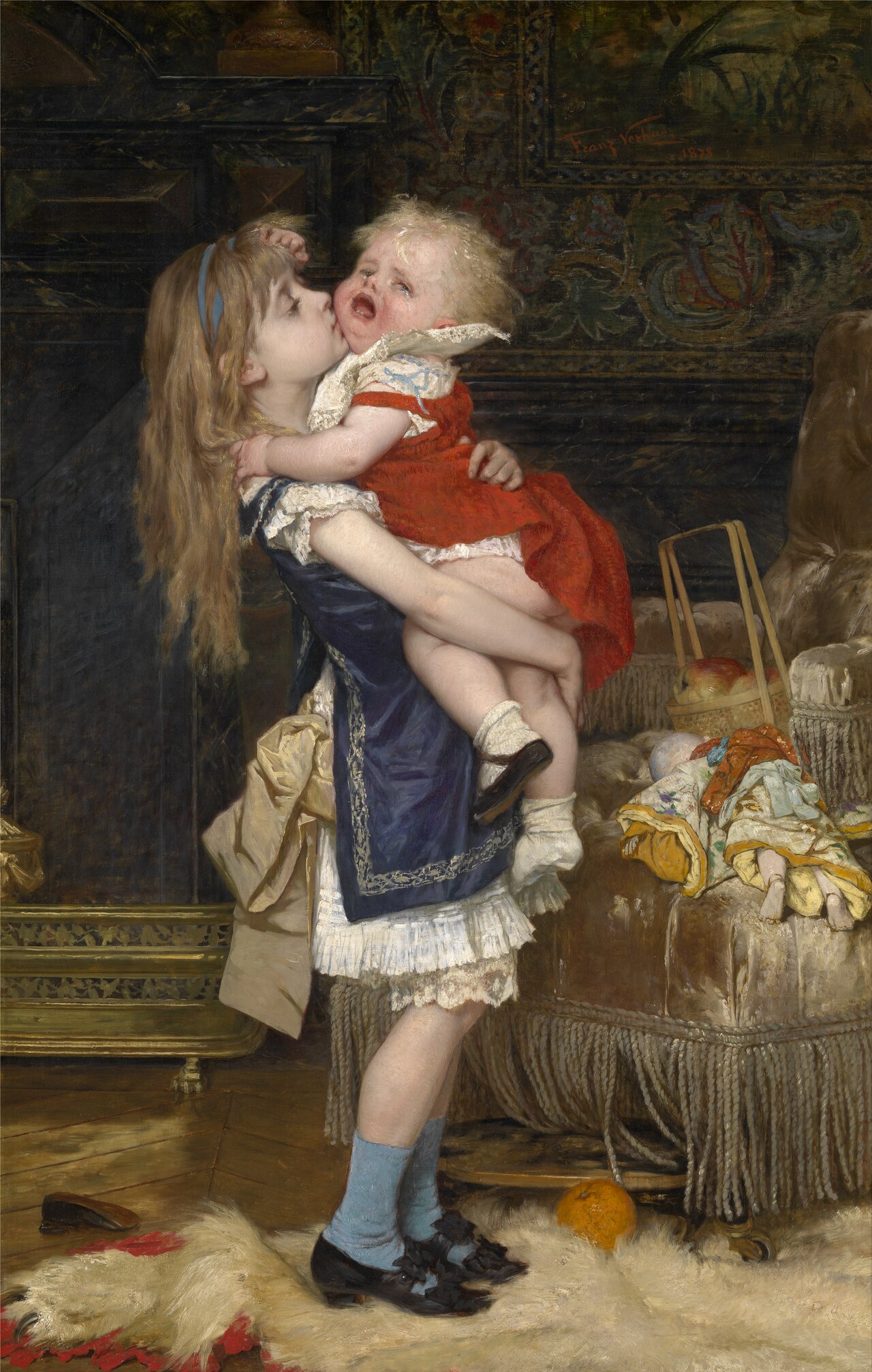
Career and style After completing his studies, Verhas set up his practice in Brussels, the cultural heart of Belgium. He quickly gained a reputation for painting portraits and genre scenes that captured the leisurely pursuits of the middle‑class and upper‑class. His subjects are often women and children, depicted with a sense of refinement and domestic tranquility. The interiors he painted are lavish, filled with luxurious furnishings, tapestries, silk draperies and polished marble surfaces. This focus on the material culture of the bourgeoisie aligns Verhas with a broader European interest in the detailed representation of everyday elegance that characterised much of 19th‑century genre painting.
Verhas also explored other subjects. He produced a modest number of animal paintings, history pieces and still‑life works, demonstrating his versatility. However, it is his interior genre scenes that remain the most celebrated, as they combine a narrative sensibility with an almost photographic attention to surface detail.
Signature techniques Verhas’s paintings are marked by a meticulous handling of texture. He rendered fabrics such as satin, velvet and fur with subtle variations of light, giving them a tactile quality. Metallic objects—candelabra, mirrors and decorative fittings—are painted with precise reflections that enhance the sense of depth. His colour palette often balances warm earth tones of wood and leather with cooler blues and greens of painted walls and textiles, creating a harmonious overall tone.
The artist employed a layered glazing technique, building thin translucent layers of colour over a detailed underdrawing. This method allowed him to achieve the luminous sheen of polished surfaces while preserving fine linear detail. His compositions are carefully balanced, frequently using the architecture of the room—doorways, windows and columns—to guide the viewer’s eye toward the central figures.
Major works - **Model in the studio (1850)** – One of Verhas’s earliest known works, this painting depicts a young woman posing for an artist within a well‑lit studio. The composition showcases the artist’s early interest in the interplay of light and texture, as the subject’s satin dress catches the studio’s soft illumination. - **The unexpected gift (1872)** – A genre scene in which a child presents a small parcel to an adult, set against a backdrop of richly patterned wallpaper and a polished wooden table. The work exemplifies Verhas’s ability to convey narrative emotion within a domestic setting. - **The Lion (1874)** – Diverging from his usual interior scenes, this painting portrays a majestic lion, possibly in a zoological garden or a private menagerie. The animal is rendered with a striking realism that underscores Verhas’s skill in handling animal forms and fur texture. - **Inconsolable (1878)** – A poignant portrait of a grieving woman, seated in an opulent salon. The composition uses the surrounding luxurious décor—tapestries, marble busts and gilt mirrors—to heighten the emotional intensity of the subject’s expression.
These works collectively illustrate the breadth of Verhas’s output, from intimate domestic moments to more dramatic subjects, while maintaining his characteristic attention to material detail.
Influence and legacy Frans Verhas contributed to the visual documentation of 19th‑century Belgian bourgeois life. His paintings serve as valuable historical records of interior design, fashion and social customs of the period. Though he did not found a distinct movement, his meticulous style resonated with contemporaries who shared an interest in realism and the decorative arts. Later Belgian artists who focused on genre painting and interior scenes found a visual precedent in Verhas’s work.
In the present day, Verhas’s paintings are held in several European museum collections and appear in auction houses specializing in 19th‑century European art. Scholars regard his oeuvre as representative of the high‑quality, detail‑driven genre painting that flourished in Belgium during the latter half of the 19th century. His legacy endures through the continued appreciation of his technically accomplished, aesthetically refined compositions.
Frequently asked questions
Who was Frans Verhas?
Frans Verhas was a Belgian painter (1827–1897) noted for his portraits and genre scenes that depict women and children in richly decorated bourgeois interiors.
What artistic style or movement is he associated with?
Verhas is not linked to a specific movement; his work aligns with the 19th‑century realist tradition that emphasises detailed representation of everyday luxury.
What are his most famous works?
Key works include *Model in the studio* (1850), *The unexpected gift* (1872), *The Lion* (1874) and *Inconsolable* (1878).
Why does Frans Verhas matter in art history?
He provides a vivid visual record of Belgian bourgeois life and demonstrates a high level of technical skill in rendering texture, influencing later genre painters in Belgium.
How can I recognise a Frans Verhas painting?
Look for meticulously rendered fabrics and surfaces, elegant interiors filled with tapestries, marbles and gilt objects, and subjects—often women or children—presented with a calm, refined dignity.