Henry van de Velde
1863 – 1957
In short
Henry van de Velde (1863–1957) was a Belgian painter, architect, interior designer and theorist, recognised as a founder of Art Nouveau in Belgium and a pivotal figure in the German Jugendstil, whose work spanned sculpture, architecture and design.
Notable works



,_1898_(CH_18707967).jpg)
Early life Henry Clemens van de Velde was born in 1863 in Antwerp, Belgium, into a family with artistic inclinations. He began his formal training at the Royal Academy of Fine Arts in Antwerp, where he studied painting and decorative arts. The academy’s emphasis on classical techniques gave him a solid foundation, while the vibrant cultural life of Antwerp exposed him to emerging ideas about the unity of art and everyday objects.
Career and style After completing his studies, van de Velde moved to Paris in the early 1890s. There he worked with Siegfried Bing, the pioneering dealer who opened the first Art Nouveau gallery (La Maison de l'Art Nouveau) in 1895. This collaboration introduced van de Velde to a network of designers and architects who were redefining decorative arts through flowing, organic lines and a holistic approach to design. Alongside contemporaries such as Victor Horta and Paul Hankar, he helped establish Art Nouveau as a distinct movement in Belgium, advocating for the integration of architecture, interior design, furniture and graphic art.
In the late 1890s van de Velde returned to Belgium, where he began to apply his ideas to built projects. By the turn of the century he had relocated to Germany, attracted by the country’s growing interest in Jugendstil, the German counterpart to Art Nouveau. In 1907 he was appointed director of the Kunstgewerbeschule (School of Arts and Crafts) in Weimar, a position that placed him at the centre of the nascent modernist education system. His tenure there laid the groundwork for the later Bauhaus school, emphasizing interdisciplinary training, functionalism and the social role of design. After the First World War he settled in Zurich, Switzerland, where he continued to work as an architect and educator until his death in 1957.
Signature techniques Van de Velde’s design philosophy rested on three interlocking principles. First, he championed the concept of the *Gesamtkunstwerk* – a total work of art in which architecture, interior furnishings, lighting and decorative motifs are conceived as a unified whole. Second, he employed sinuous, plant‑like lines that softened structural elements and created a sense of movement across surfaces. Third, he advocated for the use of new materials such as iron, glass and, later, reinforced concrete, allowing for greater flexibility and lightness in construction. These techniques manifested in both his built projects and his graphic work, where stylised natural forms often appeared alongside geometric grids.
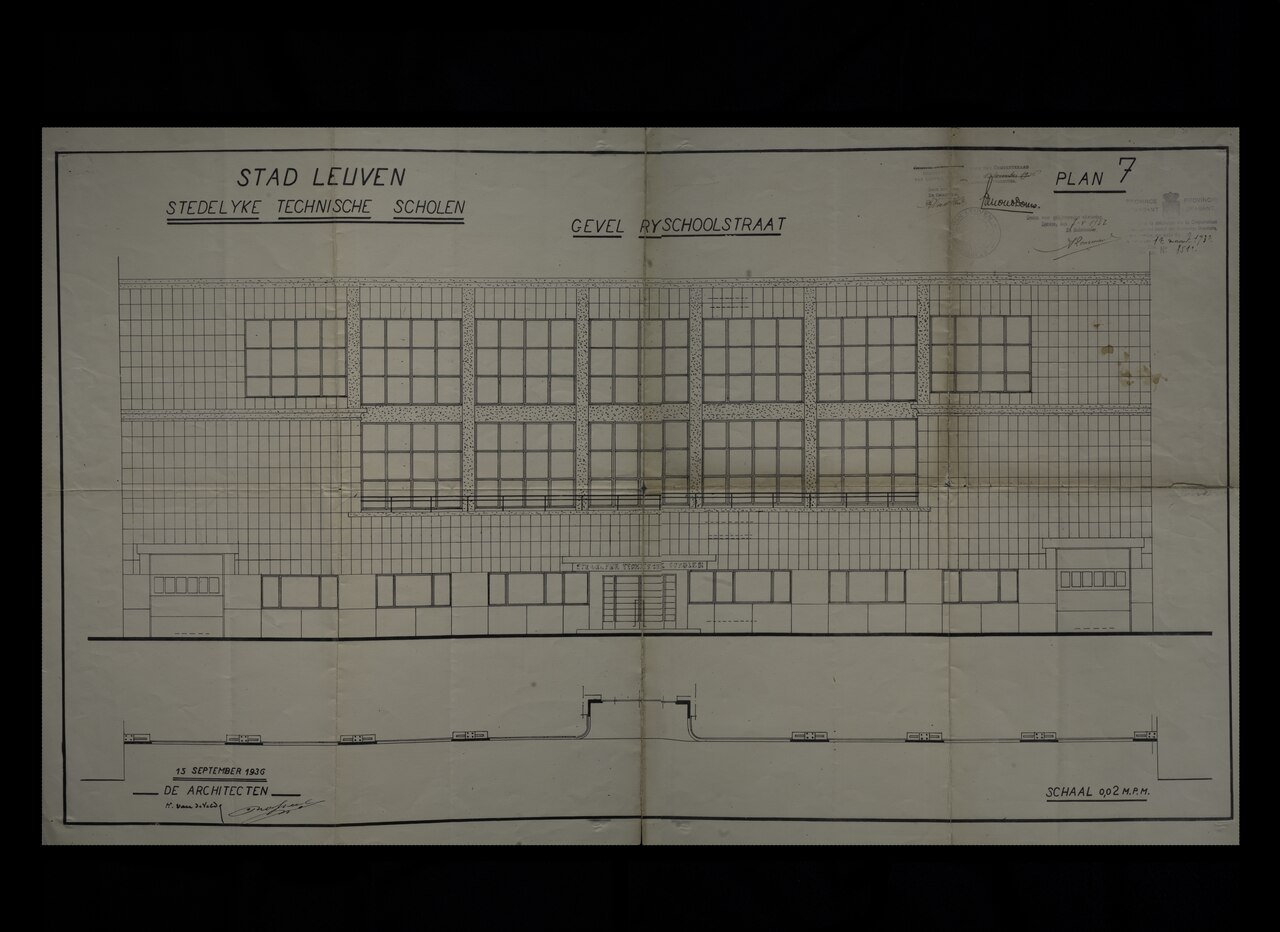
Major works - **Frédéric de Mérode memorial (1897)** – This early commission in Belgium commemorates the Belgian nobleman Frédéric de Mérode. The monument combines sculptural reliefs with a slender, ornamental column, exemplifying van de Velde’s skill in merging figurative sculpture with Art Nouveau decorative motifs. - **Tropon (1898)** – A small-scale decorative piece, often interpreted as a table or cabinet, Tropon showcases the fluid lines and organic ornamentation that became hallmarks of van de Velde’s early furniture designs. Its surface treatment integrates carved floral patterns with metal fittings, reflecting his interest in material harmony. - **Steynbank (1923)** – Built as a private residence, the Steynbank house marks a transitional phase in van de Velde’s oeuvre, where the exuberant curves of his Art Nouveau period give way to a more restrained, functional aesthetic. The façade retains subtle curvilinear details, while the interior spaces emphasise simplicity and the efficient use of light. - **RITO Leuven plan (1936)** – This urban planning project for the city of Leuven illustrates van de Velde’s later focus on civic design. The plan proposes a cohesive arrangement of public buildings, streets and green spaces, embodying his belief that architecture should serve social needs and foster community interaction. - **Georges Eekhoud (1953)** – A post‑war commemorative work dedicated to the Flemish writer Georges Eekhoud, this piece blends sculptural portraiture with a streamlined pedestal. The design reflects the mature, understated elegance of van de Velde’s late style, where ornamentation is reduced to subtle, linear accents.
Influence and legacy Henry van de Velde’s impact on 20th‑century design extends far beyond his built projects. In Germany, his leadership at the Weimar school helped shape the curriculum that would later become the Bauhaus, influencing generations of architects, designers and artists. His advocacy for interdisciplinary education promoted the idea that designers should be conversant with both artistic theory and practical engineering. In Belgium, his early collaborations with Horta and Hankar cemented the nation’s reputation as a cradle of Art Nouveau, and many of his decorative motifs continue to appear in contemporary Belgian design.
Van de Velde’s writings on aesthetics and the social function of art further cemented his status as a theoretician. He argued that design should improve everyday life, a principle that resonated with modernist movements across Europe. Today, his works are studied for their synthesis of form and function, and his legacy endures in the continued relevance of holistic design approaches that bridge architecture, interior design and decorative arts.
Overall, Henry van de Velde stands as a pivotal figure who linked the decorative exuberance of Art Nouveau with the rational, socially minded ethos of early modernism, leaving an indelible mark on both Belgian and German design histories.
Frequently asked questions
Who was Henry van de Velde?
He was a Belgian painter, architect, interior designer and art theorist (1863–1957) who co‑founded Art Nouveau in Belgium and later shaped German Jugendstil.
Which artistic movement is he most associated with?
Van de Velde is most closely linked to Art Nouveau in Belgium and its German counterpart, Jugendstil.
What are his most famous works?
Key works include the Frédéric de Mérode memorial (1897), the decorative piece Tropon (1898), the residential Steynbank house (1923), the RITO Leuven urban plan (1936) and the Georges Eekhoud commemorative sculpture (1953).
Why is Henry van de Velde important in art history?
He pioneered the concept of the total work of art, influenced the curriculum that led to the Bauhaus, and helped merge decorative art with modern architecture, leaving a lasting impact on European design.
How can I recognise a van de Velde design?
Look for fluid, plant‑like lines combined with functional forms, an integrated approach to architecture and interior elements, and a restrained use of ornament that often highlights new materials such as iron or glass.