Isidore Verheyden
1846 – 1905
In short
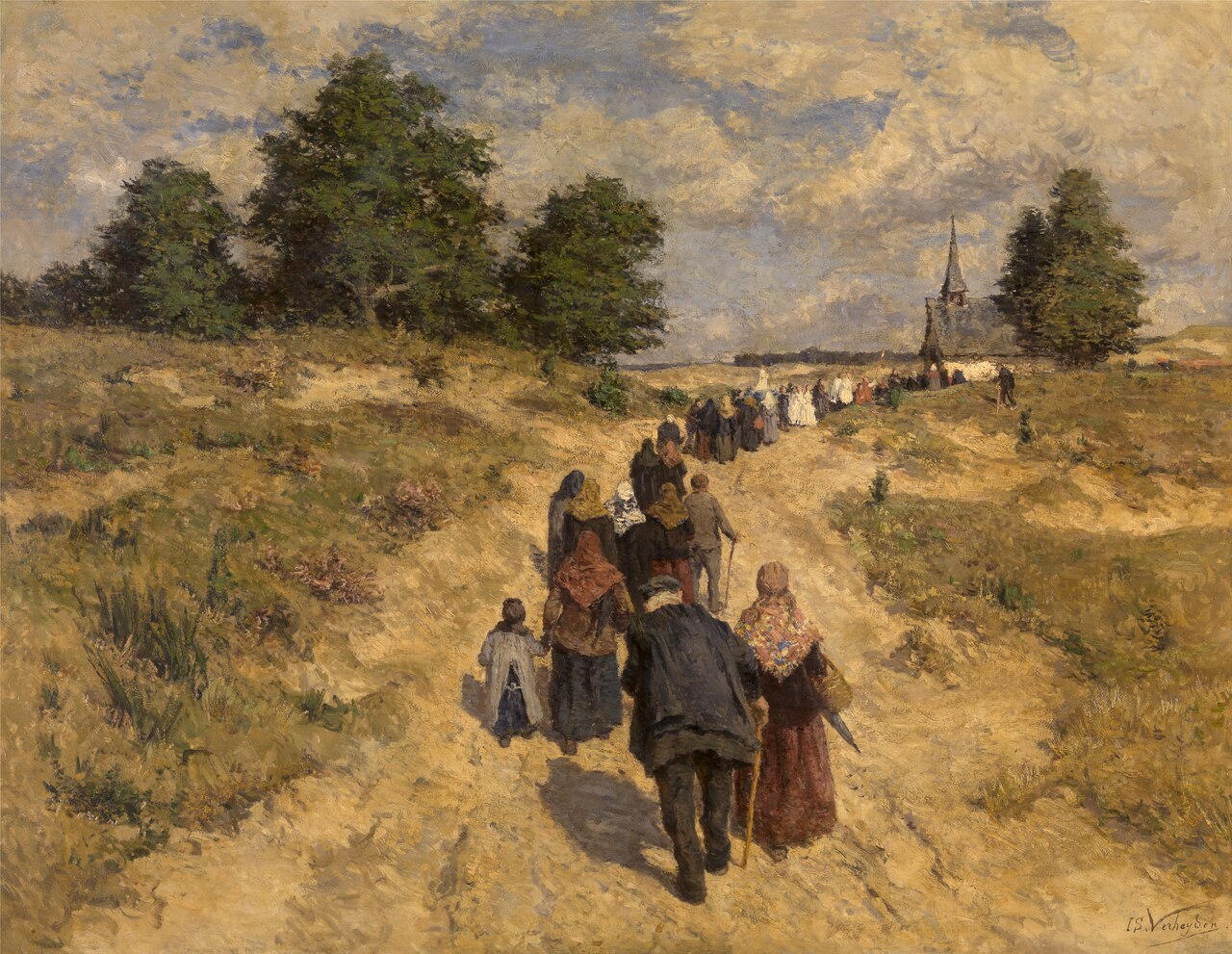
Isidore Verheyden (1846–1905) was a Belgian painter of landscapes, portraits and still lifes active in the late 19th century. He is best known for works such as Pilgrimage in the Kempen, Return from the Market (1875) and Constantin Meunier in his sculptor's studio (1887).
Notable works
.jpg)


Early life Isidore Verheyden was born in 1846 in Antwerp, a city that was then a thriving centre of artistic training in Belgium. Little is recorded about his family background, but the cultural environment of Antwerp – home to the Royal Academy of Fine Arts and a lively guild of painters – provided ample opportunity for a young talent to be exposed to academic drawing, oil painting and the burgeoning interest in plein‑air techniques. Verheyden’s formative years coincided with the rise of Realism in Europe, an influence that would later inform his approach to both genre scenes and landscape subjects.
Career and style After completing his initial studies in Antwerp, Verheyden established himself as a professional painter in the 1860s. He exhibited regularly at the Salon of the Société des Beaux‑Arts in Brussels and participated in the annual salons of his native city. While he never aligned himself formally with a single avant‑garde movement, his work reflects a synthesis of academic training and the naturalist impulse that characterised much of Belgian painting in the latter half of the 19th century. Verheyden’s canvases display a restrained palette, careful modelling of light, and an emphasis on everyday life rather than grand historical narratives. His portraiture captures the psychological presence of sitters with a modest realism, whereas his still‑life compositions reveal a delicate balance between texture and colour.
Signature techniques Verheyden favoured oil on canvas for his larger compositions, employing a layered glazing technique that allowed subtle shifts in atmospheric tone. He often began with a light underdrawing, subsequently building up form through successive translucent layers. This method produced a luminous depth that is especially evident in his landscape pieces, where the interplay of sky and foliage is rendered with nuanced gradations. In his genre works, Verheyden used a tighter brushwork around figures to convey detail, while the surrounding environment is suggested with looser strokes, creating a sense of spatial hierarchy. His palette typically includes earth tones – ochres, umbers and muted greens – punctuated by occasional bright accents such as the red of a market stall or the golden hue of ripe fruit.
Major works - **Pilgrimage in the Kempen** – This composition depicts a group of travellers moving through the forested Kempen region. Verheyden captures the muted light of a late‑summer day, using soft, overlapping brushstrokes to suggest the dense canopy above. The work exemplifies his interest in the quiet dignity of rural life. - **Chapel in the Kempen** – A small, isolated chapel set against a gently rolling landscape, this painting showcases Verheyden’s skill in rendering architectural detail within a natural setting. The subtle tonal contrasts between stone and foliage highlight his controlled handling of light. - **Return from the Market (1875)** – One of his better‑documented genre scenes, it shows market‑goers laden with produce as they make their way home. The canvas records the bustling activity of a provincial market while maintaining compositional balance through a diagonal arrangement of figures. - **An orchard in spring (1878)** – Here Verheyden celebrates the renewal of the season, with blossoming trees rendered in delicate pinks and whites. The painting’s atmospheric perspective, achieved through progressive fading of colour and detail, draws the viewer’s eye into the depth of the orchard. - **Constantin Meunier in his sculptor's studio (1887)** – This work offers a rare glimpse into the workshop of the celebrated Belgian sculptor Constantin Meunier. Verheyden portrays Meunier at work, surrounded by tools and unfinished bronze casts, emphasizing the collaborative spirit among Belgian artists of the period.
Influence and legacy Although Verheyden never achieved the fame of contemporaries such as James Ensor or Fernand Khnopff, his oeuvre contributes valuable insight into the everyday visual culture of 19th‑century Belgium. His commitment to realistic representation and his careful observation of light influenced a generation of younger painters who sought to document the changing rural landscape amidst industrialisation. Today, his paintings are held in several Belgian museum collections and appear in auction records, where they are appreciated for their technical proficiency and quiet narrative power. Scholars regard Verheyden as a representative figure of the Belgian Realist tradition, bridging the gap between academic classicism and the more spontaneous naturalism that would later dominate early‑20th‑century art.
Frequently asked questions
Who was Isidore Verheyden?
Isidore Verheyden (1846–1905) was a Belgian painter known for his landscapes, portraits and still‑life works, active mainly in Antwerp and later Ixelles.
What style or movement is his work associated with?
His work is generally linked to Belgian Realism, combining academic training with a naturalist focus on everyday subjects.
What are his most famous works?
Key works include Pilgrimage in the Kempen, Chapel in the Kempen, Return from the Market (1875), An orchard in spring (1878) and Constantin Meunier in his sculptor's studio (1887).
Why is he significant in art history?
Verheyden provides a clear example of 19th‑century Belgian Realism, documenting rural life and artistic practice, and influencing younger artists who sought realistic representation of modernising landscapes.
How can one recognise an Isidore Verheyden painting?
Look for a restrained colour palette, careful glazing to create luminous depth, detailed figures set against loosely rendered natural surroundings, and a focus on quiet, everyday scenes.