Jan van den Hoecke
1611 – 1651
In short
Jan van den Hoecke (1611–1651) was a Flemish painter, draughtsman and tapestry designer from Antwerp. He worked as a principal assistant to Peter Paul Rubens, spent a decade in Rome, and later served as court painter in Vienna and Brussels, producing portraits, history paintings and allegorical works.
Notable works




Early life Jan van den Hoecke was born in 1611 in Antwerp, a thriving centre of artistic production in the Southern Netherlands. Little is recorded about his family background, but the city's vibrant guild system provided a natural pathway into the visual arts. He most likely began his training in a local workshop, where he would have learned the fundamentals of drawing, oil painting and the preparation of tapestry cartoons—skills that would define his career.
Career and style In the early 1630s van den Hoecke entered the studio of Peter Paul Rubens, the pre‑eminent Flemish Baroque master. As one of Rubens' principal assistants, he participated in large‑scale commissions, copying figures, preparing sketches and contributing to the execution of complex compositions. This apprenticeship ingrained in him the hallmarks of the Baroque style: vigorous movement, dramatic chiaroscuro, and a rich, warm palette.
Around the mid‑1630s van den Hoecke travelled to Italy, where he spent roughly ten years in Rome. The Italian capital exposed him to the works of Caravaggio, the Carracci brothers and the classical antiquities that were then being rediscovered. He absorbed the Roman emphasis on anatomical precision and a more restrained colour scheme, integrating these influences into his own practice. His Roman period also deepened his interest in the design of tapestries, a medium that demanded a synthesis of painterly and decorative concerns.
Returning to the Low Countries in the early 1640s, van den Hoecke accepted appointments as a court painter first in Brussels and then in Vienna. In these roles he produced official portraits, ceremonial allegories and decorative schemes for palatial interiors. The court commissions required a polished, dignified style that balanced the dynamism of his Flemish training with the formality expected by aristocratic patrons.
Signature techniques Van den Hoecke’s work is characterised by a meticulous draughtsmanship that reflects his background in tapestry design. He often began with precise, finely rendered cartoons that could be translated into woven textiles. In his paintings, this translates into a clear linear structure, where figures are outlined with confident brushwork before colour is applied.
His palette, while rooted in the deep reds and golds of Rubens, shows a subtle modulation of tones, especially after his Italian sojourn. He employed a layered glazing technique to achieve luminous skin tones and a delicate handling of fabrics. Light in his compositions typically falls from a single source, creating a gentle modelling of forms that enhances the three‑dimensionality of his subjects.
In allegorical and history paintings, van den Hoecke favoured balanced compositions that guide the viewer’s eye through narrative elements. He made frequent use of symbolic objects—such as scrolls, crowns or mythological attributes—to convey the intended meaning without resorting to overt didacticism.
Major works - **The Reconciliation of Jacob and Esau (1626)** – One of his earliest known history paintings, this work demonstrates van den Hoecke’s command of biblical narrative. The composition is anchored by the two brothers, with a tender gesture that underscores the theme of forgiveness. The palette is restrained, highlighting the emotional intimacy of the scene.
- The Sibyl Agrippina (1630) – This allegorical painting reflects the artist’s fascination with classical subjects. The Sibyl, rendered with a dignified poise, holds a scroll that alludes to prophetic knowledge. Van den Hoecke’s handling of drapery here showcases the influence of Roman sculpture, while the background architecture frames the figure in a manner reminiscent of Rubens’ grand tableaux.
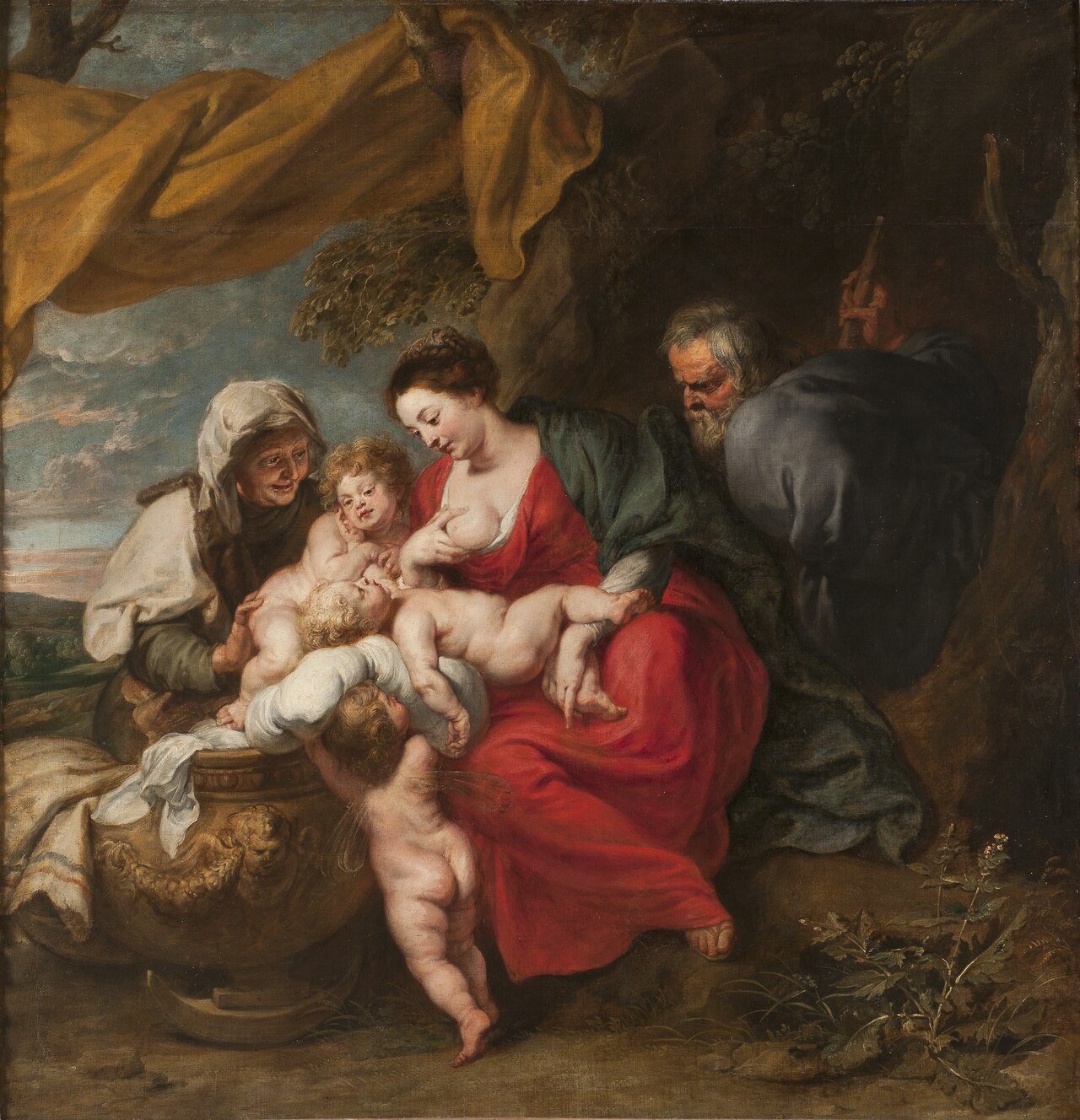
- The Holy Family (1630) – A devotional piece that combines the warmth of Flemish colour with a serene composition. The Virgin, Child and St. Joseph are arranged in a harmonious triangle, illuminated by a soft, golden light that creates a sense of sacred intimacy.
- Jacob and Esau are Reconciled (1630) – A second treatment of the same biblical episode, this version explores a more elaborate setting, with additional figures and a richer decorative scheme. The work underscores van den Hoecke’s ability to revisit a subject with varying narrative emphasis, offering both a private moment and a public display of reconciliation.
- Portrait of Emperor Ferdinand III (1643) – Executed during his Viennese period, this official portrait captures the Habsburg ruler in a stately pose, adorned with the regalia of imperial authority. The portrait is noted for its meticulous rendering of textiles, the subtle modelling of the emperor’s face, and a background that hints at the grandeur of the court.
These works collectively illustrate van den Hoecke’s versatility: from intimate biblical scenes to grand courtly portraiture, each piece bears his characteristic blend of Flemish vigor and Italianate refinement.
Influence and legacy Jan van den Hoecke occupies a transitional position in 17th‑century Flemish art. As a close collaborator of Rubens, he helped disseminate the master’s compositional language across Europe, particularly through his tapestry cartoons that were woven for royal courts. His Roman experience introduced a measured classicism that softened the exuberance of the Baroque, influencing younger Flemish artists who sought a balance between dynamism and restraint.
Although he never achieved the fame of his mentor, van den Hoecke’s contributions to court portraiture in Vienna and Brussels provided a visual model for subsequent Habsburg artists. His tapestries, many of which survive in museum collections, continue to be studied for their technical excellence and their role in the cross‑cultural exchange between the Southern Netherlands and the Italian peninsula.
In modern scholarship, van den Hoecke is recognised as a skilled intermediary: a painter who absorbed the best of Rubens’ drama, the Roman classicism of his decade in Italy, and the diplomatic polish required by court patronage. His works remain valuable primary sources for understanding the visual culture of the mid‑Baroque period, and they offer insight into the collaborative workshop practices that defined Flemish art production.
---
Frequently asked questions
Who was Jan van den Hoecke?
Jan van den Hoecke (1611–1651) was a Flemish painter, draughtsman and tapestry designer from Antwerp who worked as an assistant to Rubens, spent a decade in Rome, and later served as a court painter in Vienna and Brussels.
What artistic style or movement is he associated with?
He worked within the Flemish Baroque tradition, blending Rubens’ dynamic composition with Italian classicism and a refined courtly aesthetic.
What are his most famous works?
Key works include *The Reconciliation of Jacob and Esau* (1626), *The Sibyl Agrippina* (1630), *The Holy Family* (1630), a second *Jacob and Esau are Reconciled* (1630), and the *Portrait of Emperor Ferdinand III* (1643).
Why is Jan van den Hoecke important in art history?
He helped transmit Rubens’ Baroque style across Europe, contributed high‑quality tapestry designs, and set a precedent for court portraiture that influenced later Habsburg artists.
How can I recognise a painting by Jan van den Hoecke?
Look for a clear, confident drawing, a balanced composition, a warm yet nuanced palette, meticulous rendering of fabrics, and often a subtle blend of Flemish vigor with classical restraint.