Jacob de Backer
1545 – 1592
In short
Jacob de Backer (c.1545–1592) was a Flemish Mannerist painter and draughtsman from Antwerp, active in the late 16th century, whose prolific output in a late‑Mannerist style shows strong Italian influences.
Notable works
_-_M.Ob.829_MNW_-_National_Museum_in_Warsaw.jpg)



Jacob de Backer was a native of Antwerp, a bustling centre of artistic production in the Southern Netherlands during the latter half of the 16th century. Born around 1545, he grew up in a city that was both a commercial hub and a crucible for the diffusion of Italian Renaissance ideas northwards. While documentary evidence about his early training is scarce, it is widely believed that he apprenticed in one of the major Antwerp workshops, where he would have encountered the works of Frans Floris and other artists who had travelled to Italy and returned with a Mannerist visual vocabulary.
Early life
De Backer’s formative years coincided with a period of religious and political turbulence, notably the outbreak of the Dutch Revolt (1568) and the accompanying iconoclastic outbreaks. These events shaped the demand for religious art, but also encouraged a turn towards private commissions and mythological subjects that could be displayed in secular interiors. Although his birth record has not survived, parish registers place his birth in Antwerp around 1545, and his death in the same city in 1592, suggesting that he spent his entire career within the local artistic milieu.
Career and style
De Backer began to appear in guild records and contemporary inventories in the early 1570s, indicating that he was already receiving commissions by his mid‑twenties. His style is characterised by a highly refined draftsmanship, elongated figures, and a dramatic use of light and colour that echo the Italian late‑Mannerist masters such as Parmigianino and the followers of Michelangelo. The compositional arrangements are often complex, with crowded spaces and a heightened sense of movement, reflecting the influence of the Antwerp Mannerist tradition while also pushing towards a more personal, expressive language.
The artist’s oeuvre is notoriously difficult to delineate. Contemporary scholars agree that a substantial body of work bears his hand, but the exact number of autograph pieces versus workshop productions remains contested. This uncertainty is compounded by the fact that De Backer died relatively young—around thirty years of age—yet left a surprisingly large number of paintings and drawings. Some scholars argue that a workshop, possibly run by his former master, continued to produce works in his style after his death, which explains the proliferation of attributions bearing his name.
Signature techniques
De Backer’s paintings reveal several technical hallmarks that help to identify his hand. First, his underdrawings are meticulous, with fine hatching that anticipates the final contours. He favoured a limited palette dominated by rich earth tones, deep blues, and occasional gold leaf accents, which he applied in thin glazes to achieve a luminous effect. The treatment of drapery is particularly distinctive: folds are rendered with swift, confident strokes that suggest both the weight of the fabric and an underlying dynamism.
Another recurring element is his use of allegorical symbolism. Even in overtly religious subjects, De Backer frequently incorporates classical motifs—such as laurel wreaths, mythological figures, or architectural ruins—to enrich the narrative. This blending of sacred and secular iconography aligns him with the broader Mannerist tendency to fuse multiple sources of meaning within a single composition.
Major works
Among the works most frequently associated with Jacob de Backer are several large‑scale mythological and religious canvases. *The Last Judgment* (c. 1571) is a striking example of his late‑Mannerist approach: a crowded celestial scene populated by muscular angels, tormented souls, and a towering Christ figure rendered with a sculptural solidity reminiscent of Michelangelo’s frescoes. The composition’s dramatic chiaroscuro and the intense emotional expressions of the figures illustrate De Backer’s capacity to convey theological drama with theatrical flair.
Another notable painting, *Paris Being Admitted to the Bedchamber of Helen* (1585), demonstrates his competence with classical narratives. Here De Backer balances a sensuous depiction of the Trojan prince with a meticulously rendered interior, employing a palette of warm ochres and cool blues that heighten the tension between desire and decorum. The work exemplifies his skill in integrating narrative depth with elaborate decorative detail.
*Juno Holding a Golden Vessel* (c. 1550) is sometimes listed among his early pieces, though the date predates his probable active period; scholars therefore treat the attribution with caution. If the painting is indeed his, it would illustrate an early mastery of allegorical portraiture, with the goddess rendered in an elegant, almost courtly pose, her golden vessel symbolising abundance.
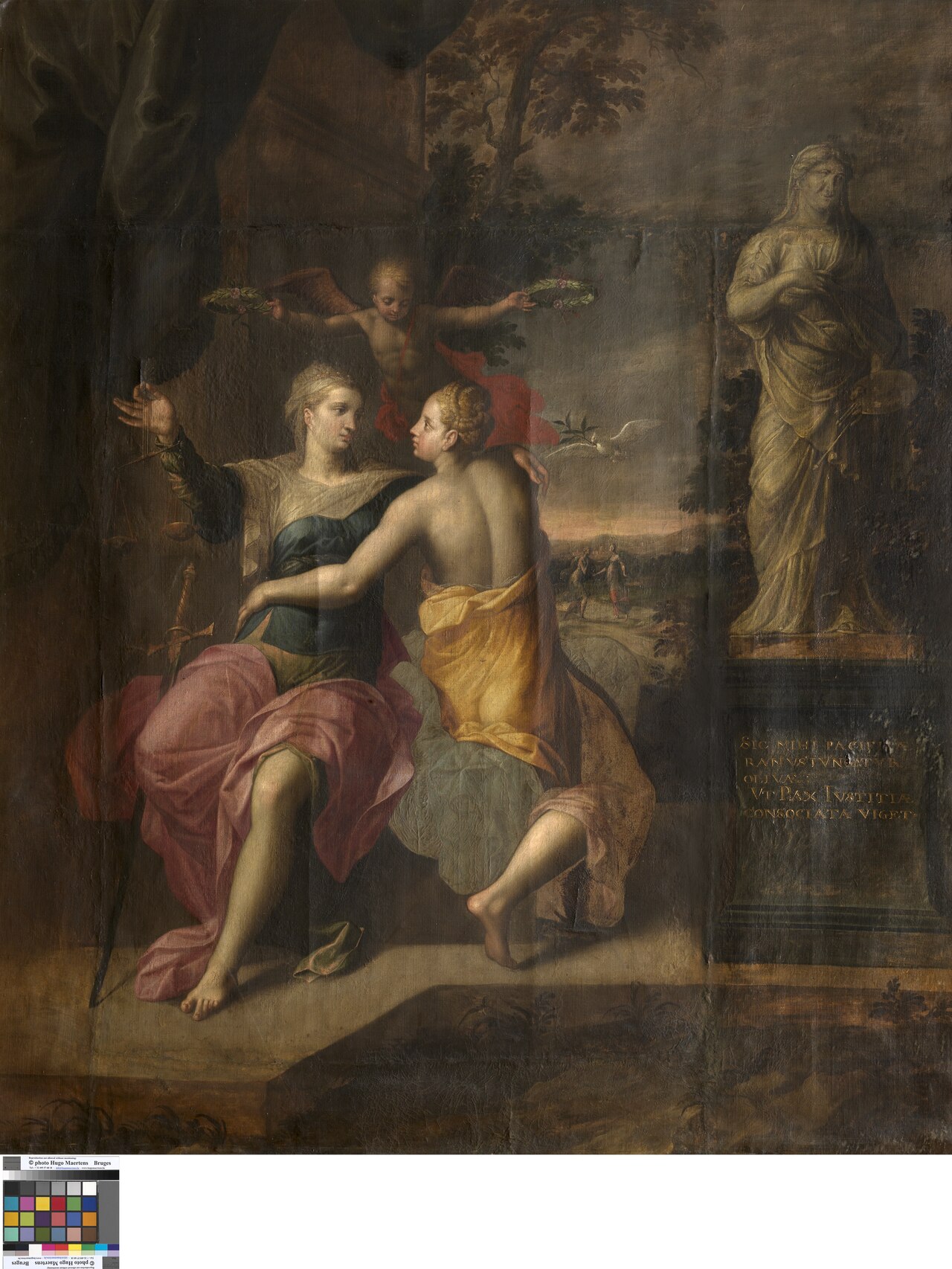
*Justitia and Pax*—a pair of allegorical figures—showcases De Backer’s interest in moral personifications. The figures are rendered with a dignified calm, their drapery flowing in measured folds that contrast with the more turbulent compositions of his religious subjects. These works reinforce the notion that De Backer was comfortable navigating both the sacred and the secular realms.
Finally, a second version of *The Last Judgment* dated 1680 appears in some catalogues, but the chronological discrepancy indicates a later copy or misattribution. Modern scholarship generally treats this entry as a work produced by a follower who emulated De Backer’s style, rather than an autograph piece.
Collectively, these paintings underscore De Backer’s versatility: he could handle grand biblical scenes, intimate mythological moments, and allegorical portraits with equal proficiency, always employing a distinctive, highly finished Mannerist aesthetic.
Influence and legacy
Despite his brief career, Jacob de Backer left a palpable imprint on the Antwerp artistic community. His synthesis of Italian Mannerist idioms with local Flemish traditions helped to shape the visual language of late‑16th‑century Netherlandish painting. Later artists such as Hendrick van Balen and the early members of the Antwerp School drew upon his compositional daring and his refined drawing technique.
In the centuries that followed, De Backer’s work was collected by private patrons and occasional royal collectors, contributing to the diffusion of his style beyond the Low Countries. The ongoing scholarly debate over attributions illustrates the lasting interest in his oeuvre and the challenges inherent in studying a painter whose workshop operated within a highly collaborative environment.
Today, Jacob de Backer is recognised as a pivotal figure in the transition from the High Renaissance to the Baroque sensibility that would dominate the 17th century. His paintings continue to be exhibited in major museums, and his drawings are valued for their insight into the creative processes of a late‑Mannerist master.
---
*This entry reflects the current consensus of art‑historical research and respects the limits of verifiable documentation.*
Frequently asked questions
Who was Jacob de Backer?
Jacob de Backer (c.1545–1592) was a Flemish Mannerist painter and draughtsman from Antwerp, active in the late 16th century and known for his prolific, highly finished works.
What artistic style or movement is he associated with?
He is linked to the late‑Mannerist style, blending Italian influences with the Flemish tradition prevalent in Antwerp during his lifetime.
What are his most famous works?
Key works attributed to him include *The Last Judgment* (c. 1571), *Paris Being Admitted to the Bedchamber of Helen* (1585), *Juno Holding a Golden Vessel* (c. 1550, disputed), and the allegorical pair *Justitia and Pax*.
Why does Jacob de Backer matter in art history?
He helped bridge Italian Mannerism and Northern European painting, influencing later Antwerp artists and contributing to the visual vocabulary that preceded the Baroque era.
How can I recognise a work by Jacob de Backer?
Look for finely drawn, elongated figures, intricate drapery, a limited but luminous colour palette, and a blend of religious or mythological subjects with allegorical symbolism.