Holger Roed
1846 – 1874
In short
Holger Roed (1846–1874) was a Danish painter born in Copenhagen and active in the mid‑19th century, known for works such as The Judgment of Paris (1872) and a self‑portrait (1863). His brief career produced a modest but respected body of paintings and illustrations before his early death in Iselingen.
Notable works
_med_sin_viola,_ca._1869,_0135NMK,_Nivaagaards_Malerisamling.jpg)


Early life Holger Roed was born in Copenhagen in 1846, during a period when the Danish capital was a vibrant centre for artistic education. Little is recorded about his family background, but he grew up in a city that hosted the Royal Danish Academy of Fine Arts, an institution that shaped many of his contemporaries. It is therefore reasonable to assume that Roed received his foundational training in Copenhagen, absorbing the academic principles that dominated Danish art schools of the era.
Career and style Roed's professional activity spanned roughly a decade, from the early 1860s until his untimely death in 1874. During this time he produced a range of works that display a careful balance between academic rigour and a personal sensitivity to subject matter. Although he is not formally linked to a specific movement, his paintings echo the realist and historicist tendencies prevalent in Denmark after the Golden Age. He worked primarily in oil, a medium that allowed him to render both the subtle modelling of flesh in portraits and the more dramatic chiaroscuro required for mythological scenes.
Signature techniques Across his oeuvre Roed consistently employed a restrained palette, favouring earth tones and muted blues that lend his canvases a calm, contemplative mood. His brushwork is precise yet fluid, especially in the rendering of textures such as the sheen of a violin's varnish or the fur of an animal. Light is often introduced from a single source, creating a soft illumination that highlights the central figure while allowing background elements to recede gently. In his illustrations, notably the bird‑and‑fish motif, he combined fine line drawing with delicate washes, demonstrating an ability to adapt his painterly sensibility to graphic formats.
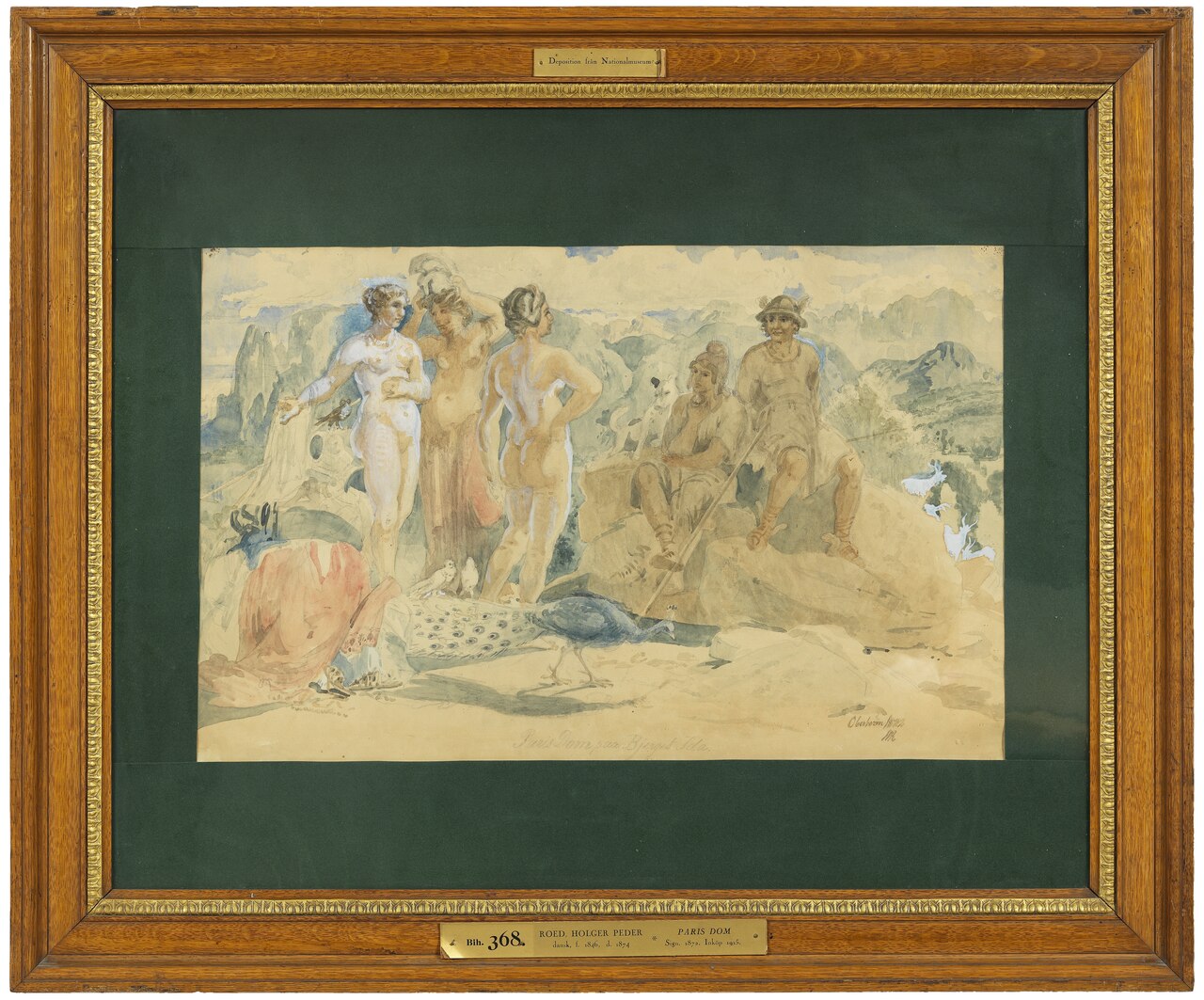
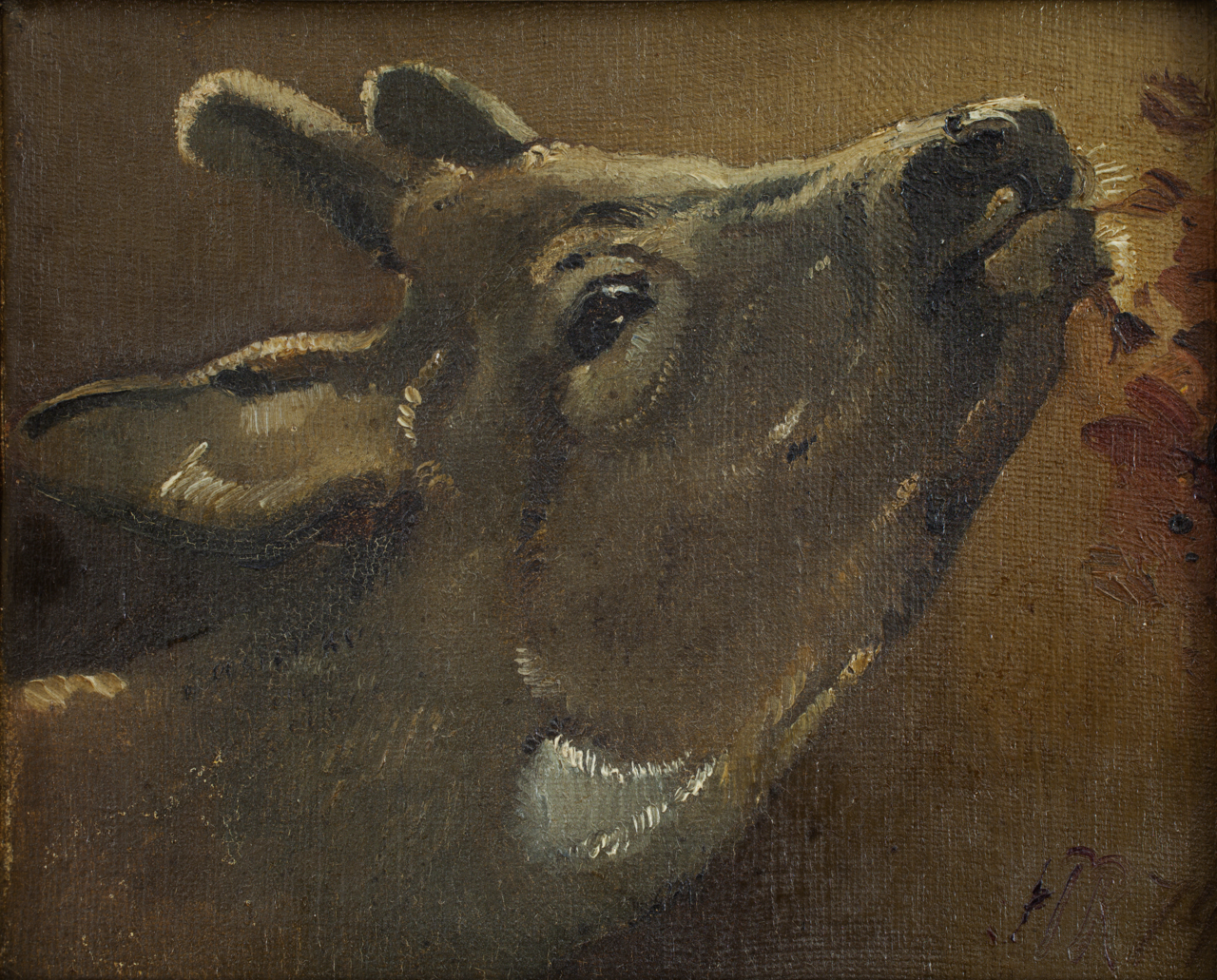
Major works - **The Judgment of Paris (1872)** – This large composition interprets the classical myth in which Paris must choose the fairest goddess. Roed arranges the three female figures in a semi‑circular formation, using a muted colour scheme that underscores the narrative tension. The work reflects his comfort with historical subject matter and his skill at orchestrating complex groupings. - **Study of a deer (1874)** – Completed shortly before his death, this animal study showcases Roed's observational accuracy. The deer is rendered with a keen eye for anatomy, the muscles and coat depicted in subtle gradations of tone. The piece serves as an example of his ability to capture natural subjects with the same seriousness he accorded to mythic scenes. - **A young musician with his viola. Portrait of Mr. Fr. Rung (1854‑1914) (1869)** – In this portrait, Roed combines a straightforward likeness with an intimate portrayal of the sitter’s profession. The violinist is shown holding a viola, his hands delicately poised, while a muted background focuses attention on the instrument and the musician’s expression. The work illustrates Roed's talent for rendering both character and context. - **Self‑portrait (1863)** – Executed when Roed was only about seventeen, this early self‑portrait reveals a youthful confidence. The artist presents himself directly to the viewer, employing a modest colour range and a composed pose that hints at the academic training he had received. - **Sjöfågel med fisk i näbben, diktillustration** – Translating roughly as “Sea bird with fish in its beak,” this illustration was created to accompany a poem. Roed’s drawing balances fine line work with subtle tonal washes, capturing the dynamism of the bird in mid‑flight while preserving the lyrical quality of the accompanying verse.
Influence and legacy Holger Roed’s career was cut short at the age of twenty‑eight, limiting the volume of his output and his exposure beyond Denmark. Nevertheless, his works have been preserved in Danish museum collections and continue to be referenced in studies of mid‑19th‑century Scandinavian art. His ability to navigate both portraiture and narrative painting places him among the generation of artists who bridged the Romantic legacy of the Danish Golden Age and the emerging realist tendencies of the later 19th century. Contemporary scholars regard Roed as a competent practitioner whose surviving pieces offer insight into the artistic currents of his time, and his paintings are occasionally exhibited in retrospectives that explore Denmark’s artistic transition after 1860.
Frequently asked questions
Who was Holger Roed?
Holger Roed was a Danish painter (1846–1874) born in Copenhagen, known for works such as The Judgment of Paris and a self‑portrait, who died in Iselingen.
What artistic style or movement is he associated with?
He is not tied to a single movement, but his work reflects the realist and historicist tendencies of mid‑19th‑century Danish academic painting.
What are his most famous works?
His best‑known pieces include The Judgment of Paris (1872), Study of a deer (1874), the portrait of Mr Fr Rung (1869), his 1863 self‑portrait, and the illustration Sjöfågel med fisk i näbben.
Why does Holger Roed matter in art history?
Although his career was brief, Roed provides a valuable example of the transitional period in Danish art between the Golden Age and later realism, and his surviving works illustrate the academic techniques of his era.
How can I recognise a painting by Holger Roed?
Look for a restrained colour palette, careful modelling of light from a single source, precise brushwork that renders texture, and a compositional calm typical of Danish academic painting of the 1860s‑70s.