Hendrik van Minderhout
1630 – 1696
In short
Hendrik van Minderhout (1630–1696) was a Southern‑Netherlands painter born in Rotterdam who spent most of his career in Bruges and Antwerp, specialising in marine, harbour and city‑scape scenes within the Flemish Baroque tradition.
Notable works

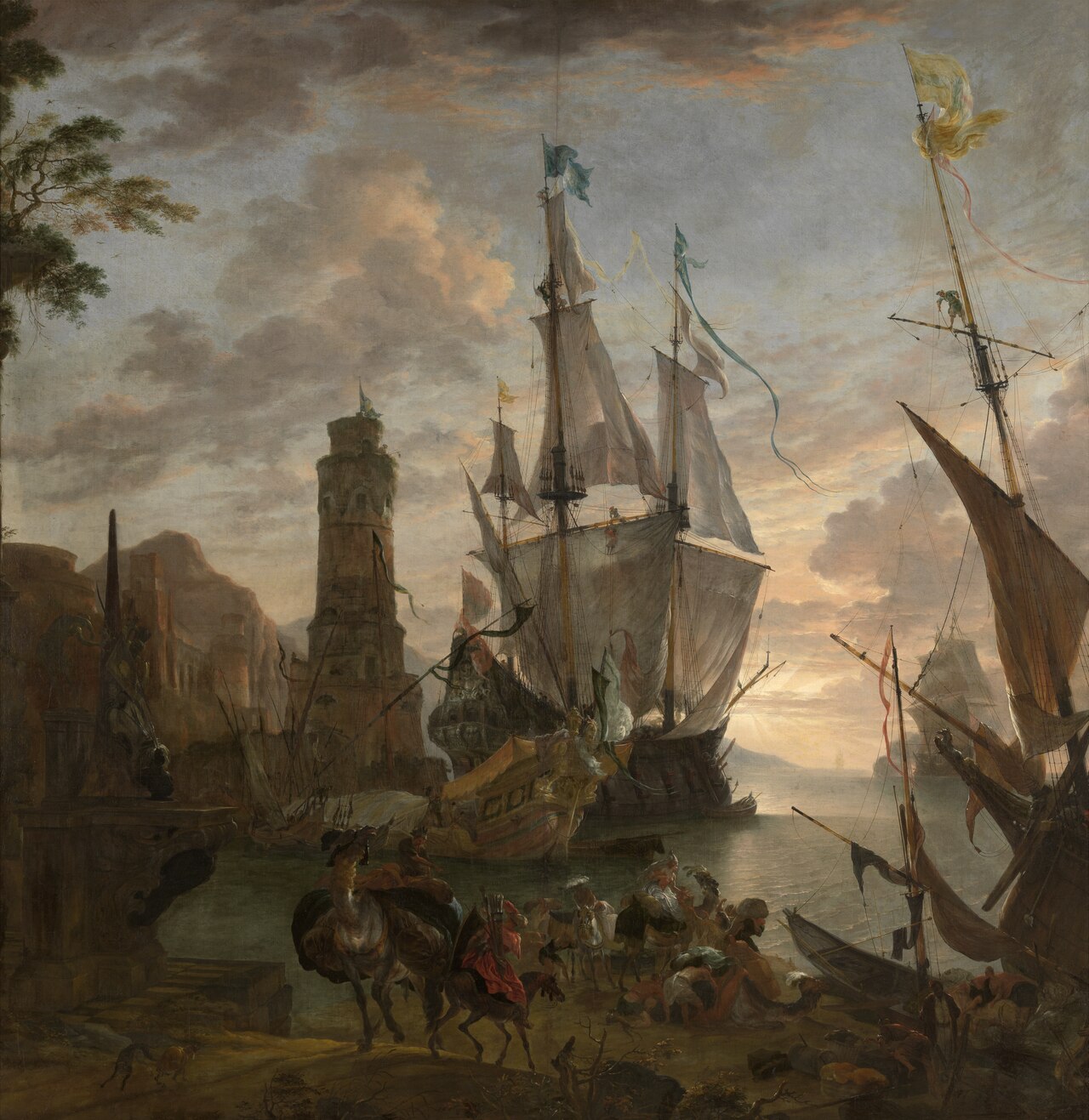


Early life Hendrik van Minderhout was born in 1630 in Rotterdam, a thriving port city of the Dutch Republic. Little is recorded about his family background or formal apprenticeship, but the artistic climate of his birthplace—steeped in maritime trade and a flourishing market for marine art—provided a natural orientation toward seascapes. By the early 1650s he had moved southward, likely attracted by the patronage networks of the Southern Netherlands, where Flemish cities such as Bruges and Antwerp offered lucrative commissions for painters capable of depicting bustling harbours and bustling urban life.
Career and style Van Minderhout established himself in Bruges by the mid‑1650s, a period when the city was still an important commercial hub despite its declining political significance. His oeuvre reflects the prevailing Flemish Baroque taste for dramatic light, rich colour and a narrative sense of space. He produced a variety of subjects—marine battles, tranquil coastal views, market scenes and architectural capricci—yet all share a consistent emphasis on the interaction between water, vessels and the built environment. He often worked in collaboration with specialist landscape painters, supplying the staffage (human figures) that animated the broader compositions. This collaborative practice was common in the Low Countries, allowing each artist to focus on his strongest skill.
Signature techniques Van Minderhout’s paintings are distinguished by several technical hallmarks. First, his handling of water surfaces combines fine brushwork with subtle glazing, creating a reflective sheen that conveys both movement and atmospheric depth. Second, he favoured a restrained palette of muted blues, greys and earthy tones, punctuated by occasional bursts of warm ochre or vermilion to highlight sails, lanterns or market stalls. Third, his compositional structures often employ a diagonal sweep of the horizon line, guiding the viewer’s eye from foreground activity toward a distant vanishing point, a device that reinforces the sense of space and narrative progression. Finally, his staffage figures are rendered with delicate modelling, suggesting a collaborative input rather than the dominant hand of a single painter.
Major works Among van Minderhout’s documented works, **Landscape with Rape of Europa (1696)** stands out as a rare mythological subject rendered within a marine context; the composition places the classical drama amidst a calm sea and distant shoreline, showcasing his ability to integrate narrative with his favourite seascape motifs. **Eastern Seaport (1675)** depicts a bustling oriental harbour, complete with exotic vessels and a crowded quayside, reflecting the 17th‑century fascination with far‑eastern trade routes. **The Fish Market of Antwerp (1695)** offers a vivid snapshot of daily life in one of the city’s most important commercial districts, with stalls, buyers and a network of canals rendered in meticulous detail. **The Harbour Basin in Bruges (1653)** is an early work that records the layout of Bruges’ waterways, combining a precise topographical approach with the atmospheric effects that would become his trademark. Finally, **View on Ostend (1675)** captures the coastal town’s fortifications and harbour activity, balancing architectural accuracy with a lively depiction of ships loading and unloading cargo. Each of these paintings demonstrates his consistent focus on the interplay of architecture, water and human activity.
Influence and legacy Although van Minderhout never achieved the fame of contemporaries such as Jacob van Ruisdael, his paintings constitute an important visual record of 17th‑century Flemish maritime commerce. By documenting the ports of Bruges, Antwerp and Ostend, he provided later historians and scholars with valuable information about urban planning, ship design and market practices of the period. His collaborative approach, in which he supplied staffage to landscape specialists, exemplifies the cooperative workshop culture of the Low Countries and influenced subsequent generations of marine painters who adopted a similar division of labour. Today, his works are prized by collectors for their historical authenticity and the quiet, measured beauty of their compositions, ensuring that Hendrik van Minderhout remains a respected figure in the study of Flemish Baroque marine art.
Frequently asked questions
Who was Hendrik van Minderhout?
He was a 17th‑century painter from the Southern Netherlands, born in Rotterdam and active mainly in Bruges and Antwerp, known for marine and harbour paintings.
What style or movement is he associated with?
His work belongs to the Flemish Baroque tradition of marine and city‑scape painting, although no specific movement is recorded for him.
What are his most famous works?
His best‑known pieces include Landscape with Rape of Europa (1696), Eastern Seaport (1675), The Fish Market of Antwerp (1695), The Harbour Basin in Bruges (1653) and View on Ostend (1675).
Why is he important in art history?
He documented the bustling ports and urban life of 17th‑century Flanders, providing valuable visual records and influencing later marine painters through his collaborative practice.
How can I recognise a van Minderhout painting?
Look for detailed harbour settings, a balanced composition of ships and architecture, muted yet luminous colour palettes and occasional staffage figures added by collaborating landscape artists.