Hendrik-Frans De Cort
1742 – 1810
In short
Hendrik‑Frans De Cort (1742–1810) was a Flemish landscape painter and draughtsman from Antwerp who specialised in topographical views of English castles, country houses and rural scenes, working across Antwerp, Paris, England and Wales before dying in London.
Notable works




Early life Hendrik‑Frans De Cort was born in Antwerp in 1742, a city that was then part of the Southern Netherlands and a thriving centre for the visual arts. Little is known about his family background, but the artistic environment of Antwerp—home to the Guild of Saint Luke and a strong tradition of landscape painting—provided a natural entry point for his training. De Cort likely began an apprenticeship in his teenage years, absorbing the techniques of Flemish masters who combined meticulous observation with a lyrical sense of atmosphere.
Career and style By the mid‑1760s De Cort had established himself as a competent draughtsman and painter, and his career soon took on an international dimension. He spent a period in Paris, where the French taste for topographical and picturesque subjects was at its height. The exposure to French academies and the thriving market for travel‑related imagery sharpened his eye for architectural detail and landscape composition.
Around the 1770s De Cort moved to Britain, a relocation that would define the most productive phase of his career. England’s burgeoning interest in the documentation of its historic estates and medieval ruins aligned perfectly with his skill set. He travelled extensively across the country, producing watercolours, gouaches and pen‑and‑ink drawings that combined accurate rendering of structural elements with a subtle atmospheric tone. His works were often commissioned by aristocratic patrons who wished to record their properties, and they were also sold to the emerging market of print collectors eager for images of the British countryside.
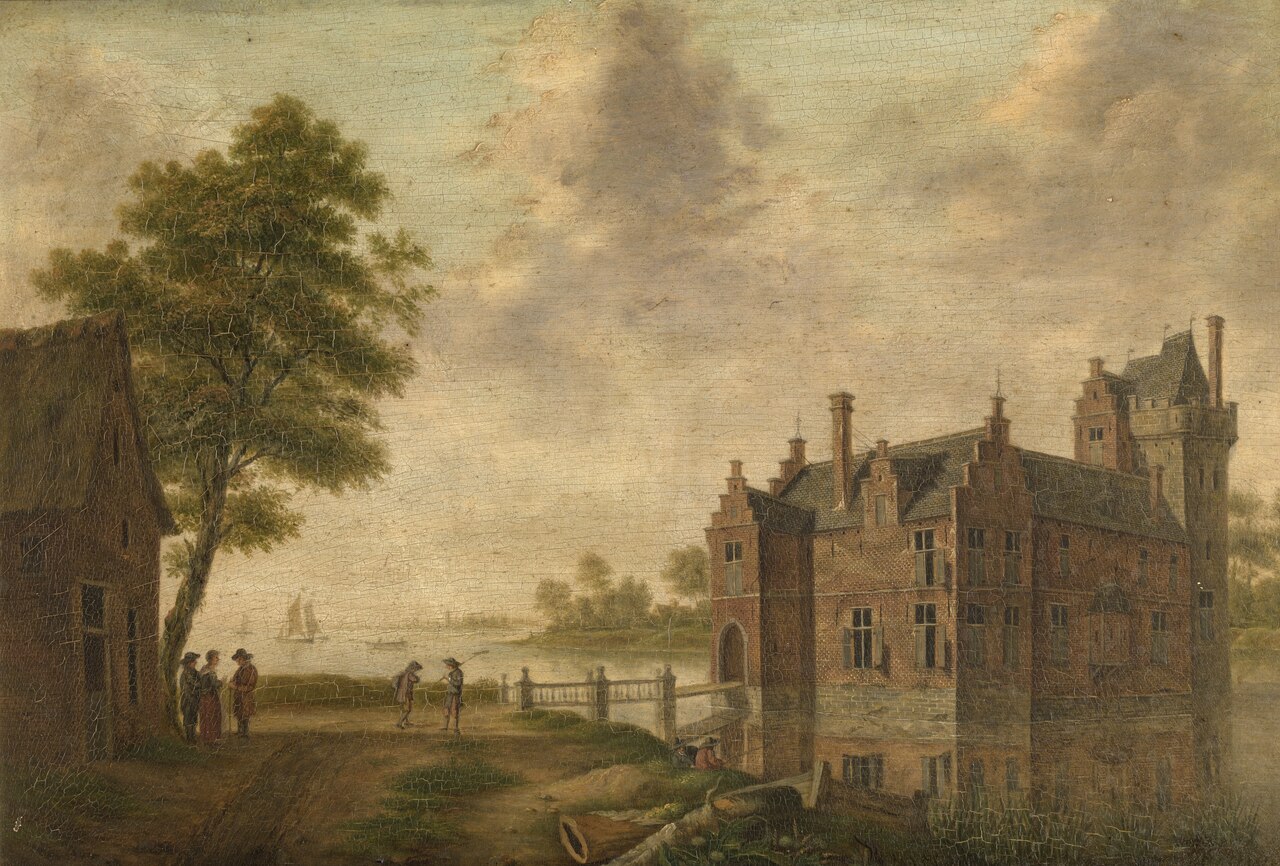
Stylistically, De Cort’s landscapes occupy a middle ground between the precise topographical tradition of Dutch and Flemish masters and the more romantic, idealised visions of the English picturesque movement. He favoured a balanced composition where the architectural focal point—often a castle or manor house—was set within a gently rolling landscape, punctuated by trees, watercourses and distant hills. The colour palette is restrained, dominated by earthy greens, muted ochres and occasional sky blues, allowing the structural forms to dominate the visual narrative.
Signature techniques De Cort’s drawings are characterised by a fine, controlled line that captures both the structural integrity of buildings and the texture of natural elements. He frequently employed a wash of diluted ink or watercolor to suggest atmospheric depth, a technique that softened the hard edges of his pen work without sacrificing detail. In his paintings, he used a layered approach: an initial underdrawing in graphite or charcoal, followed by thin washes of watercolor to build tone, and finally a glaze of more saturated pigment to highlight architectural features.
Another hallmark of his practice is the careful placement of human figures or animals as scale references. Small, almost anecdotal figures—farmers, shepherds, or horses—are positioned within the scene to convey the size of the structures and to add a narrative element. This compositional device also reflects the Enlightenment interest in the relationship between humanity and the environment.
Major works De Cort’s oeuvre includes several works that are frequently cited by scholars and collectors:
- Village Scene on a River (1750) – Though dated early in his life, this work demonstrates his early proficiency in rendering water and rural architecture. The composition presents a tranquil riverbank with modest dwellings, showcasing his ability to convey atmosphere through delicate washes.
- View of Carmosteyn Castle in Hombeek (1750) – This topographical piece records the Flemish castle of Carmosteyn, combining precise architectural lines with a surrounding landscape that hints at the estate’s cultivated gardens.
- Chepstow Castle (1795) – Executed during his English period, the drawing captures the dramatic ruins of Chepstow Castle perched above the River Wye. De Cort’s rendering emphasises the interplay of light on stone and the surrounding foliage, reinforcing the romantic appeal of medieval ruins.
- Fauldon, South Greenhoe, Norfolk (1794) – This work illustrates a Norfolk country house set within a gently undulating rural scene. The painting’s muted palette and careful treatment of the sky reflect his mature style.
- Ripon Minster (1800) – One of his later works, this piece portrays the Gothic cathedral of Ripon with an emphasis on its soaring towers and the surrounding landscape. The composition balances architectural grandeur with a calm, expansive sky, underscoring De Cort’s mastery of perspective.
These works, together with numerous unpublished sketches, form a visual record of late‑18th‑century British architecture and landscape, and they remain valuable resources for historians of art and architecture alike.
Influence and legacy Hendrik‑Frans De Cort may not belong to a formally defined movement, but his contribution to the topographical genre helped shape the visual culture of his time. By providing accurate yet aesthetically pleasing depictions of English estates, he reinforced the emerging taste for the picturesque and influenced later British landscape artists who sought to blend documentary precision with romantic sensibility.
His drawings were reproduced as engravings, circulating widely among the educated classes and thereby extending his reputation beyond the immediate circles of patronage. Moreover, his cross‑cultural career—moving from the Southern Netherlands to France and then to Britain—exemplifies the fluid artistic exchanges of the Enlightenment era, illustrating how Flemish techniques were adapted to meet English tastes.
De Cort died in London in 1810, leaving behind a body of work that continues to be referenced in studies of eighteenth‑century topography. Contemporary scholars regard his paintings and drawings as reliable visual documents of historic sites, many of which have since been altered or lost. While his name is not as widely recognised as some of his contemporaries, his meticulous approach and the enduring quality of his compositions secure his place in the canon of European landscape art.
---
Further reading: For those interested in exploring De Cort’s work in greater depth, the collections of the Royal Academy of Arts, the British Museum and several regional archives in England hold examples of his drawings and watercolours. Recent exhibition catalogues on British topographical art also feature critical essays on his contribution to the genre.
Frequently asked questions
Who was Hendrik‑Frans De Cort?
He was a Flemish landscape painter and draughtsman (1742–1810) known for topographical views of English castles, country houses and rural scenes.
What artistic style or movement is he associated with?
De Cort worked in a topographical style that blends Flemish precision with the English picturesque, but he is not tied to a specific formal movement.
What are his most famous works?
Key works include *Village Scene on a River* (1750), *View of Carmosteyn Castle in Hombeek* (1750), *Chepstow Castle* (1795), *Fauldon, South Greenhoe, Norfolk* (1794) and *Ripon Minster* (1800).
Why is Hendrik‑Frans De Cort important in art history?
He documented late‑18th‑century British architecture with artistic skill, influencing the development of the topographical genre and providing valuable visual records of historic sites.
How can I recognise a work by De Cort?
Look for finely drawn architectural outlines, subtle watercolor washes, restrained earth tones, and small human figures used as scale within balanced, gently rolling landscapes.