Harald Giersing
1881 – 1927
In short
Harald Giersing (1881–1927) was a Danish post‑impressionist painter who helped shape Denmark’s classic modernism, becoming renowned for his portraits and landscapes that combined bold colour with simplified forms.
Notable works


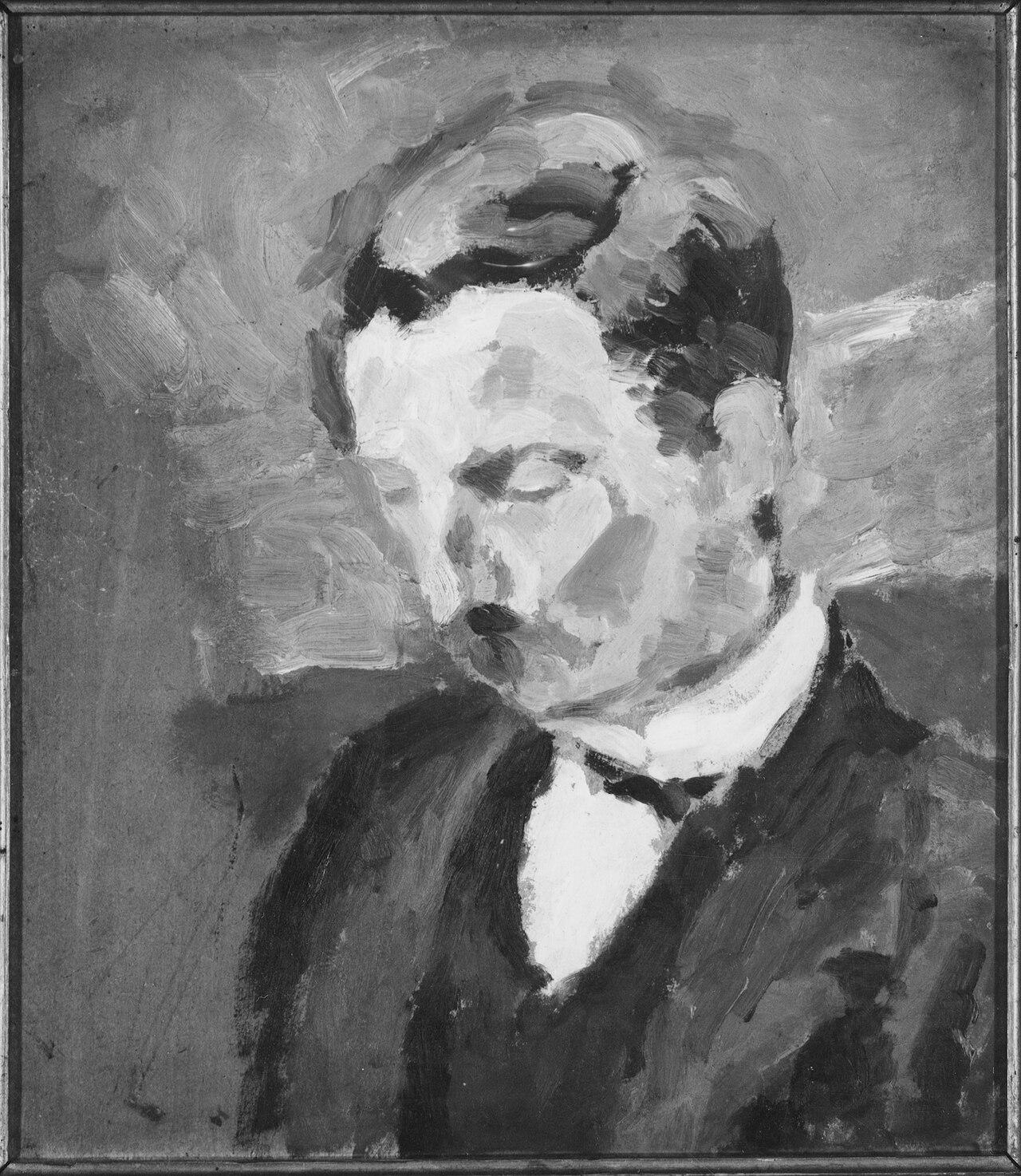


Early life Harald Giersing was born on 7 April 1881 in Copenhagen, the capital of the Kingdom of Denmark. He grew up in a middle‑class family that encouraged artistic pursuits. After completing his primary education, Giersing enrolled at the Royal Danish Academy of Fine Arts, where he received formal training in drawing and painting. Early exposure to the academy’s traditional curriculum gave him a solid grounding in classical techniques, but his curiosity soon led him beyond its conservative walls. By his early twenties, he was already experimenting with the vibrant palettes and loose brushwork that would later define his mature style.
Career and style Giersing’s artistic development accelerated after a brief sojourn in Paris in 1905. There, he encountered the work of post‑impressionist masters such as Paul Cézanne and Vincent van Gogh, as well as the emerging Symbolist currents of the time. The Parisian avant‑garde left a lasting imprint on his approach, prompting him to abandon the meticulous realism of his academy training in favour of a more expressive, colour‑driven language.
Returning to Copenhagen in 1907, Giersing became a central figure in a loose circle of Danish artists who were seeking to modernise national art. He was instrumental in forging what is often termed “classic modernism” in Denmark—a synthesis of post‑impressionist colour theory with a restrained, almost architectural composition. Throughout the 1910s, his work oscillated between figurative portraiture, genre scenes, and increasingly abstracted landscapes. By the end of the decade, Giersing’s canvases displayed a distinctive balance between flat colour planes and a subtle sense of depth, reflecting his belief that modern art should retain an emotional resonance without relying on overt narrative.
Signature techniques Giersing’s technique is characterised by three inter‑related elements. First, he employed a bold, sometimes non‑naturalistic palette, often juxtaposing complementary hues to heighten visual tension. Second, his brushwork was economical: broad, flat strokes that conveyed both form and atmosphere in a single gesture. Third, he frequently simplified shapes, reducing figures and objects to their essential outlines while preserving a sense of volume through tonal modulation. This combination of colour, brushstroke, and abstraction allowed him to capture the fleeting qualities of light and movement without resorting to detailed rendering.
Major works - **The Judgment of Paris (1909)** – This early masterpiece illustrates Giersing’s engagement with mythological subject matter through a post‑impressionist lens. The composition is dominated by vibrant blues and warm ochres, with the three goddesses rendered as flattened silhouettes, emphasizing colour over anatomical precision. - **A Lady Dressing (1907)** – One of his first mature works, the painting depicts a woman at a dressing table, bathed in soft, diffused light. Giersing’s use of muted pastel tones and simplified forms creates an intimate atmosphere, foreshadowing his later portraiture. - **Karl Isakson, 1878‑1922 (1910)** – A portrait of fellow Danish‑Swedish painter Karl Isakson, this work showcases Giersing’s ability to convey personality through colour. The background is reduced to a single, warm field, while the sitter’s features are suggested rather than meticulously detailed. - **The Painter Sigurd Swane (1910)** – In this portrait of his contemporary Sigurd Swane, Giersing employs contrasting blues and reds, highlighting the artist’s focused gaze. The brushwork is loose, allowing the viewer to sense the painter’s creative energy. - **Football Players. Sofus Heads (1917)** – A later composition that merges sport and portraiture, the painting captures the dynamism of a football match while focusing on the heads of the players. Giersing’s flattened perspective and rhythmic brushstrokes convey motion, and the limited colour range underscores the intensity of the scene.
Influence and legacy Harald Giersing’s contribution to Danish art extends beyond his canvases. As a teacher at the Royal Academy and a participant in several artist societies, he mentored a generation of painters who adopted his modernist principles. His emphasis on colour harmony and structural simplification resonated with later Danish artists such as Vilhelm Lundstrøm and the Skagen painters of the 1930s. Major Danish museums, including the Statens Museum for Kunst, hold extensive collections of his work, and his paintings continue to appear in international exhibitions that explore early 20th‑century modernism. Giersing is now regarded as a pivotal bridge between the late‑19th‑century impressionist tradition and the more abstract currents that defined the interwar period, securing his place as one of Denmark’s most important 20th‑century artists.
Frequently asked questions
Who was Harald Giersing?
Harald Giersing (1881–1927) was a Danish post‑impressionist painter who helped develop classic modernism in Denmark, known for his portraits and landscapes.
What artistic movement is he associated with?
He is linked to post‑impressionism and is considered a key figure in the classic modernism movement that emerged in Denmark around 1910‑1920.
What are his most famous works?
Among his best‑known paintings are *The Judgment of Paris* (1909), *A Lady Dressing* (1907), *Karl Isakson, 1878‑1922* (1910), *The Painter Sigurd Swane* (1910) and *Football Players. Sofus Heads* (1917).
Why does Giersing matter in art history?
He introduced bold colour and simplified forms to Danish art, influencing subsequent generations and helping to bridge impressionist traditions with early modernist abstraction.
How can I recognise a Giersing painting?
Look for flat, vibrant colour planes, economical brushwork, and simplified outlines that retain a sense of volume, often combined with a restrained, almost architectural composition.