Jan Baptiste de Jonghe
1785 – 1844
In short
Jan Baptiste de Jonghe (1785–1844) was a Belgian painter, draughtsman, etcher and lithographer known for Romantic landscapes that combine figures, livestock and ruins, and for his teaching roles at the Kortrijk and Antwerp academies.
Notable works

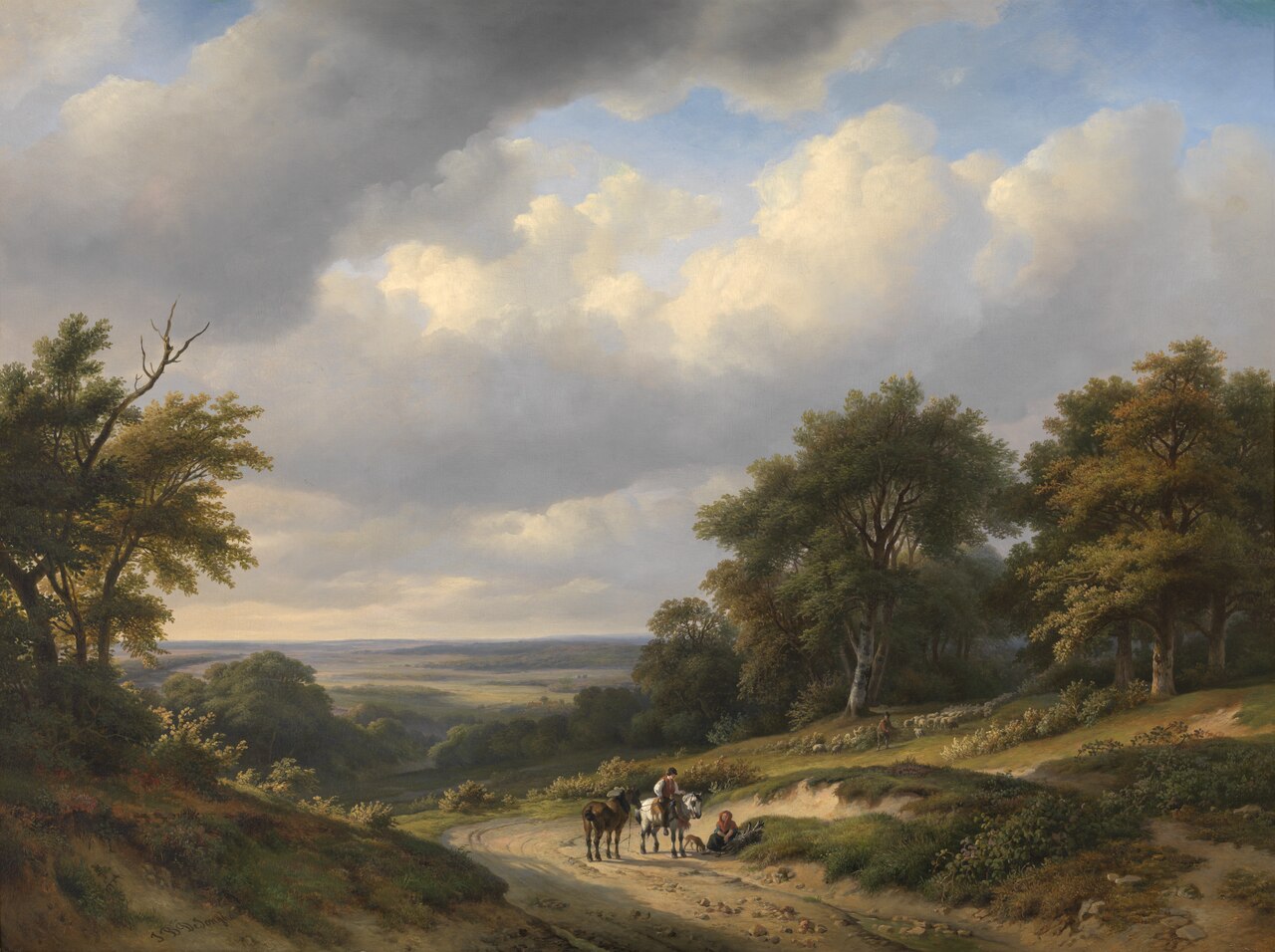
.jpg)
.jpg)
_-_Cattle_and_Sheep_by_a_River_-_13754_-_National_Trust.jpg)
Early life
Jan Baptiste de Jonghe was born in 1785 in the Flemish city of Kortrijk, a town that would later feature prominently in his artistic output. Little is recorded about his family background, but his early exposure to the bustling market life and the surrounding countryside of West Flanders left a lasting impression. He received his first formal instruction in drawing at the local Academy of Kortrijk, where the curriculum emphasized drawing from life and the study of classical antiquities. By his late teens, de Jonghe was already producing sketches of the city's streets and the nearby rural scenes, a habit that would evolve into a lifelong fascination with the interaction between human activity and landscape.
Career and style
In the first decade of the 19th century de Jonghe moved to Antwerp, the cultural hub of the Southern Netherlands, to continue his studies at the prestigious Antwerp Academy of Fine Arts. There he encountered the emerging Romantic sensibility that was reshaping European art, a movement that favoured emotion, dramatic light, and an idealised vision of nature. De Jonghe absorbed these ideas while retaining a strong grounding in the Flemish tradition of meticulous observation. His paintings therefore combine a Romantic atmospheric quality with a faithful rendering of local topography and architecture.
De Jonghe’s oeuvre is characterised by a focus on everyday scenes set within expansive natural environments. He frequently populated his canvases with peasants, shepherds, and livestock, allowing viewers to sense the rhythms of rural life. Ruins and weathered structures often appear as silent witnesses to human endeavour, imbuing his works with a subtle melancholy. Although he is not formally linked to a specific school, his style aligns with the broader Romantic landscape tradition that flourished across Europe in the early 1800s.
Signature techniques
De Jonghe worked across several media—oil painting, drawing, etching and lithography—each informing the others. In his paintings, he employed a delicate palette of earth tones, muted greens and soft blues, punctuated by brighter highlights that suggested sunrise or storm‑lit skies. His handling of light was particularly noteworthy; he often rendered the diffusion of daylight through clouds to create a sense of depth and mood.
In graphic work, de Jonghe demonstrated a keen eye for line. His city views were executed with precise, controlled strokes that captured architectural detail while still conveying the bustling atmosphere of urban life. Etching and lithography allowed him to explore texture, especially in the rendering of foliage and water surfaces, where cross‑hatching and stippling created a tactile impression.
Major works
- Market Day in Courtrai (1828) – This oil on canvas depicts the lively market square of his native Kortrijk. Figures crowd the foreground, trading goods under a bright sky, while the town’s historic buildings frame the scene. The work exemplifies de Jonghe’s ability to blend genre painting with landscape, highlighting the social fabric of the city.
- Landscape in the Ardennes – Though the exact date is uncertain, this piece captures the rugged, forested terrain of the Ardennes region. Dark, towering trees dominate the composition, and a misty atmosphere suggests an early morning. The painting reflects his Romantic fascination with wild, untamed nature.
- The Approaching Storm (1812) – One of his earlier known works, this painting shows a dramatic sky gathering clouds over a quiet countryside. A lone figure or shepherd can be seen contemplating the impending weather, a common Romantic motif that underscores humanity’s vulnerability before nature.
- The Surroundings of Courtrai – In this work de Jonghe returns to his hometown, presenting a panoramic view of the fields and waterways that lie beyond the city walls. The composition balances open sky with detailed depictions of farmsteads, emphasizing the harmony between cultivated land and natural landscape.
- Cattle and Sheep by a River (1824) – This tranquil scene features a herd of cattle and a flock of sheep drinking from a gently flowing river. The animals are rendered with careful observation, their silhouettes softened by the reflective water surface. The painting conveys a peaceful coexistence between livestock and their environment, a recurring theme in de Jonghe’s art.
These works collectively demonstrate de Jonghe’s preoccupation with the interplay of human activity, animal life, and the surrounding landscape, all rendered through a Romantic lens that values emotion and atmosphere.
Influence and legacy
During his lifetime de Jonghe held teaching posts at both the Academy of Kortrijk and the Antwerp Academy of Fine Arts. His role as professor allowed him to transmit his techniques and aesthetic values to a new generation of Belgian artists, many of whom continued to explore Romantic landscape themes. Although his name is not as widely recognised as some of his contemporaries, de Jonghe contributed to the development of a distinctly Belgian visual language that merged local subject matter with the broader European Romantic movement.
His graphic works, particularly his city views and lithographs, provide valuable historical records of early‑19th‑century urban environments in Belgium and the Netherlands. Scholars cite his drawings for their accuracy and artistic merit, and they remain a resource for understanding the visual culture of the period.
In contemporary art historical scholarship, Jan Baptiste de Jonghe is appreciated for his synthesis of genre and landscape, his nuanced handling of light, and his commitment to depicting everyday life within an evocative natural setting. His paintings continue to appear in museum collections and exhibitions that explore Romanticism and the early formation of Belgian national art.
Overall, de Jonghe’s legacy endures through his contributions as an educator, his body of landscape paintings that capture the spirit of his time, and his graphic documentation of the built environment in the Low Countries.
Frequently asked questions
Who was Jan Baptiste de Jonghe?
Jan Baptiste de Jonghe (1785–1844) was a Belgian painter, draughtsman, etcher and lithographer noted for Romantic landscapes that combine figures, livestock and ruins.
What artistic style or movement is he associated with?
He is linked to the Romantic landscape tradition of the early 19th century, blending emotive atmospheres with detailed observation of nature and everyday life.
What are his most famous works?
Key works include *Market Day in Courtrai* (1828), *Cattle and Sheep by a River* (1824), *The Approaching Storm* (1812), *Landscape in the Ardennes* and *The Surroundings of Courtrai*.
Why does Jan Baptiste de Jonghe matter in art history?
He helped shape a distinctly Belgian Romantic visual language, taught at major academies, and his graphic works provide valuable historical records of early‑19th‑century Belgian and Dutch cities.
How can I recognise a de Jonghe painting?
Look for Romantic light, tranquil rural scenes populated with figures or livestock, a muted earth‑tone palette, and meticulous detail in both natural and architectural elements.