Frederik van Valckenborch
1565 – 1623
In short
Frederik van Valckenborch (1565–1623) was a Flemish painter and draughtsman from Antwerp, known for imaginative late‑Mannerist landscapes populated with figures and for topographically accurate drawings; he spent much of his career in Germany and died in Nuremberg.
Notable works



Early life Frederik van Valckenborch was born in 1565 in Antwerp, a thriving commercial centre of the Southern Netherlands. He came from a family of artists; his father, Marten van Valckenborch, was a painter who specialised in landscape and architectural scenes. Growing up in this environment, Frederik received his initial training in the family workshop, where he absorbed the techniques of drawing and oil painting that were prevalent in the late Renaissance of the Low Countries.
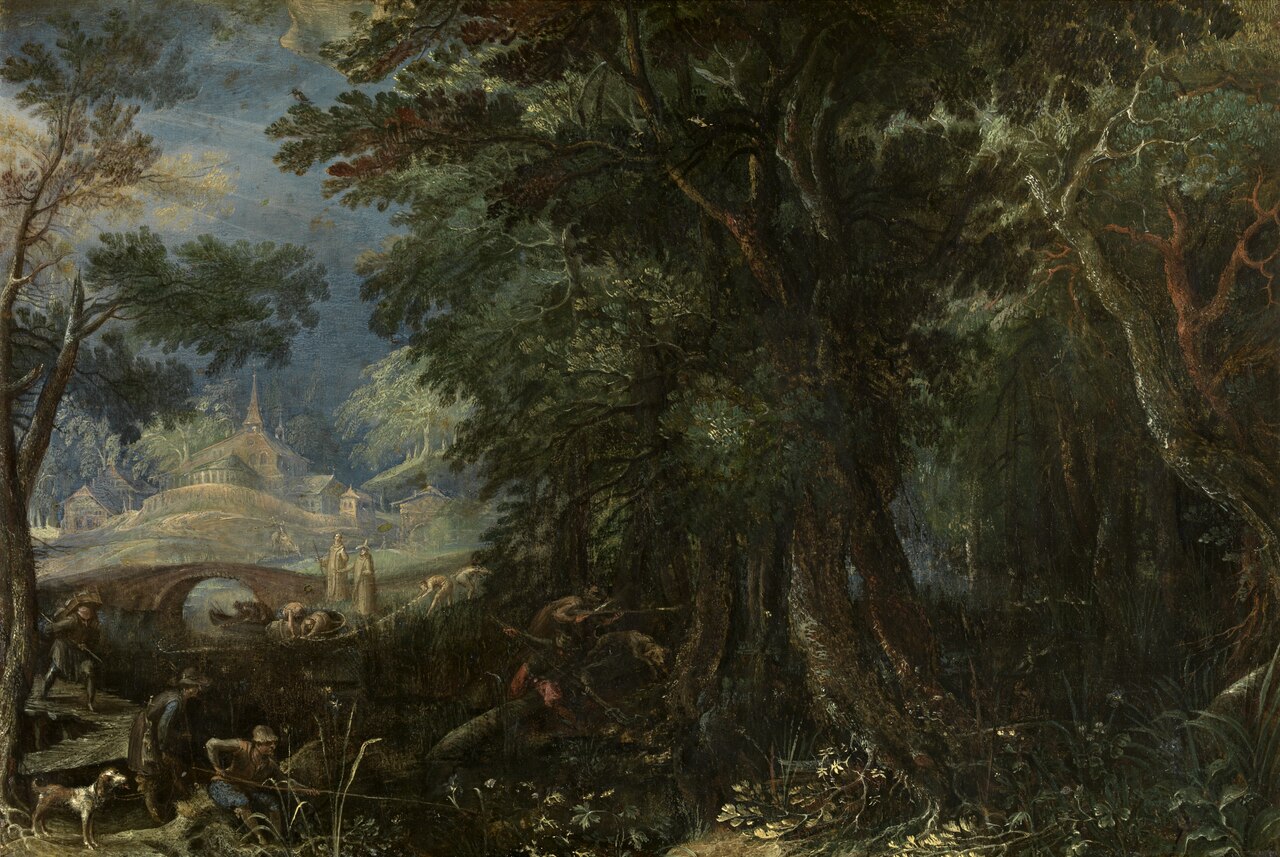
Career and style In the late sixteenth century Frederik left the Dutch‑speaking region for the German lands, a move that was common among Flemish artists seeking patronage in the burgeoning courts of the Holy Roman Empire. He settled for a period in Augsburg and later in Nuremberg, where he remained active until his death in 1623. His oeuvre is characterised by a synthesis of imaginative invention and a keen observation of nature. The dominant style of his paintings is often described as late Mannerist: figures are placed within expansive, dramatic vistas, and the composition frequently employs exaggerated perspective and complex spatial arrangements.
While his paintings lean towards the fantastical, his drawings reveal a contrasting impulse toward topographical accuracy. In these works he rendered mountains, rivers and architectural elements with a level of detail that suggests direct observation, or at least a careful study of existing prints and travel sketches. This duality—imagined scenery in paint, realistic rendering in draughtsmanship—places van Valckenborch at a crossroads between the Mannerist imagination and the emerging naturalism of the early seventeenth century.
Signature techniques Van Valckenborch’s paintings are distinguished by several recurring techniques:
* Layered atmospheric perspective – He often used a gradation of colour and clarity to convey depth, with distant hills rendered in pale blues and greens, while foreground elements retain richer, more saturated tones. * Dynamic composition – Diagonal lines of rock formations or winding rivers guide the eye through the picture plane, creating a sense of movement that enhances narrative drama. * Integration of figures – Small, often biblical or mythological figures are incorporated into the landscape, serving both as focal points and as a means of populating the scene with human activity. * Detailed draughtsmanship – In his preparatory sketches, van Valckenborch employed fine hatching and cross‑hatching to model landforms, demonstrating a precise understanding of geological forms.
These methods allowed him to construct scenes that were both visually compelling and intellectually engaging, appealing to patrons who prized both decorative beauty and scholarly curiosity.
Major works The following works illustrate the range of van Valckenborch’s practice:
* Fields on a mountainside (1598) – This early mature work shows a sweeping hillside dotted with cultivated fields, a small village, and distant peaks. The composition balances human activity with the grandeur of nature, a hallmark of his style. * Mountainous Landscape (1605) – In this painting the artist intensifies the dramatic effect of altitude, using steep rock faces and a turbulent sky to heighten emotional impact. The work exemplifies his late‑Mannerist penchant for theatrical scenery. * Landscape with a Shipwreck (1603) – Here van Valckenborch combines maritime disaster with a rugged coastline, juxtaposing the fragility of human endeavour against the indomitable forces of the sea and land. * Landscape (1606) – This piece presents a more tranquil setting, with a gentle river winding through a forested valley. The subtle use of light and colour demonstrates his ability to convey serenity within his expansive vistas. * Landscape with a river and trees (1625) – Although dated two years after his recorded death, this work is attributed to his workshop or a close follower. It retains the characteristic compositional structure and meticulous rendering of foliage that define van Valckenborch’s hand.
Each of these paintings reinforces his reputation for creating imaginative, yet convincingly detailed, environments that catered to the tastes of both courtly and civic patrons.
Influence and legacy Frederik van Valckenborch’s contribution to the development of landscape painting lies in his bridging of the Mannerist fantasy with a nascent naturalism. His emphasis on topographical detail anticipated the more scientific approach to landscape that would be embraced by Dutch Golden Age painters later in the seventeenth century. Moreover, his presence in German artistic centres helped disseminate Flemish techniques across the empire, influencing local artists who adopted his dramatic compositions and refined drawing methods.
Although he is less celebrated today than contemporaries such as Jan Brueghel the Elder, van Valckenborch’s works continue to be studied for their hybrid aesthetic and for the insight they provide into the cultural exchange between the Southern Netherlands and the German lands during a period of political and religious upheaval. Modern scholarship recognises his paintings as valuable exemplars of the transitional phase between late Renaissance Mannerism and early Baroque landscape art.
--- *This biography reflects current scholarly consensus and is based on documented works and historical records.*
Frequently asked questions
Who was Frederik van Valckenborch?
Frederik van Valckenborch (1565–1623) was a Flemish painter and draughtsman from Antwerp, renowned for his imaginative late‑Mannerist landscapes and detailed drawings, who worked mainly in Germany and died in Nuremberg.
What artistic style or movement is he associated with?
He is most closely linked to late Mannerism, combining dramatic, exaggerated compositions with a growing interest in realistic, topographically accurate rendering.
What are his most famous works?
Key works include *Fields on a mountainside* (1598), *Mountainous Landscape* (1605), *Landscape with a Shipwreck* (1603), *Landscape* (1606) and the workshop‑attributed *Landscape with a river and trees* (1625).
Why is Frederik van Valckenborch important in art history?
He bridges the gap between fantastical Mannerist scenery and the emerging naturalism of the seventeenth‑century landscape, influencing both Flemish and German artists and contributing to the evolution of topographical painting.
How can I recognise a van Valckenborch painting?
Look for expansive, dramatic vistas with steep rock formations, a muted atmospheric perspective, small narrative figures, and finely detailed foliage rendered with precise hatching in preparatory sketches.