Cornelis van Cleve
1520 – present
In short
Cornelis van Cleve (c.1520–?) was a Flemish Renaissance painter from Antwerp, noted for religious scenes and portraiture. He trained in his father Joos van Cleve’s workshop, spent a brief, unsuccessful period in London, and is remembered for works such as the Holy Family with Elisabeth and John the Baptist and The Adoration of the Magi.
Notable works


_-_M%C3%A4nnliches_Bildnis_in_schwarzem_Mantel_mit_Pelzkragen_-_1557_-_F%C3%BChrermuseum.jpg)

Early life Cornelis van Cleve was born in Antwerp around 1520 into a family already entrenched in the artistic life of the Southern Netherlands. His father, Joos van Cleve, was a prominent painter whose workshop was one of the most productive in the city. Growing up amid canvases, pigments and the bustling market for devotional images, Cornelis received his first instruction at the family studio. The apprenticeship system of the time meant that he learned the fundamentals of drawing, composition and the handling of oil paint directly from his father, absorbing the stylistic currents that characterised the Flemish Renaissance—particularly the rich colour palette and meticulous attention to detail that characterised the works of his contemporaries in Antwerp.
Career and style By the early 1540s Cornelis had begun to establish himself as an independent master. He continued to work in the familiar religious genre, producing altarpieces and devotional panels for local churches and private patrons. The exact chronology of his career is difficult to reconstruct because documentary evidence is scarce; however, references to a Cornelis van Cleve operating in Antwerp during the 1520s and 1530s suggest that he was active from a relatively young age.
Around the middle of the 16th century he travelled to London, a city that was then opening to continental artistic influences. The English court and its aristocratic patrons were keen to import the sophisticated visual language of the Low Countries, and several Flemish artists sought commissions there. Cornelis’s stay in London appears to have been brief and financially unrewarding; after a period of limited success he returned to the Low Countries. Contemporary accounts hint at a personal crisis that followed his return—he is said to have suffered a mental breakdown, after which he ceased painting. The precise nature of his illness is not documented, and the date of his death remains unknown.
Stylistically, Cornelis’s work reflects the transitional character of the mid‑Renaissance in the Southern Netherlands. He retained the luminous colourism and careful modelling of figures inherited from his father, while also incorporating a more dynamic compositional structure that anticipates the later Mannerist tendencies of the region. His portraits, though few, reveal a keen observational skill, capturing the textures of fabrics and the nuanced expressions of his sitters.
Signature techniques Cornelis favoured oil on panel, a medium that allowed for fine detail and subtle gradations of tone. His brushwork is typically tight in the rendering of faces and hands, while broader, more expressive strokes are used in drapery and background elements. He employed a layered glazing technique, building up thin translucent layers of pigment to achieve depth and a gentle luminosity, especially in flesh tones. Light often falls from the upper left, creating a chiaroscuro effect that highlights the central figures and gives a three‑dimensional presence to the scene. In his religious compositions, he frequently used a shallow, almost theatrical space, positioning the main figures against a relatively flat architectural backdrop, a choice that focuses the viewer’s attention on the narrative moment.
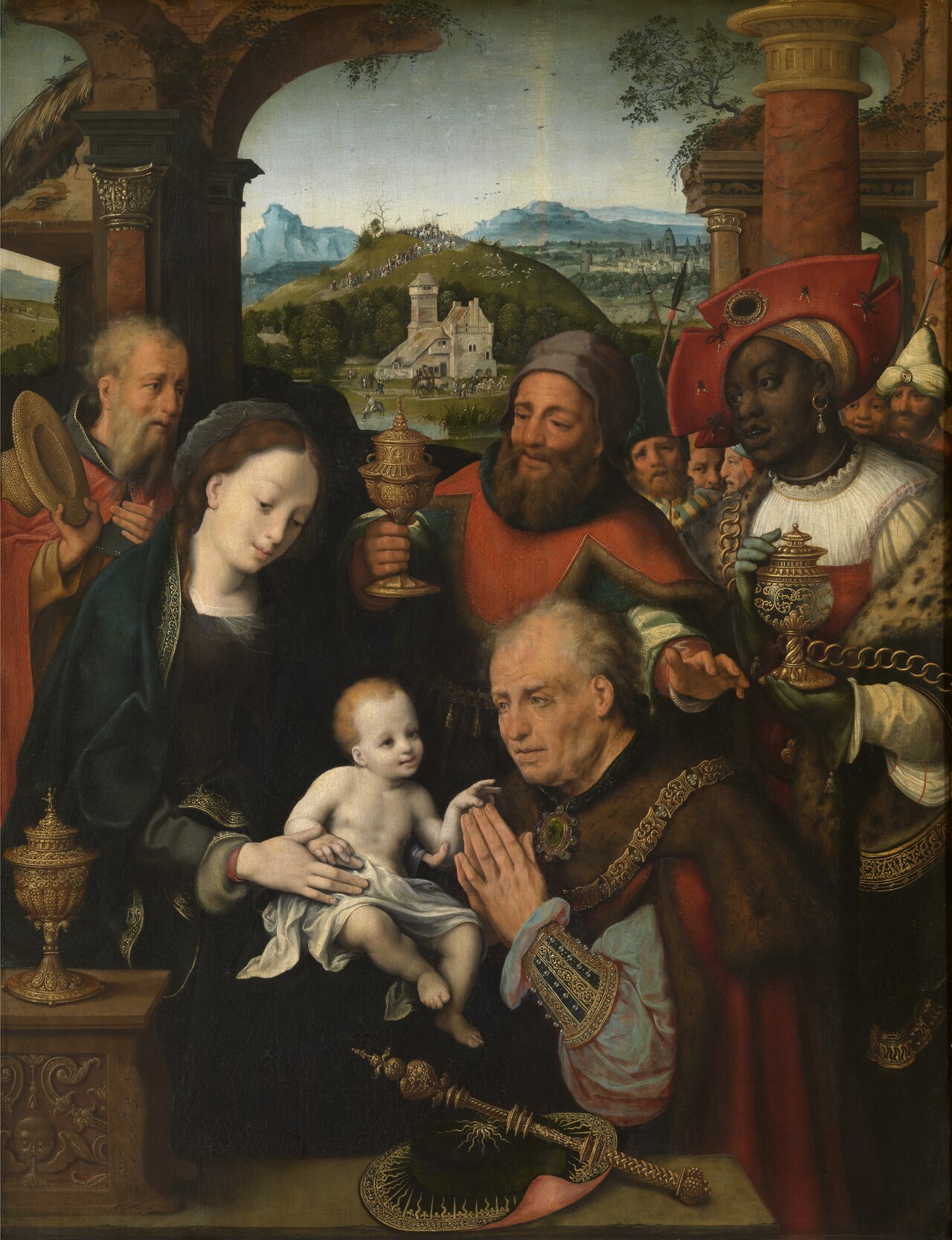
Major works - **Epitaph of Lodewijk Clarys and his Wife Marie le Batteur** – This funerary panel combines portraiture with symbolic elements typical of Flemish memorial art. The couple are rendered with dignified realism, while the surrounding motifs—such as a candle and a coat of arms—underscore their social status. - **Holy Family with Elisabeth and John the Baptist (1520)** – One of his earliest dated works, it presents a tender domestic scene. The composition centres on the Virgin and Child, flanked by Saint Elisabeth and a youthful John the Baptist, whose gestures create a sense of narrative anticipation. - **Portrait of a Man with Gloves (1520)** – A fine example of his portraiture, the sitter is depicted in half‑length, his gloved hand suggesting wealth and refinement. The meticulous rendering of the gloves demonstrates Cornelis’s skill in portraying texture. - **Madonna and Child (1550)** – This work shows a mature handling of colour, with a warm, golden background that contrasts with the delicate blues of the Virgin’s robe. The figures are imbued with a quiet serenity, reflecting the devotional purpose of the piece. - **The Adoration of the Magi (1564)** – Among his largest known compositions, it features a crowded, bustling scene of the three Magi presenting gifts to the Christ child. The painting showcases Cornelis’s ability to manage complex groupings while maintaining a clear focal point on the infant.
Influence and legacy Cornelis van Cleve occupies a peripheral yet intriguing position in the history of Flemish art. Though he never achieved the fame of his father or of contemporaries such as Pieter Bruegel the Elder, his works provide valuable insight into the artistic practices of mid‑16th‑century Antwerp. His paintings demonstrate how a second‑generation workshop artist could both preserve inherited techniques and experiment with emerging compositional ideas. The limited number of surviving works, combined with the scarcity of documentary evidence, has meant that his oeuvre is often overlooked in broader surveys of the period. Nevertheless, scholars of the Flemish Renaissance regard his religious panels as representative of the devotional trends that dominated the market, and his portraits as illustrative of the growing demand for personal likenesses among the mercantile elite.
In recent years, renewed interest in lesser‑known artists of the Northern Renaissance has led to a modest re‑evaluation of Cornelis’s contribution. Exhibitions focusing on the van Cleve family workshop have highlighted his role in sustaining the artistic reputation of Antwerp during a time of political and religious upheaval. While his premature withdrawal from painting curtailed his potential impact, the surviving works continue to attract attention for their technical proficiency and the subtle emotional resonance they convey.
Overall, Cornelis van Cleve remains a figure whose life story—marked by early promise, a brief foray abroad, and a tragic end—mirrors the uncertainties faced by many artists of his era. His paintings endure as quiet testaments to a skilled hand working within the vibrant artistic milieu of the Southern Netherlands.
Frequently asked questions
Who was Cornelis van Cleve?
Cornelis van Cleve (c.1520–?) was a Flemish Renaissance painter from Antwerp, known for religious scenes and portraits, and the son of the notable artist Joos van Cleve.
What artistic style or movement is he associated with?
He worked within the Flemish Renaissance tradition, blending his father’s colour‑rich approach with emerging dynamic compositions that foreshadowed early Mannerism.
What are his most famous works?
Key works include the Holy Family with Elisabeth and John the Baptist (1520), Portrait of a Man with Gloves (1520), Madonna and Child (1550), The Adoration of the Magi (1564) and the Epitaph of Lodewijk Clarys and his Wife Marie le Batteur.
Why is Cornelis van Cleve important in art history?
He exemplifies the second‑generation Flemish workshop artist, illustrating how familial studios sustained Antwerp’s artistic output and how personal circumstances could affect an artist’s career.
How can I recognise a painting by Cornelis van Cleve?
Look for tight brushwork on faces, a warm glazing technique that gives flesh a luminous quality, and compositions that place the main figures against relatively flat architectural backdrops with a clear light source from the upper left.