Cornelis Massijs
1508 – 1556
In short
Cornelis Massijs (1508–1556) was a Flemish Renaissance painter, draughtsman and engraver from Antwerp, best known for his pioneering landscape paintings that bridge the fantastical scenery of Joachim Patinir and the more naturalistic landscapes of later Netherlandish art.
Notable works
_Le_raccomodeur_de_soufflets.jpg)



Early life Cornelis Massijs was born in 1508 in Antwerp, a bustling centre of commerce and artistic activity in the Southern Netherlands. Little is recorded about his family background or early training, but the artistic environment of Antwerp—home to a thriving guild of painters and a vibrant market for prints—provided ample opportunity for an aspiring artist. It is presumed that Massijs apprenticed with a local master, absorbing the techniques of both panel painting and engraving that were common in the city’s workshops.
Career and style Massijs emerged as a professional artist in the 1520s, working as a painter, draughtsman and engraver. His oeuvre reflects the transitional nature of early‑16th‑century Netherlandish art. While the dominant landscape tradition was still dominated by the fantastical, panoramic vistas of Joachim Patinir, Massijs began to introduce a greater sense of observation and naturalism into his scenes. His landscapes often combine a detailed foreground populated with figures—sometimes biblical or genre subjects—with a more atmospheric, less exaggerated background. This balance signals a move toward the ‘pure landscape’ genre that would flourish later in the century.
Massijs was also active as an engraver, producing prints that circulated widely beyond Antwerp. His prints demonstrate a keen eye for line and a capacity to render texture, contributing to the diffusion of his compositional ideas throughout the Low Countries. Though specific details of his patronage are scarce, the presence of his works in both private and ecclesiastical collections suggests that he enjoyed the support of both civic and religious patrons.
Signature techniques Massijs’s paintings are characterised by several recurring technical traits:
* Layered atmospheric perspective – He employed progressively lighter tones and less defined outlines to convey depth, a technique that softened the dramatic cliffs and rock formations typical of earlier fantasy landscapes. * Integration of figures – Human and animal figures are placed deliberately within the landscape, often engaged in narrative activities that give the scene a moral or devotional context. * Fine hatching in engravings – His prints display meticulous cross‑hatching, allowing subtle gradations of light and shadow that enhance the three‑dimensionality of the depicted terrain. * Use of colour – In his painted works, Massijs favoured a muted palette of earthy greens, browns and ochres, punctuated by occasional vivid reds or blues in clothing or architectural details. * Attention to botanical detail – Trees, shrubs and foliage are rendered with a degree of realism that anticipates the more naturalistic approach of later Netherlandish landscape painters.
These techniques collectively mark Massijs as a bridge between the imaginative medieval tradition and the emerging observational style of the High Renaissance in the Netherlands.
Major works The surviving corpus of Massijs’s work is modest, but several pieces illustrate his artistic evolution:
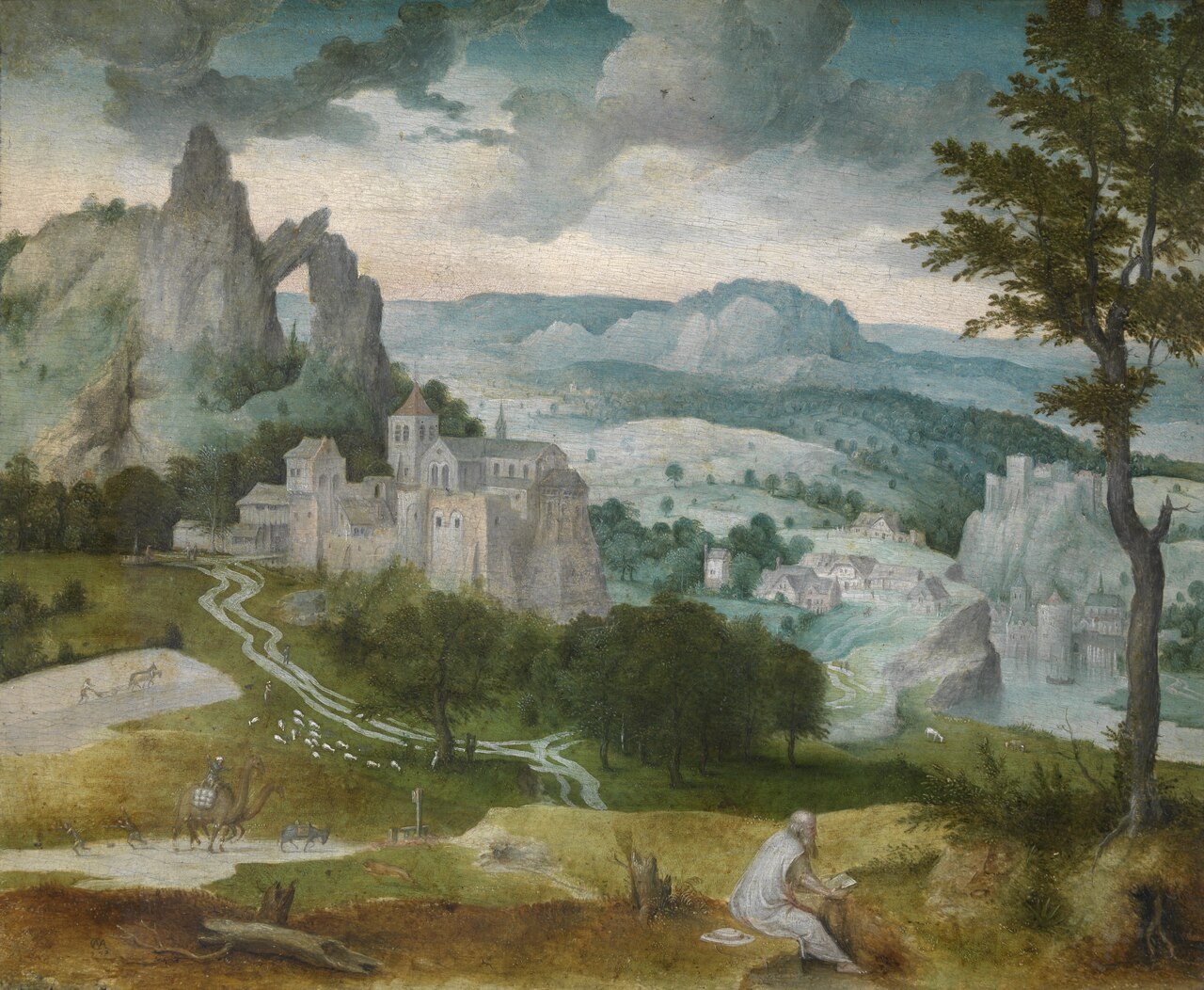
* The Bellows Repairer (c. 1560) – Although dated after Massijs’s recorded death in 1556, this work is commonly attributed to him, suggesting either a later dating error or post‑humous completion by a follower. The painting depicts a craftsman repairing a bellows, set within a modest interior that opens onto a tranquil landscape, exemplifying Massijs’s skill in genre scenes and his integration of everyday life with a broader natural setting. * The Temptation of Saint Anthony (c. 1550) – This composition presents the saint beset by grotesque demons amidst a barren, rocky terrain. The work reflects Massijs’s ability to blend narrative drama with his evolving landscape vocabulary, using stark contrasts and a muted palette to heighten the spiritual tension. * The Parable of the Prodigal Son (c. 1538) – A narrative painting that situates the biblical story within a detailed countryside. The foreground figures are rendered with careful attention to clothing and gesture, while the background recedes into a softly rendered horizon, illustrating the artist’s developing approach to depth. * Landscape with Saint Jerome (c. 1547) – In this piece, Saint Jerome is shown in a contemplative pose within a lush, rolling landscape. The work highlights Massijs’s mature handling of atmospheric perspective and his capacity to embed a solitary figure within a harmonious natural environment. * Landscape with the Flight to Egypt (c. 1550) – This painting combines a biblical episode with a sweeping, yet restrained, landscape. The composition balances the narrative action of the Holy Family’s departure with an expansive view of hills and trees, underscoring Massijs’s synthesis of story and scenery.
These works collectively demonstrate Massijs’s contribution to the early development of landscape painting in the Low Countries, as well as his versatility in handling religious, genre and mythological subjects.
Influence and legacy Cornelis Massijs occupies an important, if sometimes overlooked, position in the evolution of Netherlandish art. By moving away from the exaggerated, almost otherworldly panoramas of Patinir and introducing a more measured, observation‑based approach, he paved the way for later masters such as Pieter Bruegel the Elder and Joachim van den Velde, who would fully embrace the ‘pure landscape’ as an independent genre. His prints also played a role in disseminating these new compositional ideas across Europe, influencing artists who never saw his original panels.
Scholars recognise Massijs as a transitional figure whose work embodies the shift from medieval imagination to Renaissance realism in the northern tradition. While his name may not be as widely known as some of his contemporaries, his contributions to landscape painting and his skillful integration of narrative and environment remain vital to understanding the trajectory of Flemish art in the 16th century.
--- *Cornelis Massijs died sometime after 1556; the exact location of his death remains unknown.*
Frequently asked questions
Who was Cornelis Massijs?
Cornelis Massijs (1508–1556) was a Flemish Renaissance painter, draughtsman and engraver from Antwerp, celebrated for his early landscape paintings that link the fantastical scenery of Patinir with later Netherlandish naturalism.
What style or movement is he associated with?
Massijs worked in the Northern Renaissance, pioneering a more observational landscape style that moved away from the fantastical panoramas of early 16th‑century Flemish art toward a naturalistic ‘pure landscape’ approach.
What are his most famous works?
Among his notable works are *The Temptation of Saint Anthony* (c. 1550), *Landscape with Saint Jerome* (c. 1547), *Landscape with the Flight to Egypt* (c. 1550), *The Parable of the Prodigal Son* (c. 1538) and the genre piece *The Bellows Repairer* (c. 1560, attribution uncertain).
Why does Cornelis Massijs matter in art history?
He is regarded as a key figure in the transition from the imaginative, fantastical landscapes of the early 1500s to the more realistic, nature‑focused landscapes that defined later Netherlandish painting, influencing artists such as Pieter Bruegel the Elder.
How can I recognise a Massijs painting?
Look for a balanced composition that places narrative figures within a gently receding landscape, characterised by muted earth tones, careful atmospheric perspective, fine hatching in any print elements, and a realistic rendering of trees and terrain.