Abraham Genoels
1640 – 1723
In short
Abraham Genoets (1640–1723) was a Flemish Baroque painter, draughtsman, engraver and tapestry designer, best known for his landscape paintings and prints. He worked in Antwerp, Paris and Rome, blending classical compositional ideals with the naturalism of the Dutch Golden Age.
Notable works



Early life Abraham Genoets was born in 1640 in Antwerp, a city that was then a thriving centre of artistic production in the Southern Netherlands. His family was part of the city's middle class; his father was a merchant who encouraged his son's early interest in drawing. Genoets received his first artistic training in the workshop of a local master, where he learned the fundamentals of drawing, composition and the handling of oil paint. The vibrant artistic milieu of Antwerp, with its guild system and the legacy of Peter Paul Rubens, provided a fertile backdrop for his formative years.
Career and style Around the early 1660s Genoets left Antwerp for Paris, joining a community of Flemish expatriates who were drawn to the French capital's courtly patronage. In Paris he absorbed the decorative tastes of the French Baroque, while maintaining a close connection to the naturalistic landscape tradition of his native Flanders. By the late 1660s he had travelled to Rome, where he encountered the classicising landscape tradition of Annibale Carracci and the emerging works of the Bamboccianti. The Roman experience deepened his appreciation for classical architecture and mythological subject matter, which later appeared in his own compositions.
Returning to Antwerp in the 1680s, Genoets established a workshop that catered to both local and international clients. His output combined the dramatic chiaroscuro of the Baroque with a measured, almost academic, arrangement of elements. He often placed mythological or allegorical figures within expansive, carefully rendered natural settings, creating a dialogue between humanity and the environment. His style is characterised by a restrained palette of earth tones, delicate modelling of foliage, and a compositional balance that echoes the principles of classical architecture.
Signature techniques Genoets is noted for his meticulous draughtsmanship. He employed fine, controlled lines in his preparatory sketches, which he later translated into oil paintings with a soft, blended brushwork. In his prints, he favoured the etching technique, exploiting its capacity for subtle tonal variation to render atmospheric effects such as mist and distant light. A recurring technical hallmark is his use of a muted underpainting—often a warm ochre—upon which he built layers of translucent glazes, achieving depth and a luminous quality in the foliage and sky. His tapestry designs display a keen eye for pattern and repeat, integrating intricate foliage motifs with narrative scenes.
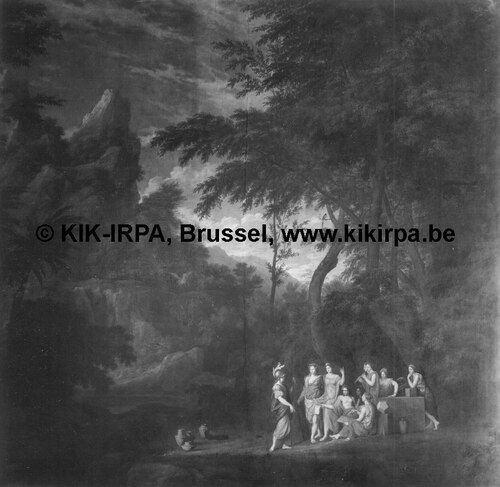
Major works - **Landscape with Diana Hunting (1685)** – This painting illustrates Genoets's skill in merging mythological narrative with a believable natural setting. The hunt unfolds in a forested valley, where the goddess Diana is depicted on horseback, accompanied by hounds. The composition balances the dynamic movement of the hunt with a tranquil background of rolling hills. - **Mountainous Landscape with a Monastery (1689)** – Here Genoets portrays a remote monastery perched atop a craggy peak. The work showcases his ability to render rugged terrain and atmospheric perspective, using cool blues and greys to convey altitude and distance. - **Landscape with Diana and Calliope (1696)** – In this later work Genoets pairs two classical figures—Diana and the muse Calliope—within a verdant landscape. The scene is structured around a central clearing, with a delicate play of light that highlights the figures while preserving the integrity of the surrounding foliage. - **Minerva and the Muses in a Landscape** – Although undated, this composition reflects Genoets's continued fascination with the integration of allegorical subjects into pastoral scenes. The goddess Minerva is shown in dialogue with the Muses, surrounded by a cultivated garden that hints at intellectual cultivation. - **Landscape with a Natural Arch (1718)** – One of his final dated works, this painting presents a striking natural arch as the focal point of the landscape. The arch, framed by towering trees, creates a compositional gateway that guides the viewer's eye deeper into the scene, demonstrating Genoets's mature handling of perspective.
Influence and legacy Abraham Genoets occupies a distinctive niche in the Baroque landscape tradition. By synthesising the naturalistic detail of Flemish painting with the classical compositional rigour he encountered in Italy, he contributed to a hybrid style that prefigured the later Rococo pastoral scenes of artists such as François Boucher. His prints circulated widely, influencing both contemporary landscape artists and later generations of draughtsmen. Genoets's tapestry designs also left an imprint on the decorative arts, where his delicate foliage patterns were repeatedly adapted. Although his name is less prominent today than that of his more famous Flemish contemporaries, scholars recognise him as a pivotal figure in the cross‑cultural exchange that shaped European landscape painting at the turn of the 18th century.
Frequently asked questions
Who was Abraham Genoets?
Abraham Genoets (1640–1723) was a Flemish Baroque painter, draughtsman, engraver and tapestry designer, celebrated for his landscape paintings and prints.
What artistic movement did he belong to?
He worked within the Baroque movement, combining dramatic lighting with classical compositional principles.
What are his most famous works?
His most noted paintings include *Landscape with Diana Hunting* (1685), *Mountainous Landscape with a Monastery* (1689), and *Landscape with a Natural Arch* (1718).
Why is he important in art history?
Genoets bridged Flemish naturalism and Italian classicism, influencing the development of European landscape painting and decorative arts in the 17th and early 18th centuries.
How can I recognise a Genoets landscape?
Look for a balanced composition that places mythological or allegorical figures within a meticulously rendered natural setting, marked by subtle tonal glazing, fine line work, and a muted earth‑tone palette.