Vilhelm Melbye
1824 – 1882
In short
Vilhelm Melbye (1824–1882) was a Danish marine painter of the Romantic era, renowned for his dramatic seascapes and coastal scenes that capture the atmosphere of Northern European waters. He worked across Denmark, the Baltic, and the British Isles, producing works that combine topographical accuracy with emotive colour and light.
Notable works


_-_Off_the_Shetlands_-_RCIN_406266_-_Royal_Collection.jpg)
_-_Cruising_in_the_Baltic_-_RCIN_406267_-_Royal_Collection.jpg)
Early life Vilhelm Melbye was born on 23 January 1824 in the historic port town of Helsingør, Denmark, a place intimately linked with maritime activity. His family background was modest, but the proximity of the Øresund Strait provided early exposure to ships, tides, and the play of light on water – elements that would later dominate his artistic output. Melbye displayed an aptitude for drawing from a young age, and his talent was recognised by local teachers who encouraged him to pursue formal training. In 1841 he entered the Royal Danish Academy of Fine Arts in Copenhagen, where he received a grounding in academic drawing, anatomy, and perspective. While the Academy’s curriculum emphasized historical and mythological subjects, Melbye gravitated toward the study of marine subjects, a niche that was gaining popularity among Danish artists seeking to celebrate their nation’s seafaring heritage.
Career and style After completing his studies, Melbye embarked on a series of study trips that broadened his visual vocabulary. In the late 1840s he travelled to Norway and the German coastal regions, sketching harbours, fishing villages, and the rugged shoreline. These journeys coincided with the rise of Romanticism in Denmark, a movement that privileged emotional intensity, dramatic weather, and the sublime power of nature. Melbye’s paintings reflect this sensibility through the use of turbulent skies, crashing waves, and stark contrasts between light and shadow. Yet he also retained a meticulous approach to detail, rendering ships and architectural elements with a near‑topographical accuracy that appealed to both connoisseurs and the wider public.
The 1850s saw Melbye expand his horizons to the British Isles. Visits to the Shetland Islands and the Scottish coast provided fresh subject matter and introduced him to the work of British marine painters such as J. M. W. Turner and William Callow. While he never adopted Turner’s abstracted approach, Melbye absorbed the British penchant for atmospheric effects, especially the rendering of fog and the muted palette of northern seas. Throughout his career he worked primarily in oil, though he also produced watercolour studies that served as preparatory sketches for larger compositions.
Melbye’s style is characterised by a synthesis of Romantic drama and documentary precision. He employed a relatively limited palette—deep blues, muted greys, and warm ochres—to convey the mood of a particular locale. The handling of paint varies across his oeuvre: in stormy scenes he applied thick impasto to suggest the physicality of waves, while calmer harbour views reveal smoother brushwork that emphasises the tranquil surface of water. His compositions often place a solitary vessel or a cluster of ships against a vast sky, underscoring the vulnerability of humanity before the elements.
Signature techniques Melbye’s most recognizable technique is his rendering of atmospheric light. He frequently captured the fleeting moments of sunrise or sunset, allowing the sun’s low angle to colour the clouds and reflect on the water’s surface. This effect is achieved through layered glazing, where thin translucent washes of colour are built up over a darker underpainting, producing depth and a luminous quality. Another hallmark is his attention to the rigging and hull forms of sailing vessels. By studying ship plans and consulting with sailors, Melbye ensured that the technical aspects of his ships were accurate, lending credibility to his romantic narratives.
A further device is the use of a foreground element—such as a rocky outcrop, a breakwater, or a low‑lying boat—to anchor the viewer’s eye before the eye is led into the expansive background. This compositional strategy creates a sense of scale and invites the viewer to imagine themselves standing on the shore, witnessing the scene. In works that depict stormy weather, Melbye often employs diagonal lines generated by the tilt of masts and the direction of wind‑driven waves, heightening the dynamism and tension of the composition.
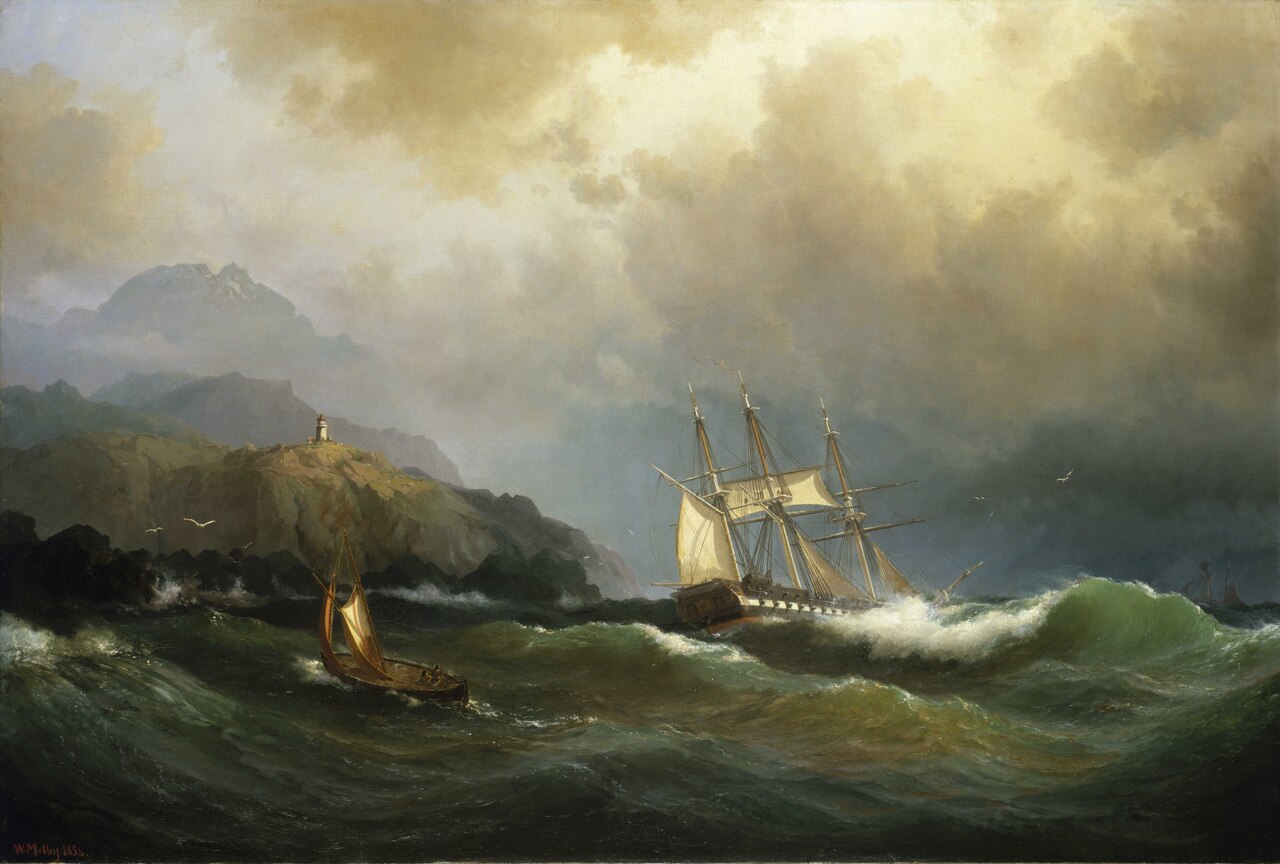
Major works - **En dansk lodsbåd i uroligt vejr. I baggrunden Kullen (1847)** – This early work demonstrates Melbye’s fascination with turbulent weather. A small Danish lugger battles a churning sea, while the distant Kullen cliffs provide a stark silhouette against a storm‑filled sky. The painting’s palette of dark blues and greys conveys the danger of the North Sea, and the meticulous rendering of the boat’s rigging underscores Melbye’s commitment to accuracy. - **Sea landscape with sailing boats (1868)** – Created later in his career, this piece shows a calmer horizon where several sailing vessels glide across a glassy sea. The subtle gradations of colour in the sky suggest a late‑afternoon light, and the reflective surface of the water demonstrates Melbye’s refined glazing technique. - **Off the Shetlands (1852)** – Inspired by his travels to the British Isles, this painting captures the rugged coastline of the Shetland archipelago. Jagged rocks rise from the sea, and a lone ship navigates the narrow channel. The work is notable for its atmospheric fog, which softens the outlines of the land and creates a sense of isolation. - **Cruising in the Baltic (1852)** – In this composition Melbye turns his attention back to the Baltic Sea, depicting a fleet of merchant vessels sailing under a clear sky. The composition is balanced, with the ships arranged in a gentle arc that leads the eye toward a distant horizon. The painting’s warm, golden tones reflect the calmer weather typical of summer cruising. - **A frigate clawing off a rocky coast (1858)** – This dramatic piece illustrates a warship forced against a steep, rocky shoreline under stormy conditions. The frigate’s towering masts lean against the wind, and the sea’s frothy crest crashes against the rocks. The tension between the massive vessel and the unforgiving coast exemplifies Melbye’s Romantic preoccupation with man versus nature.
These works collectively reveal Melbye’s range—from violent tempests to serene voyages—while maintaining a consistent focus on maritime subjects.
Influence and legacy Vilhelm Melbye occupies a distinctive place in 19th‑century Danish art. By marrying Romantic emotiveness with a systematic study of ships and coastal topography, he helped shape a national visual language that celebrated Denmark’s maritime identity. His paintings were widely exhibited at the Charlottenborg Spring Exhibition, and they found a market among naval officers, merchants, and the emerging middle class who prized depictions of their seafaring nation.
Melbye’s influence extended to younger Danish marine painters such as Anton Melbye (his brother) and Carl Frederik Aagaard, who adopted similar compositional strategies and atmospheric concerns. Although the rise of Impressionism in the latter part of the 19th century shifted artistic focus away from detailed marine realism, Melbye’s works continued to be reproduced in prints and postcards, ensuring his visual legacy persisted into the early 20th century.
In contemporary scholarship, Melbye is recognised not only for his artistic merit but also as a documentary source. His paintings provide valuable visual records of 19th‑century ship design, harbour infrastructure, and coastal landscapes that have since undergone significant change. Museums in Denmark, including the National Gallery of Denmark (Statens Museum for Kunst) and the Danish Maritime Museum, hold several of his works, and they remain a focal point for exhibitions on Romantic marine art.
Overall, Vilhelm Melbye’s dedication to portraying the sea’s power and beauty has secured his reputation as one of Denmark’s foremost marine painters, a status that endures in both academic study and public appreciation.
Frequently asked questions
Who was Vilhelm Melbye?
Vilhelm Melbye (1824–1882) was a Danish painter known for his Romantic‑style marine and coastal scenes.
What artistic movement did he belong to?
He worked within the Romantic movement, emphasising dramatic weather, emotive light, and the sublime power of the sea.
What are his most famous works?
Key paintings include *En dansk lodsbåd i uroligt vejr. I baggrunden Kullen* (1847), *Off the Shetlands* (1852), *Cruising in the Baltic* (1852), and *A frigate clawing off a rocky coast* (1858).
Why is Melbye important in art history?
He combined Romantic drama with precise ship detail, helping to define a distinctly Danish marine painting tradition that documented 19th‑century seafaring life.
How can I recognise a Vilhelm Melbye painting?
Look for dramatic northern maritime scenes, meticulous ship rigging, atmospheric light rendered through layered glazing, and a foreground element that frames a vast, often storm‑tossed sea.