Viggo Johansen
1851 – 1935
In short
Viggo Johansen (1851–1935) was a Danish painter renowned for his luminous interior scenes and his role as a leading member of the Skagen Painters. His work blends Danish realism with Impressionist influences and includes well‑known pieces such as 'Kitchen, with the artist’s Wife' and 'Evening Talk'.
Notable works

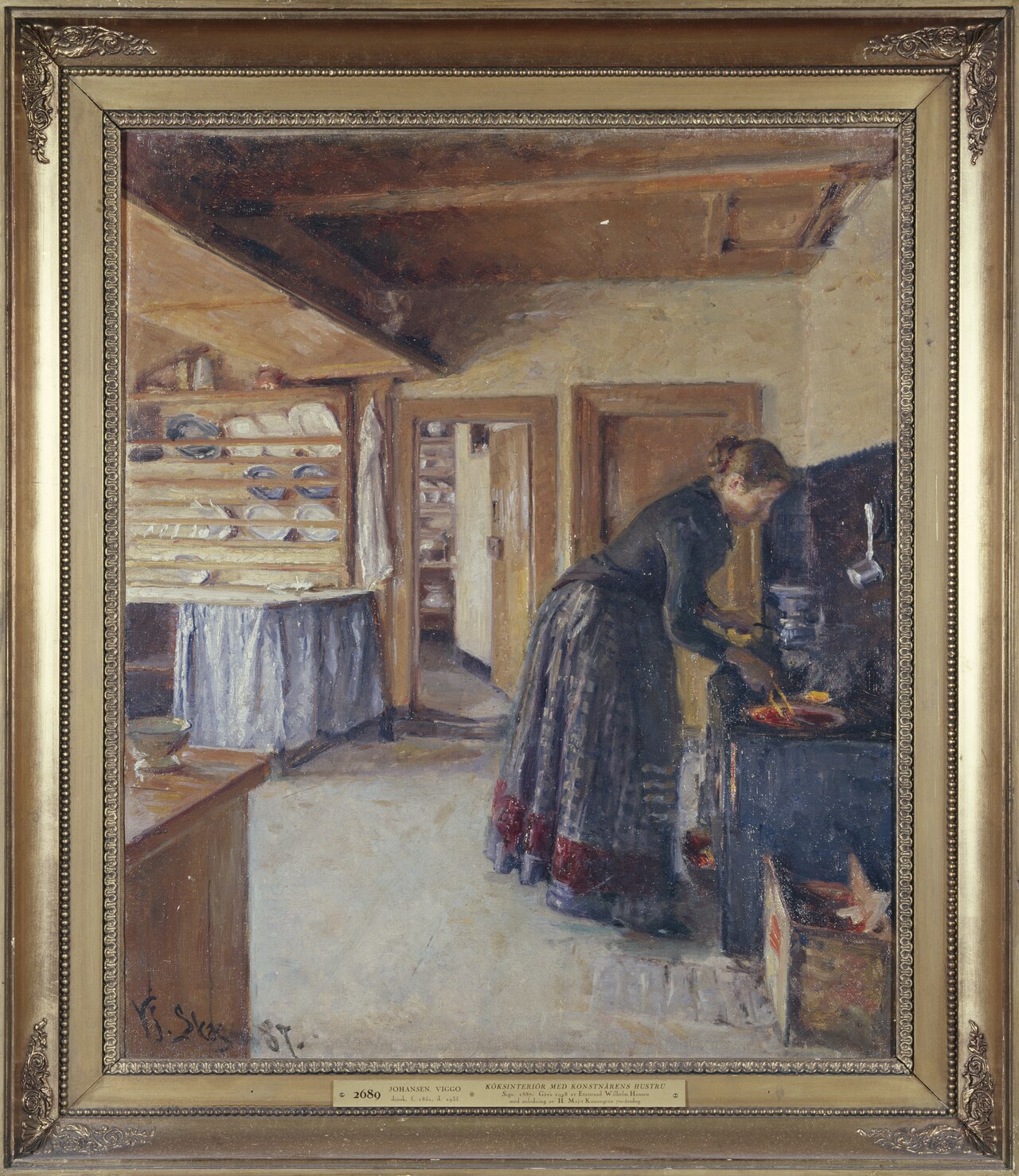
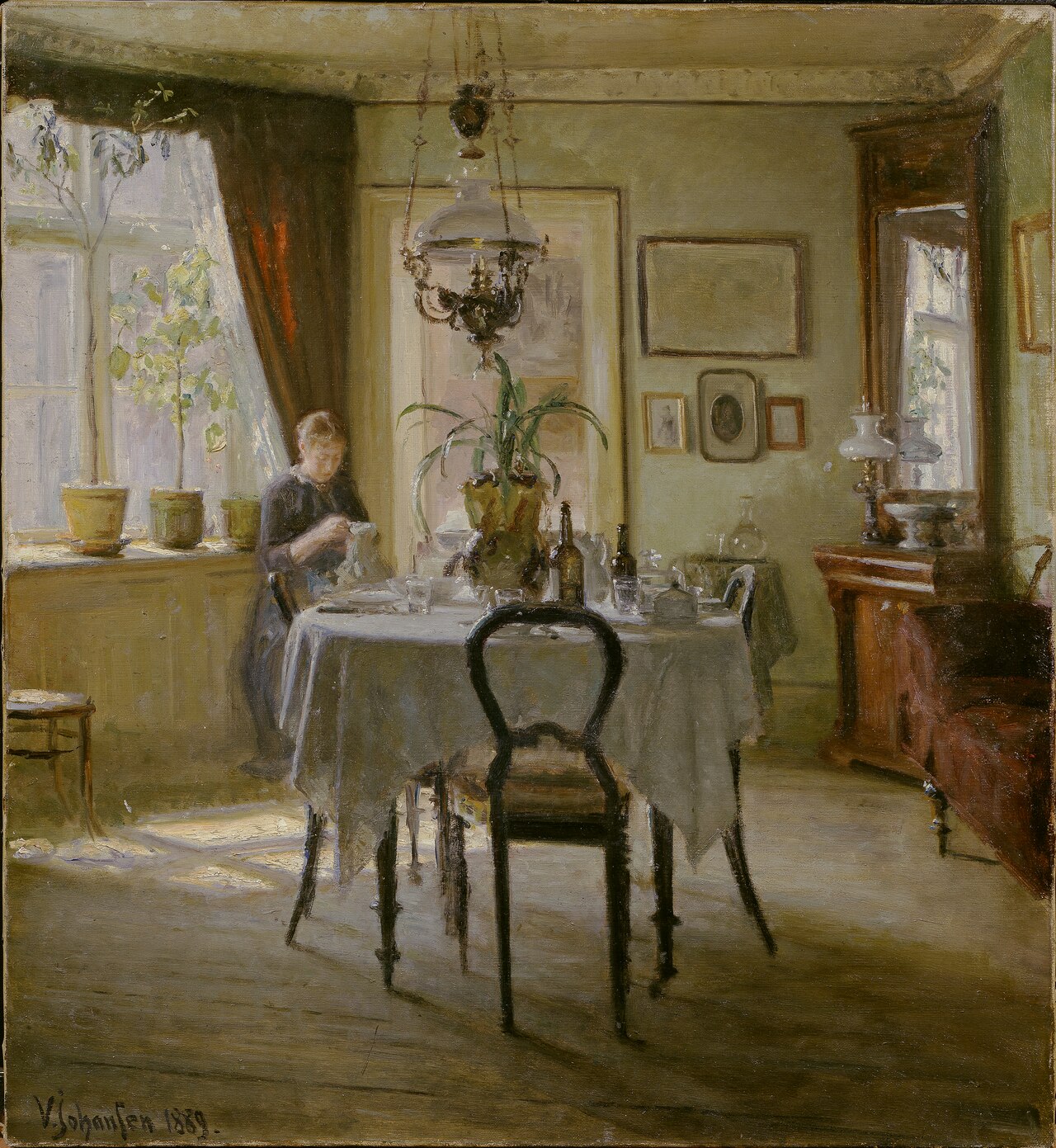


Early life Viggo Johansen was born in Copenhagen in 1851 into a middle‑class family. From a young age he displayed a talent for drawing, which was encouraged by his parents. He entered the Royal Danish Academy of Fine Arts in the early 1870s, where he received formal training in drawing, composition and the techniques of the Old Masters. His academic education provided a solid foundation in realism, but his exposure to contemporary European art would soon broaden his artistic outlook.
Career and style Johansen began exhibiting at the Charlottenborg Spring Exhibition in the late 1870s, quickly gaining recognition for his finely rendered genre scenes. In the 1880s he became a regular participant in the annual gatherings of the Skagen Painters, a loosely organised group of artists who worked together in the coastal village of Skagen each summer. The Skagen community, influenced by French Impressionism, encouraged an interest in natural light and plein‑air painting. Johansen adapted these ideas to interior subjects, focusing on domestic spaces where sunlight streamed through windows, creating a subtle interplay of light and shadow.
His mature style is characterised by a restrained colour palette, soft modelling of forms, and a careful observation of how light changes the appearance of objects. While his compositions retain a clear structure, his brushwork becomes increasingly loose, allowing surfaces to dissolve into atmospheric effects. Throughout his career Johansen balanced a respect for academic drawing with a desire to capture fleeting moments, positioning him between traditional Danish realism and the emerging modernist tendencies of the late 19th century.
Signature techniques Johansen’s paintings are distinguished by several recurring techniques. He often placed a strong light source—typically a window—at an angle that illuminated the interior, producing a warm, amber‑toned glow. He employed a layered application of paint, beginning with thin washes to establish colour temperature before building up more opaque areas. This approach allowed him to render the translucency of fabrics and the reflective quality of porcelain and glass.
His brushwork varies from delicate hatching in the rendering of textiles to broader, more expressive strokes in the treatment of shadows. Johansen also made frequent use of compositional framing, positioning figures near doorways or windows to guide the viewer’s eye through the space. The resulting balance between detail and suggestion gives his works a sense of immediacy while preserving a refined finish.
Major works - **Evening Talk (1886)** – This early work depicts a small group gathered around a table in a modest interior, illuminated by a single lamp. The painting exemplifies Johansen’s interest in social interaction and the subtle effects of artificial light, highlighting his skill in rendering both the figures’ expressions and the surrounding objects. - **Kitchen, with the artist’s Wife (1887)** – One of his most celebrated domestic scenes, it shows his wife, Martha, engaged in kitchen work while sunlight pours through a window. The composition balances the bustling activity of the kitchen with a tranquil, light‑filled atmosphere, illustrating Johansen’s ability to combine narrative content with a study of light. - **Sunlight in the Dining‑room (1889)** – In this piece the dining room is bathed in bright daylight that filters through large panes, casting gentle shadows across a polished table and upholstered chairs. The work demonstrates his mastery of colour modulation, with warm yellows contrasting against cooler blues, and underscores his fascination with the way sunlight transforms interior spaces. - **A Cowshed (1894)** – Departing from his usual domestic interiors, Johansen turned his attention to a rural setting, portraying a simple cowshed suffused with soft daylight. The painting retains his characteristic focus on light, yet the subject matter reflects a broader interest in everyday Danish life beyond the urban home. - **An Artist's Gathering (1903)** – This later work brings together several artists in a studio environment, illuminated by both natural light and studio lamps. The composition celebrates the camaraderie of the Skagen community while allowing Johansen to explore complex lighting scenarios, merging multiple light sources to create depth and ambience.
Influence and legacy Viggo Johansen emerged as one of Denmark’s most prominent painters in the 1890s, and his contributions helped shape the direction of Danish modern art. His integration of Impressionist light effects into traditionally Danish subject matter offered a new visual language that influenced younger artists, particularly those interested in domestic genre painting. Johansen also taught at the Royal Danish Academy of Fine Arts, where he passed on his technical knowledge and emphasis on observation to a new generation of painters.
His works are held in major Danish institutions, including the Statens Museum for Kunst, and continue to be featured in exhibitions that explore the Skagen Painters and the development of Scandinavian Impressionism. Today, Johansen is recognised for his subtle yet powerful renderings of everyday life, his nuanced handling of light, and his role in bridging 19th‑century realism with early modernist tendencies.
Frequently asked questions
Who was Viggo Johansen?
Viggo Johansen (1851–1935) was a Danish painter noted for his luminous interior scenes and his active participation in the Skagen Painters collective.
What style or movement is his work associated with?
His paintings combine Danish realism with the light‑focused techniques of French Impressionism, placing him between traditional realism and early modernist trends.
What are his most famous works?
Key works include 'Kitchen, with the artist’s Wife' (1887), 'Sunlight in the Dining‑room' (1889), 'Evening Talk' (1886), 'A Cowshed' (1894) and 'An Artist's Gathering' (1903).
Why is he important in art history?
Johansen helped introduce Impressionist light effects to Danish genre painting, influencing later Scandinavian artists and cementing his reputation as one of Denmark’s leading painters of the late 19th century.
How can you recognise a Viggo Johansen painting?
His works are marked by interior scenes bathed in natural or soft artificial light, careful colour modulation, and a balance of detailed modelling with loose brushwork that captures fleeting atmospheric effects.