Thorald Læssøe
1816 – 1878
In short
Thorald Læssøe (1816–1878) was a Danish landscape painter of the Golden Age, best known for his Italian and Central European vistas. His works, including several held by the National Gallery of Denmark, exemplify a careful observation of light and atmosphere.
Notable works
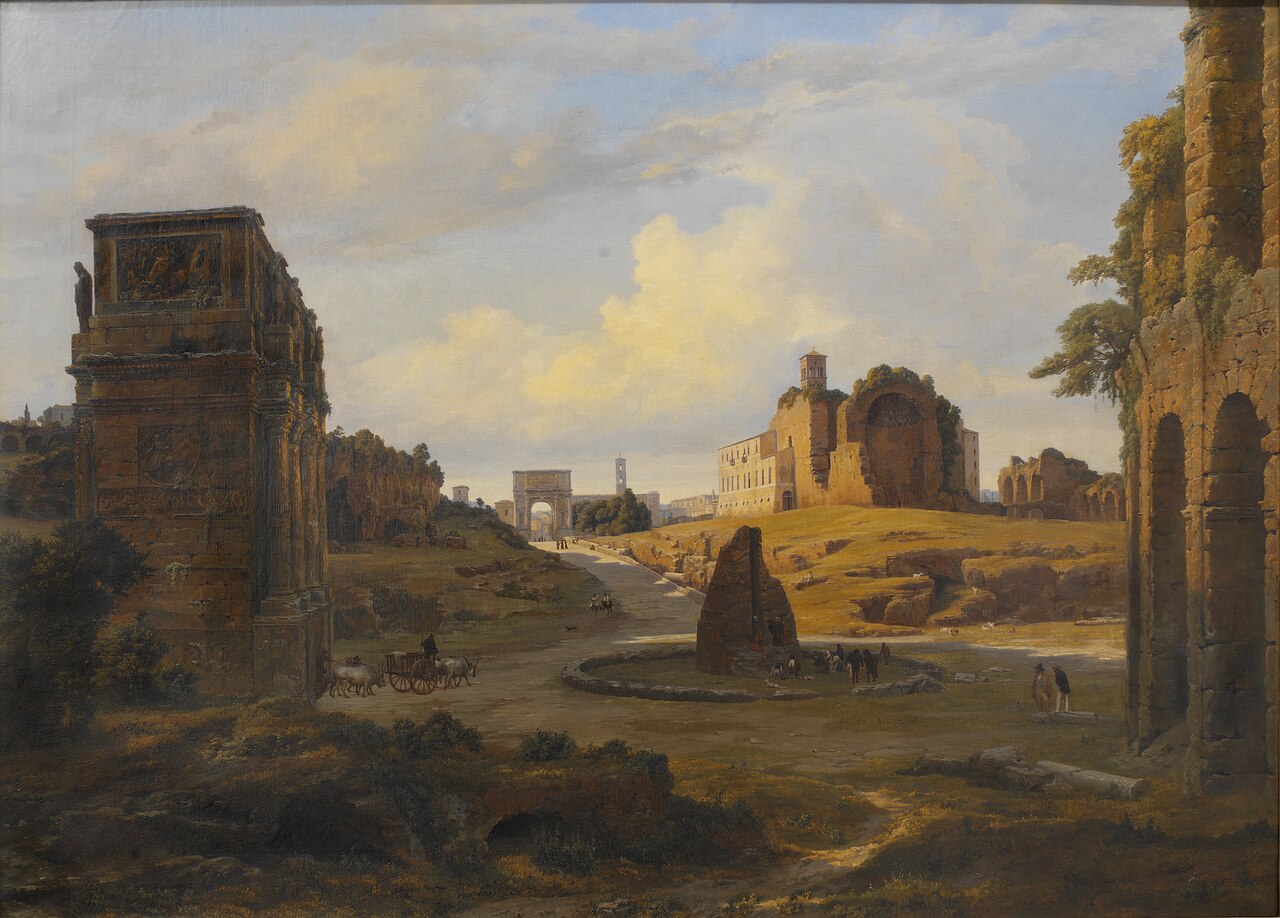


Early life Thorald Læssøe was born in 1816 in the coastal town of Frederikshavn, in the northern reaches of the Kingdom of Denmark. Little is recorded about his family background, but the maritime environment of his birthplace left an early imprint on his visual sensibility. Growing up amid the shifting skies and sea‑spray of the North Sea, Læssøe developed a keen eye for natural light, a trait that would later become a hallmark of his landscape paintings. As a young man he moved to Copenhagen, the cultural centre of Denmark, where he joined the circle of artists who were shaping the Danish Golden Age—a period marked by a flourishing of national art, literature and science.
Career and style Læssøe’s artistic career unfolded during a time when Danish painters were increasingly drawn to the study of nature en plein air, yet still adhered to the academic standards of composition and drawing. Although his exact training is not documented, it is reasonable to infer that he received a conventional art education, likely at the Royal Danish Academy of Fine Arts, which was the principal institution for aspiring painters of his generation. This background equipped him with a solid grounding in figure drawing, perspective, and colour theory, enabling him to translate his observations of the natural world into disciplined yet expressive canvases.
The painter’s oeuvre is characterised by a restrained palette, careful modelling of atmospheric effects, and a compositional balance that conveys both the immediacy of a specific moment and a timeless sense of place. Unlike some of his contemporaries who pursued overtly romantic or heroic narratives, Læssøe preferred a more observational approach, rendering his subjects with a quiet reverence. His landscapes often foreground the play of light—whether the soft dawn on a Mediterranean harbour or the crisp, clear air of a Central European vista—while maintaining a fidelity to topographical detail that reflects his careful study of the sites he visited.
Signature techniques Læssøe’s technique combined meticulous underdrawing with layered glazes of oil paint, a method that allowed him to build depth gradually. He typically began with a thin, tonal sketch to establish the composition, then applied successive layers of colour, each thin enough to let the underlying tones influence the final effect. This glazing approach produced a luminous quality, especially evident in his depictions of water and sky. He also employed a limited yet nuanced colour range, favouring earth tones, muted greens, and subtle blues, which he modulated to capture the atmospheric conditions of each locale.
Another recurring device in his work is the use of architectural elements—such as ancient ruins, observatories, or distant towers—to provide a sense of scale and to anchor the viewer’s perspective. By positioning these structures within expansive natural settings, Læssøe highlighted the dialogue between human achievement and the enduring landscape. His brushwork varies between tight, controlled passages for architectural detail and looser, more fluid strokes for foliage and clouds, demonstrating his ability to adapt his hand to the demands of each subject.
Major works Læssøe’s most documented paintings illustrate the geographical breadth of his travels and the consistent quality of his observation. "Udsigt ved Tycho Brahes observatorium i Prag" (1843) captures a view of the historic observatory in Prague, rendered with a cool, crystalline atmosphere that underscores the scientific heritage of the site. Three years later, "View towards Ariccia and the Palazzo Chigi and S. Maria dell'Assunzione, Italy" (1845) presents an Italian hill town bathed in the warm glow of late afternoon, where the delicate rendering of stone façades contrasts with the verdant surrounding hills.
In 1848, Læssøe turned his attention to the ancient heart of Rome with "View towards Forum Romanum from the Colosseum," a composition that juxtaposes the monumental ruins of the Forum with the iconic silhouette of the Colosseum, emphasizing the layered history of the city. His fascination with the Mediterranean continued in 1851, when he produced two complementary canvases of Capri’s Marina Piccola—"Afternoon Light" and "Morning Light." These works demonstrate his acute sensitivity to temporal changes in illumination; the afternoon piece glows with golden warmth, while the morning version is suffused with a cooler, more delicate light, each capturing a distinct mood of the same harbour.
All of the aforementioned paintings are part of the collection of the National Gallery of Denmark, affirming Læssøe’s standing within the Danish artistic canon. The gallery’s holdings also include several smaller studies and sketches, which reveal his process of rendering landscape on site before translating it into finished oil paintings.
Influence and legacy While Thorald Læssøe never achieved the fame of some of his Golden Age peers, his work contributes a valuable perspective on the Danish engagement with European travel and landscape painting. By documenting sites across Central and Southern Europe, he broadened the visual vocabulary of Danish art beyond the familiar Danish countryside, introducing audiences to the visual language of Roman ruins, Bohemian observatories, and the luminous coasts of Italy.
His disciplined approach to light and atmosphere anticipated later developments in Scandinavian landscape painting, where a careful modulation of colour and tone became central to the expression of northern light. Moreover, his paintings continue to serve as reference points for scholars studying the diffusion of artistic ideas across Europe in the mid‑nineteenth century. The preservation of his major works in the National Gallery of Denmark ensures that his contribution to the visual record of European sites remains accessible to both the public and researchers.
In contemporary exhibitions, Læssøe’s canvases are often positioned alongside those of his Danish contemporaries to illustrate the diversity of approaches within the Golden Age. Though his name may not be as widely recognised as some of his peers, his paintings endure as quiet yet compelling testimonies to the power of observation, the allure of travel, and the timeless appeal of landscape as a vehicle for artistic expression.
Frequently asked questions
Who was Thorald Læssøe?
Thorald Læssøe (1816–1878) was a Danish landscape painter of the Golden Age, known for his depictions of European vistas, particularly in Italy and Central Europe.
What style or movement is Læssøe associated with?
He worked within the Danish Golden Age tradition, employing a restrained palette and careful observation of light, without a distinct, named movement.
What are his most famous works?
His best‑known paintings include "View towards Forum Romanum from the Colosseum" (1848), "View towards Ariccia and the Palazzo Chigi and S. Maria dell'Assunzione" (1845), and the twin Capri scenes "Marina Piccola: Afternoon Light" and "Marina Piccola: Morning Light" (both 1851).
Why does Thorald Læssøe matter in art history?
Læssøe broadened Danish landscape painting by documenting foreign sites, influencing later Scandinavian artists’ treatment of light and atmosphere, and his works remain in the National Gallery of Denmark.
How can I recognise a painting by Thorald Læssøe?
Look for meticulous compositional balance, a limited but nuanced colour palette, subtle glazing that creates luminous skies and water, and the inclusion of architectural landmarks within expansive natural settings.