Theodor Philipsen
1840 – 1920
In short
Theodor Philipsen (1840–1920) was a Danish painter renowned for his naturalistic landscapes and animal studies, often depicting rural scenes with a keen eye for light and atmosphere. Born and died in Copenhagen, he worked across Europe and North Africa, producing works such as coastal views of Italy and pastoral scenes from Denmark.
Notable works



Early life Theodor Esbern Philipsen was born in Copenhagen on 22 February 1840 into a family of Jewish ancestry. His upbringing in the capital of the Kingdom of Denmark exposed him to a vibrant cultural milieu, and he received his first artistic instruction at the Royal Danish Academy of Fine Arts. While details of his family background remain limited, records indicate that his early education combined traditional academic drawing with an interest in the natural world, a duality that would shape his later work.
Career and style After completing his formal studies, Philipsphens embarked on a career that blended academic training with a growing fascination for plein‑air painting. Throughout the 1860s and 1870s he travelled extensively, visiting Italy, France and the Mediterranean. These journeys introduced him to Impressionist ideas emerging in France, yet he retained a distinctly Northern European sensibility. His mature style is characterised by a restrained palette, careful observation of light, and a focus on everyday rural life. He favoured realistic representation over overt romanticism, often portraying animals and landscapes with a calm, almost detached composure.
Philipsen’s subjects ranged from coastal vistas to agrarian scenes. He frequently painted the Danish countryside, especially the islands surrounding Copenhagen, capturing the subtle shifts of weather and the interplay of water and sky. His work also reflects an interest in the exotic, as seen in paintings created during his trips to Tunisia and Italy, where he recorded local architecture and wildlife with the same measured observation applied to his Danish subjects.
Signature techniques Philipsen’s technique combined disciplined drawing with a loose handling of paint. He typically prepared his compositions with careful sketches, then applied colour in thin, translucent layers to build atmosphere. His brushwork, while controlled, often conveyed the texture of foliage, water, and animal fur through short, overlapping strokes. Light plays a central role in his paintings; he frequently employed a muted tonal range to suggest overcast conditions, allowing subtle tonal variations to convey depth.
In addition to oil on canvas, Philipsen worked in wax and clay for small figurative studies, demonstrating his versatility and interest in three‑dimensional form. These sculptural works, though less widely known, reveal a keen understanding of anatomy and an ability to capture fleeting gestures, traits that also inform his painted figures.
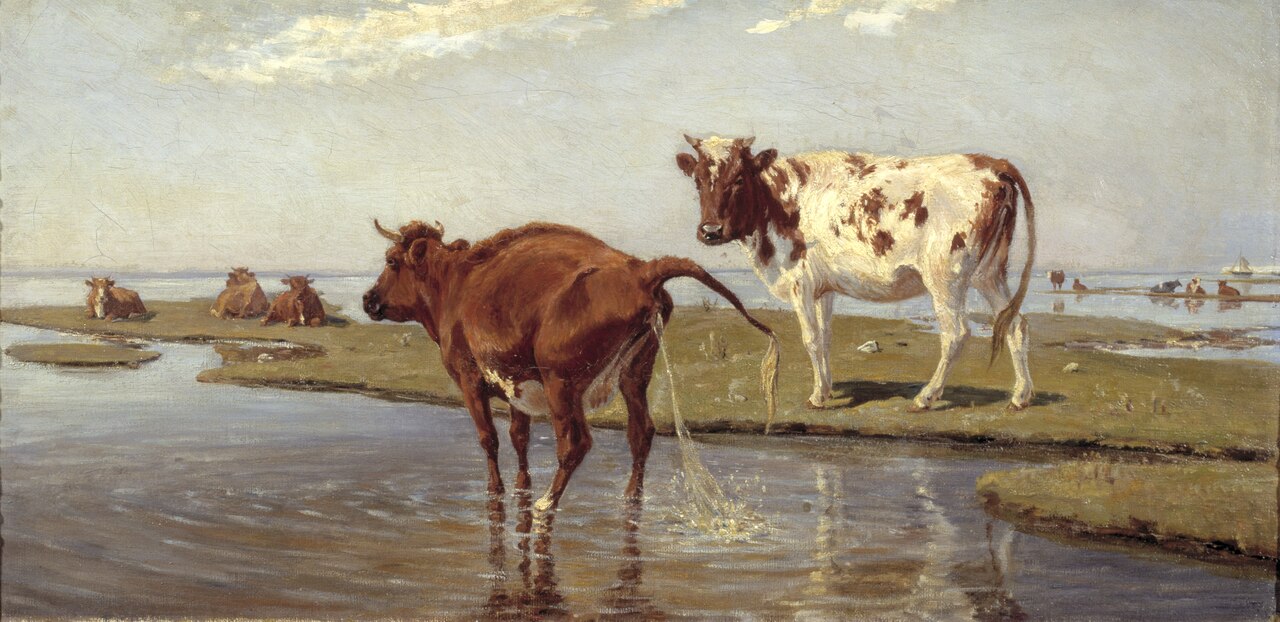
Major works - **A coastline. Amalfi, Italy (1878)** – Executed during a Mediterranean tour, this painting presents the rugged Amalfi coast under a diffused sky. Philipsen’s restrained palette captures the rocky shorelines and sea foam, highlighting his skill in rendering atmospheric effects. - **Camels in a Street in Tunisia (1882)** – Produced after a visit to North Africa, the work depicts a bustling Tunisian street populated with camels and local figures. The composition balances the exotic subject matter with Philipsen’s characteristic calm observation, using warm earth tones to convey the region’s light. - **Isola del Liri, Italy. Overcast Day (1883)** – This landscape features the Italian island under a cloudy sky, employing Philipsen’s signature muted tones to evoke a sense of quietude. The painting demonstrates his ability to translate the mood of an overcast day into subtle colour shifts. - **The Milking Place at Meilgård (1884)** – Returning to Denmark, Philipsen recorded a rural dairy scene with meticulous detail. The work showcases his interest in animal portraiture, capturing cows at work with a realistic yet gentle approach. - **Cows on Saltholm (1885)** – Set on the island of Saltholm in the Øresund, this painting presents a herd of cows against a flat, watery horizon. The composition emphasizes the relationship between land and water, and the subdued lighting underlines the tranquility of the scene.
These works illustrate Philipsen’s consistent focus on natural light, rural labour, and the quiet dignity of everyday subjects, whether rendered in the Danish countryside or abroad.
Influence and legacy Theodor Philipsen occupied a unique position in Danish art, bridging the academic tradition of the Royal Academy with emerging modernist tendencies. His dedication to observing light and atmosphere anticipated aspects of Impressionism, yet his restraint kept his work grounded in realism. Contemporary Danish painters admired his disciplined approach to plein‑air studies, and his animal portraits contributed to a broader appreciation of rural life in art.
In later decades, Philipsen’s paintings were exhibited in major Danish institutions, reinforcing his reputation as a leading figure in landscape and animal painting. His influence extended to early 20th‑century artists who sought to combine naturalistic detail with a more expressive handling of colour and light. Though not as widely known internationally as some of his French counterparts, Philipsen remains an important reference for scholars studying the development of Scandinavian naturalism and the cross‑cultural exchanges that shaped European art in the late 19th century.
Today, his works are held in the collections of the Statens Museum for Kunst in Copenhagen and other European museums, where they continue to be examined for their technical mastery and quiet, observational style. Philipsen’s legacy endures in the way he captured the subtle rhythms of the natural world, offering a nuanced perspective on the everyday scenes that define both Danish and broader European visual culture.
Frequently asked questions
Who was Theodor Philipsen?
Theodor Philipsen (1840–1920) was a Danish painter known for his naturalistic landscapes and animal portraits, working primarily in the late 19th century.
What artistic style or movement is he associated with?
Philipsen is linked to naturalism and early modernist tendencies; his work reflects a restrained realism influenced by plein‑air painting and hints of Impressionism.
Which of his works are most famous?
Among his notable paintings are *A coastline. Amalfi, Italy* (1878), *Camels in a Street in Tunisia* (1882), *The Milking Place at Meilgård* (1884), and *Cows on Saltholm* (1885).
Why does Philipsen matter in art history?
He bridged academic Danish tradition with emerging modernist approaches, influencing later Scandinavian artists and contributing to the development of naturalistic landscape painting.
How can I recognise a Philipsen painting?
Look for calm, realistic scenes of rural life, muted colour palettes, careful observation of light, and a balanced composition that often features animals or quiet landscapes.