Placido Costanzi
1702 – 1759
In short
Placido Costanzi (1702–1759) was a Roman painter of the late‑Baroque period whose religious and mythological canvases decorated many churches in Rome; he served as Principe of the Accademia di San Luca and taught artists such as Pietro Antonio Gualdi Lodrini.
Notable works

_MET_DP-12357-001.jpg)


Early life Placido Costanzi was born in Rome in 1702. Little is recorded about his family background, and his nationality is traditionally described simply as Italian, reflecting the common practice of identifying artists by the city of their activity rather than a modern nation‑state. He grew up amid the flourishing artistic environment of early‑18th‑century Rome, a city still dominated by the decorative exuberance of the Baroque. Early exposure to the works of masters such as Carlo Maratta and the decorative programmes of Roman churches likely shaped his initial artistic education.
Career and style Costanzi established himself as a painter of religious and historical subjects, working primarily for ecclesiastical patrons. His style bears the hallmarks of the late Baroque: vigorous movement, dramatic chiaroscuro, and a rich colour palette that emphasises spiritual intensity. While the precise trajectory of his training is not documented, his later election to the Accademia di San Luca suggests a solid grounding in academic drawing and composition. By the 1730s he was receiving commissions for altarpieces and decorative cycles, aligning his work with the Counter‑Reformation’s demand for emotionally resonant imagery.
His paintings combine the theatricality of Baroque narrative with a measured classicism that anticipates the more restrained Rococo sensibility emerging in the mid‑century. In his mythological scenes, Costanzi adopts a lyrical approach, softening the muscular dynamism of earlier Baroque heroes while retaining a sense of narrative momentum. This synthesis of drama and elegance became a distinguishing feature of his oeuvre.
Signature techniques Costanzi’s technique is characterised by several recurring elements:
1. Layered glazing – He built colour through multiple translucent layers, achieving a luminous depth that brings flesh tones and drapery to life. 2. Dynamic composition – Figures are often arranged in sweeping diagonal lines, creating a sense of movement that guides the viewer’s eye across the canvas. 3. Expressive lighting – Strong contrasts of light and shadow highlight the central action, a device inherited from Caravaggist influences but softened by a more refined handling of light. 4. Fine modelling of faces – Costanzi rendered facial expressions with subtle gradations, allowing saints and mythic characters alike to convey complex emotions. 5. Rich, saturated pigments – Deep blues, vermilion reds, and gold leaf accents appear frequently, enhancing the visual impact of his religious commissions.
These techniques, combined with his academic training, gave his works a polished finish that appealed to both ecclesiastical authorities and private collectors.
Major works Costanzi’s surviving oeuvre includes several notable pieces, many of which remain in Roman churches or museum collections.
- Alexander the Great Founding Alexandria (1736) – This historical canvas depicts the legendary founding of the Egyptian city. Costanzi balances the grandeur of the event with a clear narrative focus, using a radiant sky to underscore the destiny of the young ruler. The composition’s diagonal thrust and the careful rendering of exotic costumes illustrate his skill in integrating historical detail with Baroque drama.
- A Miracle of Saint Joseph of Cupertino (1750) – Though the title references a saint whose life predates Costanzi, the painting itself was executed in 1750. It portrays the saint’s levitation, a popular subject in Roman devotional art. Costanzi captures the miraculous ascent through a luminous atmosphere and a delicate handling of the saint’s ecstatic expression, reinforcing the spiritual awe associated with such miracles.
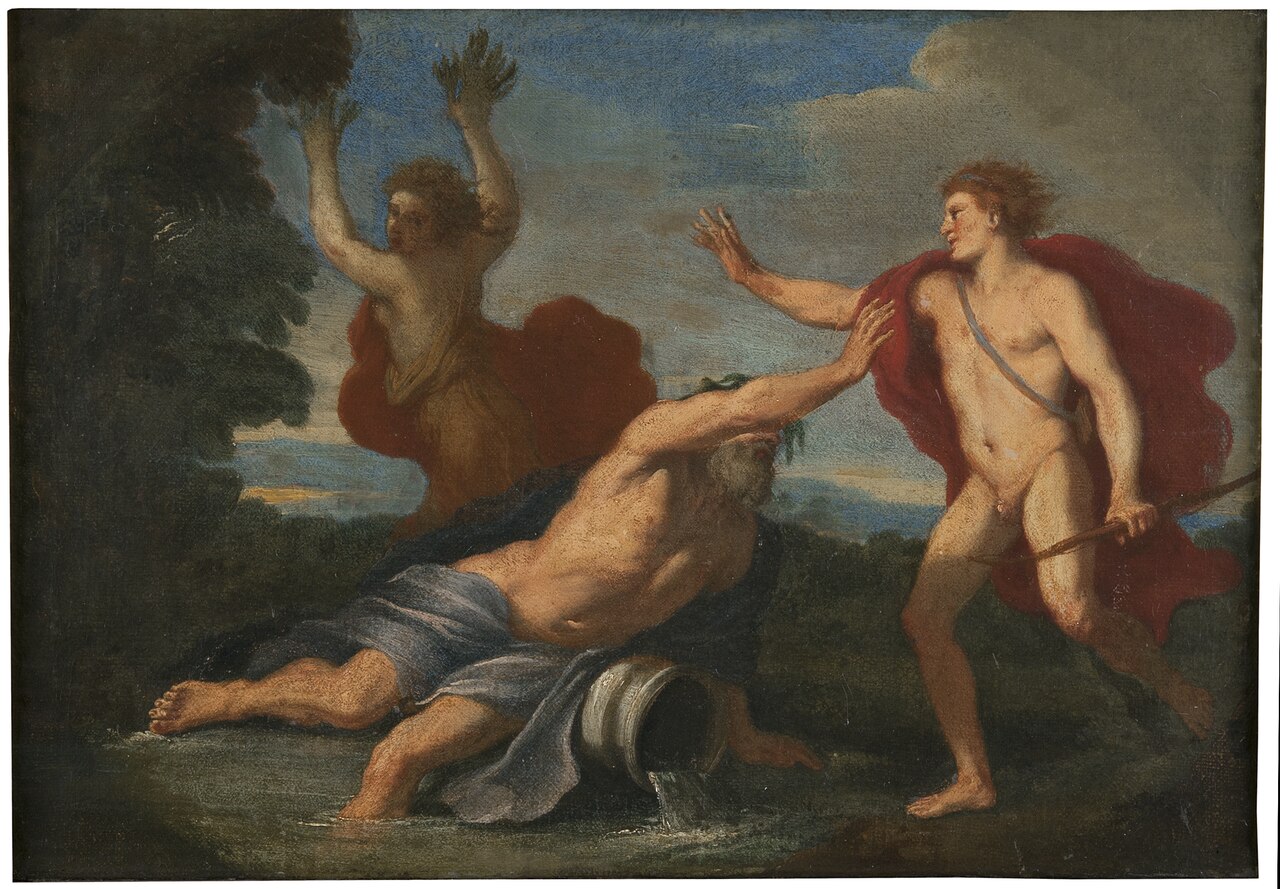
- Apollo and Daphne (circa 1800) – The date traditionally attached to this work post‑dates Costanzi’s death, indicating either a later copy or a misattribution. Nevertheless, the composition reflects his interest in classical mythology. The scene shows Apollo’s pursuit of Daphne, with the transformation captured in a cascade of leaves. The painter’s use of soft, pastel tones and gentle contouring suggests a later, more Rococo‑influenced approach.
- Immaculate Conception (1730) – Executed for a Roman chapel, this altarpiece presents the Virgin Mary surrounded by a host of angels. Costanzi employs a radiant halo of light to convey divine purity, while the delicate folds of Mary’s mantle demonstrate his mastery of drapery. The work’s devotional intensity aligns with the Counter‑Reformation emphasis on Marian cults.
- Monsignor Zondadari Blessing the Spanish (1728) – This commission commemorates a diplomatic encounter between the Roman clergy and Spanish envoys. Costanzi places the monsignor at the centre of a solemn ritual, using a restrained colour scheme to highlight the solemnity of the moment. The painting underscores his ability to merge political narrative with ecclesiastical gravitas.
These works collectively illustrate Costanzi’s versatility, ranging from sacred narratives to mythological subjects, and his capacity to adapt his style to the thematic demands of each commission.
Influence and legacy Costanzi’s standing within the Roman artistic community was cemented by his election as Principe (director) of the Accademia di San Luca in 1758, a position he held until his death the following year. This role placed him at the centre of artistic training and discourse, allowing him to shape the next generation of painters. Among his documented pupils was Pietro Antonio Gualdi Lodrini, who carried forward Costanzi’s emphasis on refined composition and luminous colour.
Although his name is less widely recognised outside specialist circles, Costanzi’s contributions to Roman Baroque art remain significant. His works continue to adorn church interiors, providing contemporary viewers with a vivid example of late‑Baroque devotional painting. Moreover, his synthesis of dramatic narrative and measured classicism offers a bridge between the high drama of the early Baroque and the more decorative tendencies of the Rococo, marking him as a transitional figure in 18th‑century Italian art.
In recent scholarship, Costanzi has been reassessed for his role in the artistic networks of Rome, particularly his involvement with the Accademia di San Luca, which functioned as a hub for artistic exchange across Italy and beyond. His paintings, therefore, are not only valuable for their aesthetic qualities but also as documents of the cultural and institutional dynamics that shaped Roman art in the mid‑1700s.
Overall, Placido Costanzi exemplifies the skilled, academically trained painter who navigated the demands of ecclesiastical patronage while contributing to the evolving visual language of his era.
---