Pieter Stevens
1557 – 1624
In short
Pieter Stevens (1557–1624) was a Flemish painter and draughtsman renowned for his atmospheric landscape paintings. He worked for Emperor Rudolf II in Prague, where his romantic Bohemian scenes helped shape 17th‑century Flemish and Dutch landscape art.
Notable works



Early life
Pieter Stevens was born in 1557 in Mechelen, a thriving artistic centre in the Southern Netherlands. Little is recorded about his family, but the city’s vibrant guild system suggests he received a conventional apprenticeship in a local workshop, where he would have learned the fundamentals of drawing, oil painting and the handling of colour that characterised Flemish art of the late 16th century. By the time he reached his twenties, Stevens had mastered the genre of landscape—a subject that was gaining popularity among Flemish patrons eager for depictions of the countryside beyond the traditional religious and portrait commissions.
Career and style
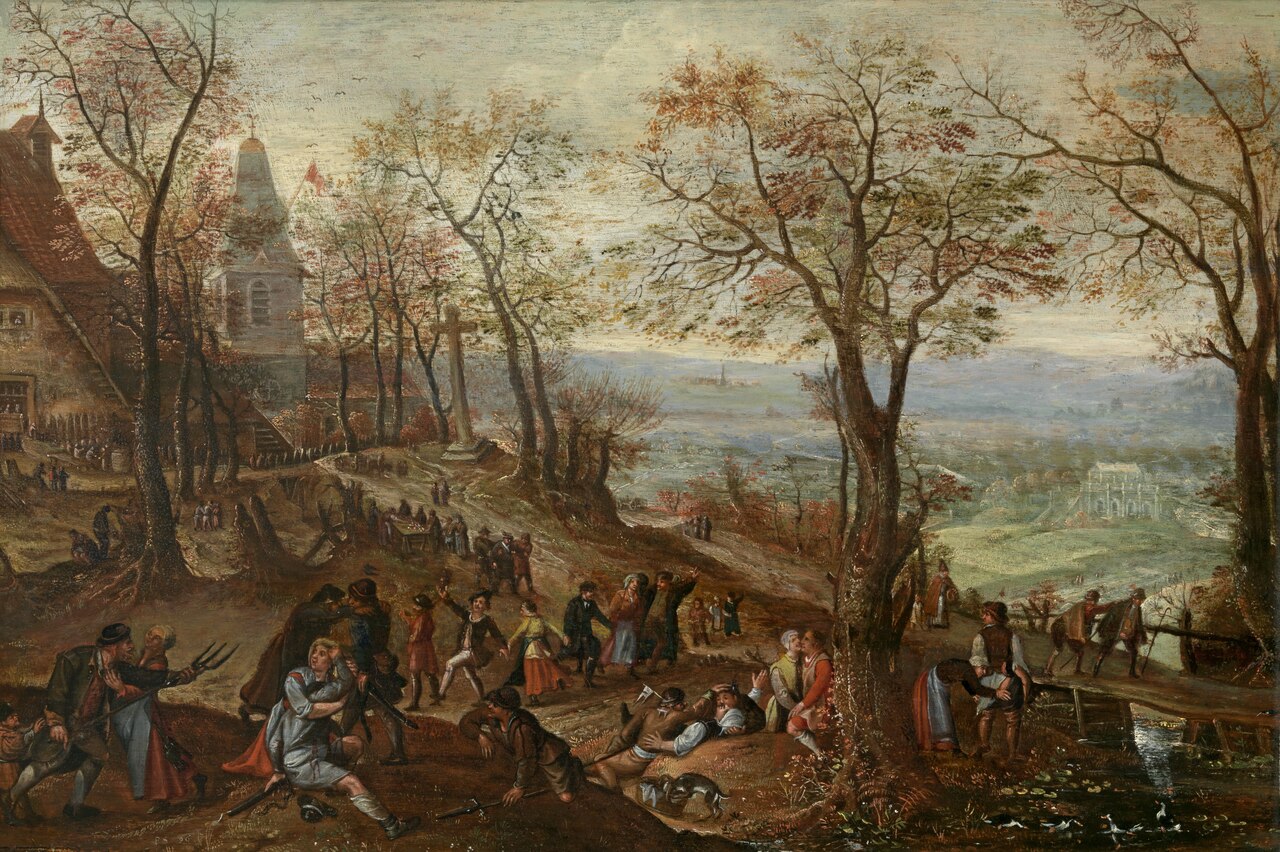
Around the turn of the 17th century Stevens moved to Prague, attracted by the cosmopolitan court of Emperor Rudolf II. The emperor’s patronage offered a rare platform for artists from the Low Countries, and Stevens soon became one of the court’s preferred landscape painters. His work reflects a synthesis of Flemish technique with the dramatic, often melancholic atmosphere of Bohemian scenery. Unlike the more formalized Dutch landscapes that would dominate later in the century, Stevens’ compositions are characterised by a lyrical, almost romantic sensibility: rugged hills, winding rivers, and solitary figures placed within a broad, mist‑laden horizon.
Stevens’ style shows the influence of Northern Mannerism in its elongated perspective and the subtle, sometimes theatrical, use of light. Yet he also anticipates the naturalism that would later define Dutch Golden Age landscape painting. His canvases often juxtapose detailed foreground elements—trees, animals, rustic structures—with a softer, atmospheric background that recedes into haze, creating a sense of depth and quiet contemplation.
Signature techniques
Stevens employed several techniques that became hallmarks of his oeuvre:
* Atmospheric perspective – By progressively lightening the colour palette and reducing contrast in distant elements, he conveyed the effect of distance and weather. * Detailed foliage and rock work – His trees are rendered with fine, almost calligraphic brushstrokes, while rocks are depicted with a tactile realism that grounds the composition. * Mastery of water effects – In works such as *Fishing at Night*, Stevens captures reflections and ripples with delicate glazing, lending a luminous quality to nocturnal scenes. * Use of chiaroscuro – He often places a strong light source—sunrise, moonlight, or a torch—against a dark foreground, heightening drama and guiding the viewer’s eye. * Integration of narrative figures – Though primarily a landscape painter, Stevens incorporated modest genre elements—goatherds, fishermen, and travelers—providing a human scale without detracting from the natural setting.
These techniques were disseminated through prints after his drawings, which circulated widely across the Low Countries and the German states, amplifying his stylistic influence.
Major works
* Landscape with a Mill and a River (1590) – One of Stevens’ earliest dated works, this painting demonstrates his command of linear perspective. A wind‑mill dominates the centre, while a gently curving river guides the viewer’s gaze toward a distant village, bathed in the warm glow of late afternoon. * Country Fair (1596) – A lively genre scene set within a bucolic landscape, the composition blends human activity with natural surroundings. Market stalls, children at play, and a distant church tower illustrate Stevens’ ability to weave narrative into his panoramas. * Fishing at Night (1600) – A nocturnal study that showcases his mastery of light. Moonlight reflects off the water’s surface, illuminating a solitary fisherman and his boat, while the surrounding trees recede into deep shadow, creating a contemplative mood. * A Path Between Trees (1603) – This work exemplifies the “path” motif common in Northern landscape tradition. A narrow track winds through a dense forest, leading the eye toward a softened horizon, suggesting both physical and metaphorical journeys. * Rocky Landscape with a Goat Hunt (1613) – Among his later pieces, this painting presents a dramatic chase through craggy terrain. The rugged rocks, dynamic figures on horseback, and the tension of the hunt display Stevens’ skill in combining action with a striking natural setting.
Each of these works reflects a consistent visual language—careful composition, nuanced light, and an emphasis on the emotive qualities of the landscape.
Influence and legacy
Stevens’ landscapes were reproduced as prints, a common practice that allowed his compositions to reach a wider audience beyond the imperial court. These prints inspired a generation of Flemish and Dutch artists, who adapted his atmospheric techniques and his integration of narrative figures into their own works. Art historians note that the romantic Bohemian motifs found in Stevens’ drawings contributed to the evolution of the Dutch Golden Age landscape, particularly in the works of artists such as Jan van Goyen and Jacob van Ruisdael.
Although Stevens never founded a formal school, his contributions helped shift the perception of landscape from a decorative background element to a primary subject worthy of independent artistic exploration. Today, his paintings are held in several European collections, and his name appears in scholarly discussions of early modern landscape painting. By bridging Flemish technical rigor with Central European scenic imagination, Pieter Stevens occupies a pivotal place in the transition toward more naturalistic and emotionally resonant landscape art.
---
In summary, Pieter Stevens stands as a key figure whose cross‑cultural career and distinctive approach to landscape painting left a lasting imprint on the visual vocabulary of Northern European art.
Frequently asked questions
Who was Pieter Stevens?
Pieter Stevens (1557–1624) was a Flemish painter and draughtsman known for his atmospheric landscape paintings, who worked for Emperor Rudolf II in Prague.
What style or movement is he associated with?
He is linked to a romantic Bohemian landscape style that blends Flemish technique with Northern Mannerist influences, predating the Dutch Golden Age landscape tradition.
What are his most famous works?
His most renowned works include *Landscape with a Mill and a River* (1590), *Country Fair* (1596), *Fishing at Night* (1600), *A Path Between Trees* (1603) and *Rocky Landscape with a Goat Hunt* (1613).
Why is Pieter Stevens important in art history?
Stevens’ prints helped spread a new, emotive approach to landscape painting across the Low Countries, influencing later Flemish and Dutch masters and elevating landscape to a principal genre.
How can I recognise a Pieter Stevens painting?
Look for finely detailed foliage, subtle atmospheric perspective, a soft, luminous handling of light—especially moonlight or sunrise—and modest genre figures set within a broad, often mist‑filled countryside.