Joseph Stevens
1816 – 1892
In short
Joseph Stevens (1816–1892) was a Belgian animalier painter and engraver best known for realistic depictions of dogs, horses and singeries. Working in the French Realist tradition, he helped introduce Realism to Belgian art and earned the admiration of Gustave Courbet.
Notable works
.jpg)

.jpg)
Early life
Joseph Stevens was born Edouard Joseph Léopold Stevens in Brussels in 1816, into a modest family that could afford a basic education but not a privileged artistic upbringing. His early fascination with animals, especially the street dogs that roamed the capital, was nurtured during long walks in the city's markets and parks. By his teenage years he had begun to sketch these creatures, developing a keen eye for anatomical detail and behavioural nuance. Although records of his formal training are sparse, it is known that he attended the Académie Royale des Beaux‑Arts in Brussels, where he received a conventional academic grounding in drawing and composition. The academy's curriculum, which stressed life‑drawing from plaster casts and live models, provided Stevens with the technical foundation that later allowed him to render animals with both precision and vitality.
Career and style
Stevens launched his professional career in the early 1840s, initially producing works that reflected the Romantic sensibility prevalent in Belgium at the time. Early paintings often portrayed dogs in sentimental, almost anthropomorphic settings—loyal companions gazing affectionately at their owners, or scenes of canine fidelity rendered with soft lighting and lyrical colour. By the mid‑1840s, however, Stevens began to shift towards a more detached, observational approach. Influenced by the burgeoning French Realist movement and the work of Gustave Courbet, he started to depict animals in the context of everyday labour and urban life. This transition is evident in works such as *Dog Carrying Dinner to its Master* (1846), where a working dog is shown delivering a meal to a travelling entertainer, and *Travelling Actor's Misfortune* (1847), which captures the hardships of itinerant performers and their animal companions.
The core of Stevens' style became the faithful representation of animal physiology combined with a narrative edge. He avoided idealisation, preferring to show the wear and fatigue on a working dog's muzzle or the muscular tension of a donkey burdened with a load. His palette remained relatively restrained, favouring earth tones, muted greens and ochres that reinforced the gritty realism of his subjects. Light is employed not for dramatic effect but to model form, often falling from a natural, diffused source that suggests outdoor markets or street alleys.
Signature techniques
Stevens employed a meticulous drawing process that began with careful graphite studies. He would observe his subjects in situ—often at the famous horse‑and‑dog markets of Brussels—making rapid sketches to capture posture and movement. These studies were later refined in the studio, where he transferred the composition onto canvas using a grid system to preserve proportion. In painting, he layered thin glazes of oil to achieve subtle tonal variations, a technique that allowed the underlying sketch to remain visible and to guide the final rendering. His handling of fur is particularly noteworthy: by employing fine, directional brushstrokes, he could suggest the direction of hair growth, creating a tactile illusion of texture.
In addition to painting, Stevens produced a body of engravings, most of which were executed in the stipple and line‑engraving methods. These prints circulated widely in French and Belgian periodicals, helping to disseminate his realistic animal subjects beyond the confines of the exhibition hall. The engravings also reveal his ability to simplify complex compositions without losing narrative clarity, a skill that contributed to his reputation among contemporaries.
Major works
- Horses and Donkeys for Hire (1854) – This canvas presents a bustling roadside stall where a pair of horses and a donkey are offered for hire. The animals are rendered with anatomical exactness, their muscles and sinews clearly defined, while the surrounding figures—farmers, children, and a vendor—provide a lively context. The work exemplifies Stevens' mature Realist phase, where the focus is on the economic role of animals rather than sentimental affection.
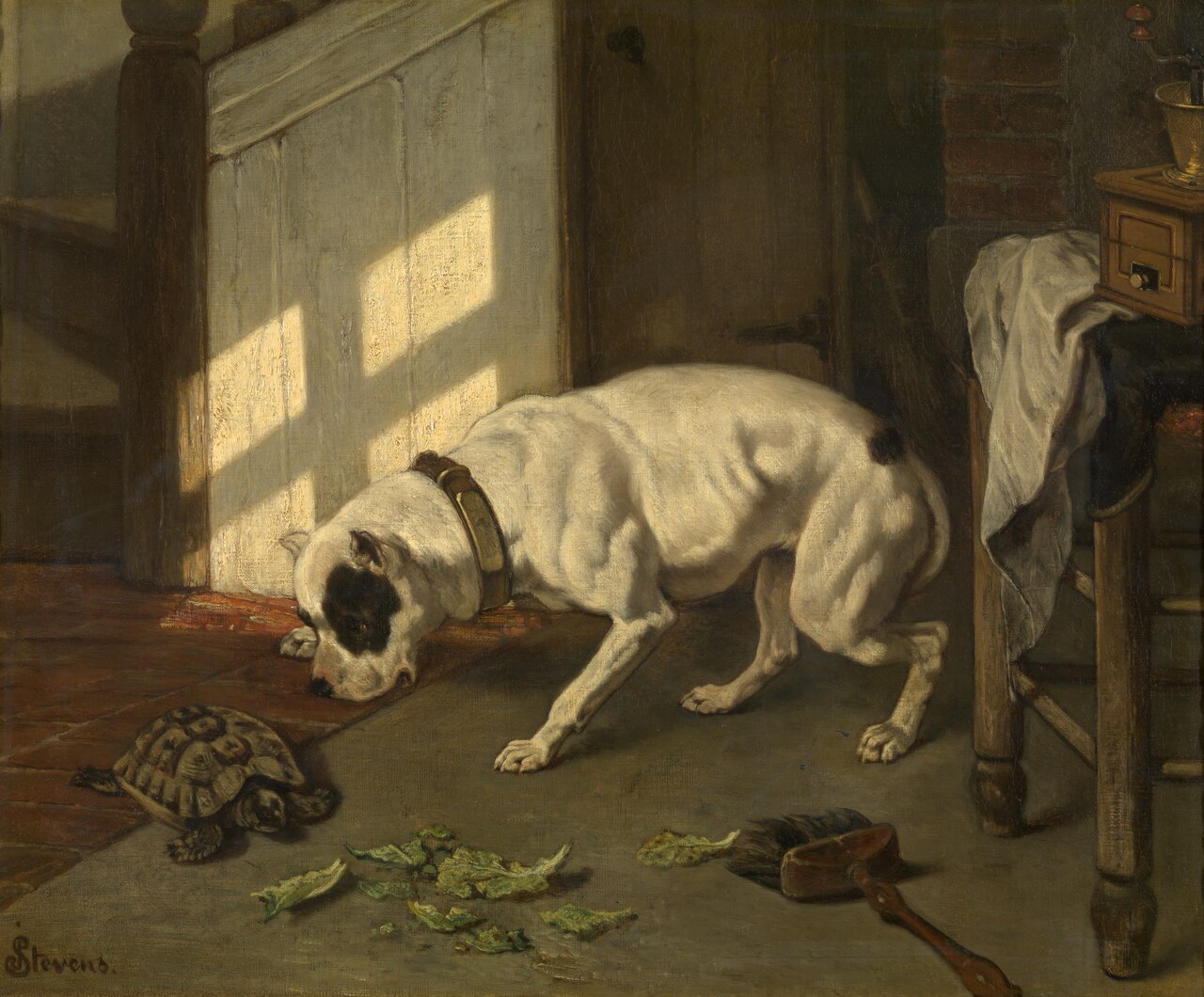
- Dog with Tortoise (1856) – In this composition, a curious dog peers at a slow‑moving tortoise, creating a subtle commentary on the contrast between speed and patience. The piece is notable for its delicate handling of light on the dog's glossy coat and the tortoise's textured shell, highlighting Stevens' skill in differentiating varied surfaces within a single scene.
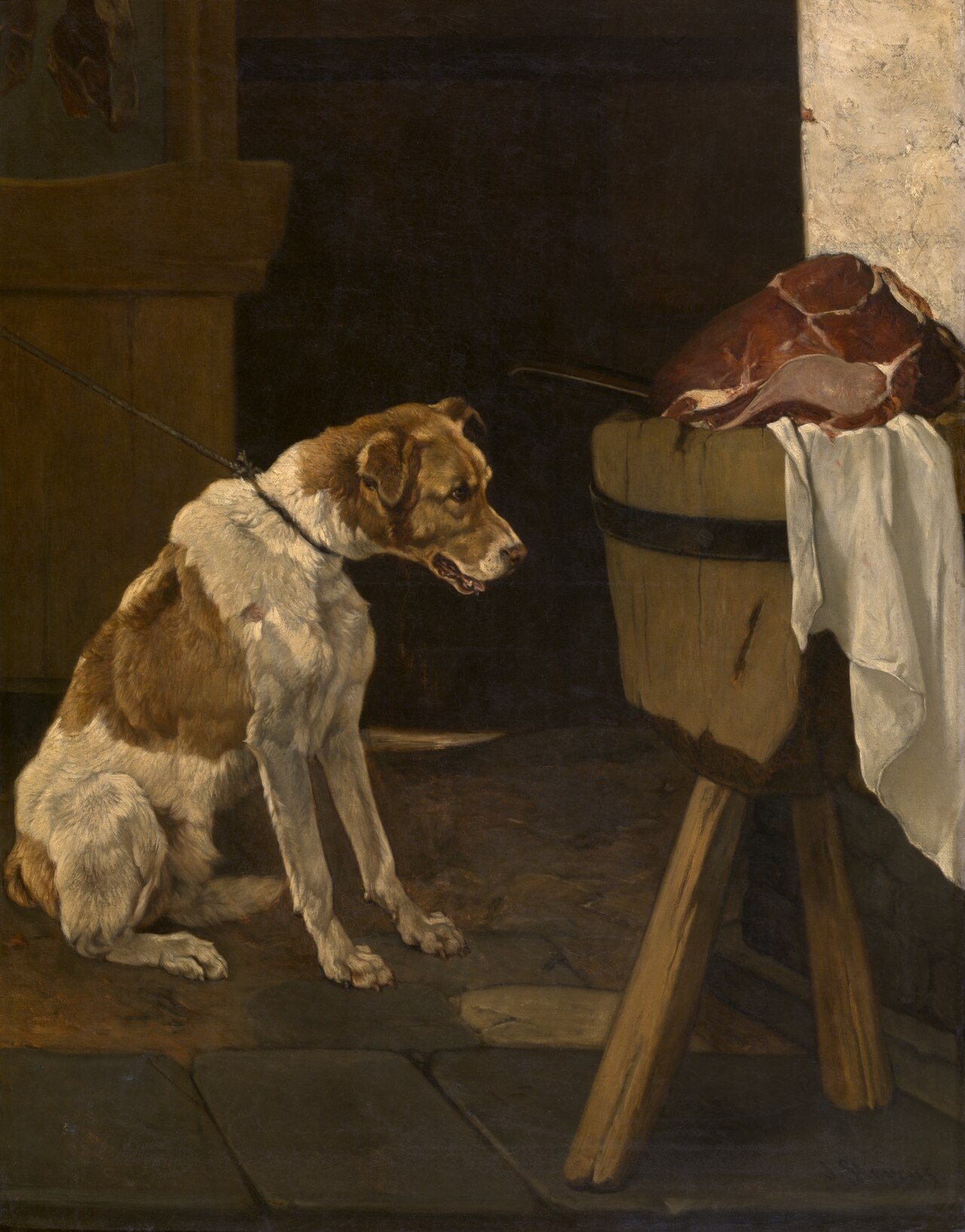
- The Torment of Tantalus – Although the title references a classical myth, Stevens interprets the theme through an animal lens. The painting depicts a dog yearning for a piece of meat hung just out of reach, mirroring the eternal punishment of Tantalus. This work underscores Stevens' ability to fuse allegorical content with his favourite subject matter.
- Dog Carrying Dinner to its Master (Fable by La Fontaine) (1846) – Based on La Fontaine’s fable, the painting shows a loyal dog delivering a meal to a travelling actor. The composition balances narrative clarity with realistic detail; the dog's coat is rendered in a warm amber hue, while the background suggests a modest camp set up on a roadside.
- Travelling Actor's Misfortune (1847) – This poignant work captures a moment of hardship: a weary actor sits on a crate while his dog rests its head on his lap. The painting’s muted palette and careful modelling of the figures convey a sense of empathy for the itinerant performers and their animal companions.
These works, together with a handful of singeries—scenes of monkeys mimicking human activities—illustrate Stevens' versatility and his commitment to portraying animals as active participants in human life.
Influence and legacy
Joseph Stevens occupies a pivotal position in the development of Belgian Realism. By turning his focus to everyday animal labour, he broadened the thematic scope of Belgian art beyond the historical and religious subjects that had dominated the academy. His realistic approach earned the respect of French Realist painters, most notably Gustave Courbet, who praised Stevens for his truthful representation of working animals. This endorsement helped to bridge the artistic exchange between Belgium and France during the mid‑19th century.
Stevens' legacy endures in several ways. First, his paintings and engravings provided a visual record of Belgian urban and rural life, documenting the role of animals in commerce, transport and entertainment. Second, his method of combining rigorous anatomical study with narrative composition influenced later animalier painters such as Alexandre Guérin and later Belgian artists who embraced Realist principles. Finally, his works remain popular among collectors and museums, with several pieces held in the Royal Museums of Fine Arts of Belgium and the Musée d’Orsay, reflecting the lasting appeal of his compassionate yet unflinching portrayal of animals.
In contemporary scholarship, Stevens is recognised not only as an accomplished animalier but also as a forerunner of socially aware art, using the humble dog or donkey to comment on broader themes of labour, poverty and human‑animal relationships. His contributions continue to be explored in exhibitions that examine the intersection of realism, genre painting and the representation of the animal world in 19th‑century Europe.
Frequently asked questions
Who was Joseph Stevens?
Joseph Stevens (1816–1892) was a Belgian painter and engraver best known for realistic depictions of dogs, horses and animal scenes within the French Realist tradition.
What artistic style or movement is he associated with?
He worked in the French Realist style, pioneering Realism in Belgian art by portraying everyday animal labour rather than idealised subjects.
What are his most famous works?
Key works include *Horses and Donkeys for Hire* (1854), *Dog with Tortoise* (1856), *The Torment of Tantalus*, *Dog Carrying Dinner to its Master* (1846) and *Travelling Actor's Misfortune* (1847).
Why does Joseph Stevens matter in art history?
He expanded the range of Belgian genre painting, earned admiration from leading Realists such as Courbet, and influenced later animalier artists by combining accurate anatomy with social narrative.
How can I recognise a painting by Joseph Stevens?
Look for meticulously rendered animal fur or feathers, a restrained earth‑tone palette, and scenes that place animals in realistic, often working‑class contexts, frequently accompanied by subtle narrative details.