Pierre Emmanuel Damoye
1847 – 1916
In short
Pierre Emmanuel Damoye (1847–1916) was a French landscape painter associated with the Barbizon school. Trained at the École des Beaux‑Arts, he became known for his atmospheric skies, tree‑filled plains and vivid rural scenes, many of which are now held in major European collections.
Notable works


_-_Rural_Landscape_with_Figures_in_the_Foreground_-_1950.24_-_The_Amelia.jpg)
Early life
Pierre Emmanuel Damoye was born in 1847 in the Montmartre district of Paris, an area that would later become synonymous with artistic bohemia. Little is recorded about his family background, but his early fascination with the natural world was evident in the sketches he produced as a teenager. Recognising his talent, he secured a place at the prestigious École des Beaux‑Arts, where he received formal training in drawing, composition and the academic traditions that dominated French art education in the mid‑nineteenth century.
Career and style
After completing his studies, Damoye aligned himself with the Barbizon school, a movement that championed direct observation of the countryside and a departure from the idealised classicism of earlier academic painting. The Barbizon artists, inspired by the French countryside around the village of Barbizon, advocated for plein‑air work and a more naturalistic palette. Damoye’s early Salon submissions reflected this ethos, earning him favourable notices from critics who praised his ability to capture the fleeting effects of light on the landscape.
Throughout the 1870s and 1880s Damoye exhibited regularly at the Paris Salon and at independent venues such as the Société des Artistes‑Français. His reputation grew steadily, and he was frequently mentioned alongside the generation of painters who carried the Barbizon legacy into the fin de siècle. While he never abandoned the school’s core principles, his work gradually incorporated a looser brushwork and a brighter chromatic range, anticipating some of the concerns of later Impressionists without abandoning his commitment to compositional balance.
Signature techniques
Damoye’s paintings are distinguished by several recurring technical traits. First, his skies dominate the canvas, often rendered in soft gradients that suggest early morning mist or the golden glow of sunset. He achieved this effect through thin, layered washes of colour, allowing the underlying tones to emerge subtly. Second, his treatment of trees and foliage is both detailed and atmospheric; trunks are defined with confident, vertical strokes, while leaves are suggested with stippled touches that dissolve into the surrounding air. Third, Damoye employed a harmonious palette of earth tones—ochres, umbers and muted greens—interrupted by occasional splashes of vivid red or blue to draw the eye to focal points such as a farmhouse or a distant hill.
Another hallmark of his style is the inclusion of modest human figures or farm animals, which provide narrative context without overwhelming the natural setting. These figures are rendered with restrained detail, serving primarily as scale markers that accentuate the vastness of the surrounding terrain.
Major works
- Rural Landscape with Figures in the Foreground (1879) – One of his earliest mature works, this painting presents a bucolic scene where a group of peasants tend to a field under a broad, luminous sky. The composition balances the human activity in the foreground with a sweeping view of cultivated land that recedes into gentle hills. The subtle modulation of light across the sky and the careful rendering of the figures’ clothing exemplify Damoye’s commitment to realism within a poetic framework.
- Flodlandskap – Translating to “River Landscape,” this work showcases Damoye’s fascination with water as a reflective surface. The river runs diagonally across the canvas, mirroring the sky’s colour and the foliage that lines its banks. The painting’s calm atmosphere is heightened by the muted palette and the delicate handling of ripples, which convey both motion and stillness.
- Hedlandskap – Meaning “Heather Landscape,” this piece captures the muted purples and greens of a heathland at the edge of a forest. Damoye’s brushwork here is particularly expressive, with short, rhythmic strokes that mimic the texture of heather stalks swaying in a gentle breeze. The work’s vertical emphasis, created by the slender heather stems, contrasts with the horizontal sweep of the horizon, creating a dynamic equilibrium.
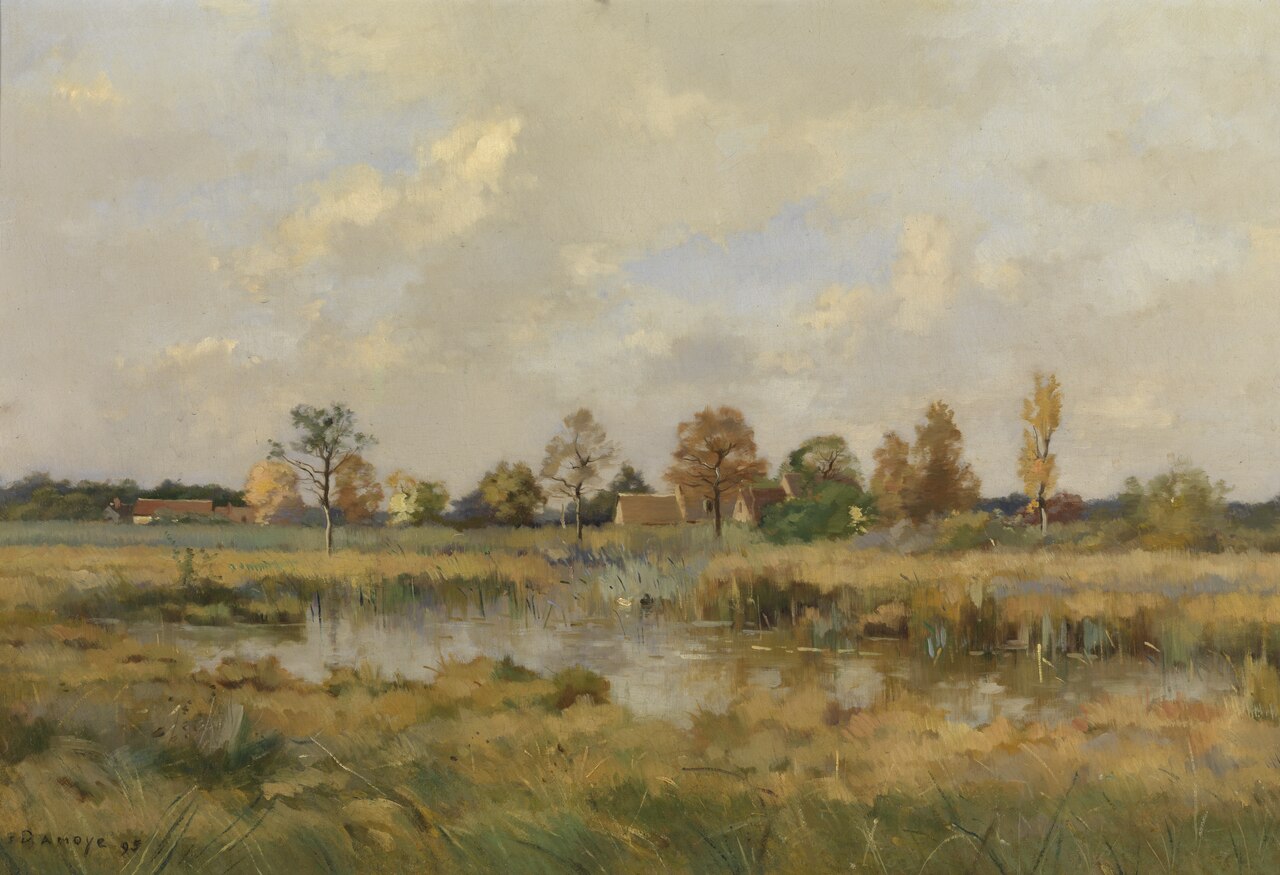
- Landscape near Amiens (1895) – Executed later in his career, this painting reflects Damoye’s mature command of atmospheric perspective. The scene depicts the rolling fields surrounding the city of Amiens, bathed in a soft, late‑afternoon light. The distant horizon is rendered with barely perceptible outlines, allowing colour temperature to convey depth. Critics of the time noted the work’s “quiet majesty” and its ability to evoke the sense of place without resorting to overt dramatization.
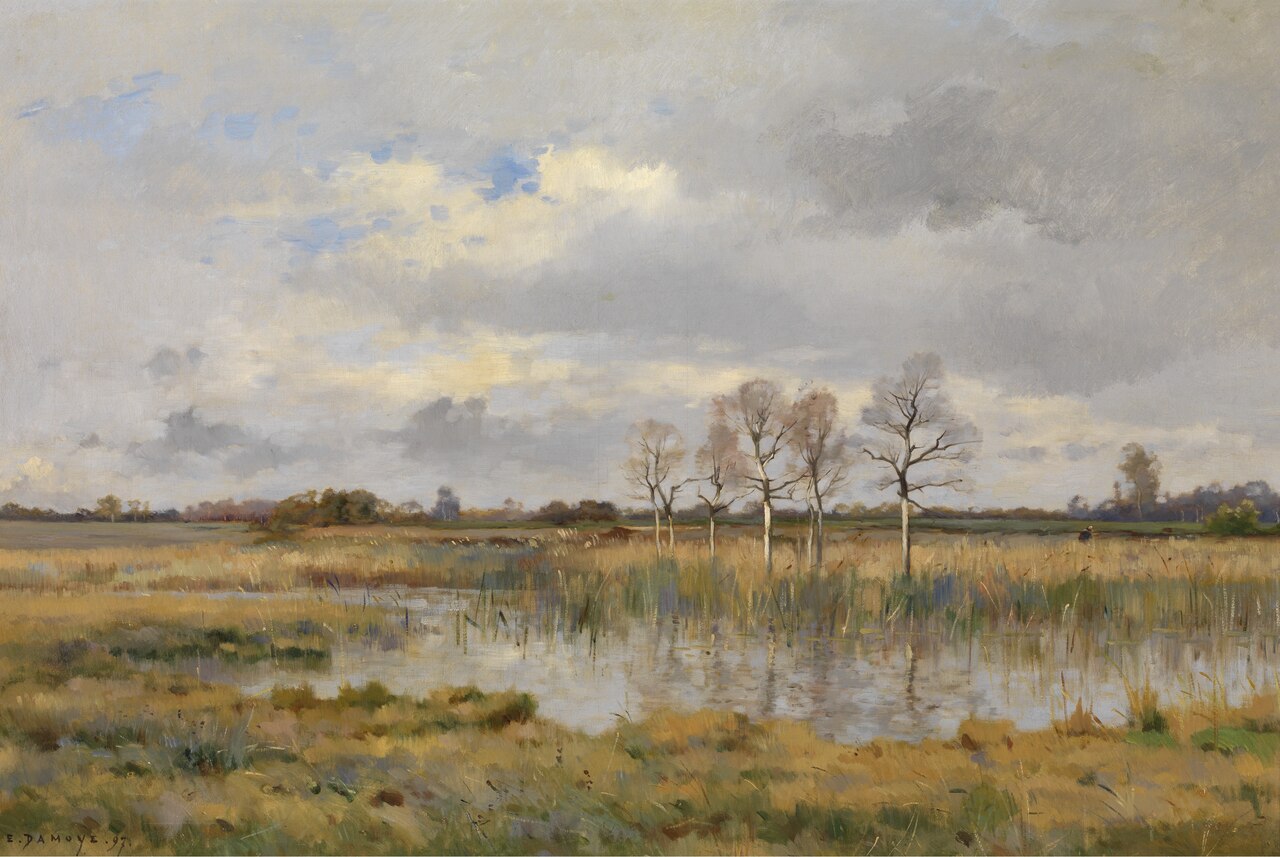
- Marsh (1897) – In this late work, Damoye turns his attention to a wetland environment. The composition is dominated by a low horizon line, allowing the sky to occupy the majority of the canvas. Subtle variations of grey and green capture the reflective quality of the marsh’s surface, while a solitary tree on the left provides a compositional anchor. The painting’s restrained palette and emphasis on mood demonstrate Damoye’s continued interest in the interplay between light, water and land.
Influence and legacy
Pierre Emmanuel Damoye is widely regarded as one of the most significant heirs to the Barbizon tradition. By preserving the school’s core values—direct observation, tonal harmony and a reverence for the French countryside—while subtly integrating newer aesthetic concerns, he bridged the gap between nineteenth‑century realism and the emerging modernist currents of the early twentieth century. His works were acquired by several municipal museums in France, and they continue to appear in exhibitions that explore the evolution of landscape painting.
Art historians credit Damoye with influencing a generation of French and European artists who sought to depict rural life with both fidelity and lyricism. His treatment of sky and water, in particular, informed later painters who explored atmospheric effects, such as the post‑Impressionist members of the Pont‑Aven circle. Although his name is less commonly invoked than that of Jean‑François Millet or Théodore Rousseau, Damoye’s paintings remain valuable reference points for scholars studying the transition from academic naturalism to the more experimental approaches that characterised the early twentieth century.
Today, his canvases are held in the collections of institutions such as the Musée d’Orsay, the Musée des Beaux‑Arts de Rouen, and several regional museums across France. The continued scholarly interest and market demand for his works underline his lasting relevance as a conduit between the Barbizon school’s foundational ideals and the broader narrative of modern French art.
Frequently asked questions
Who was Pierre Emmanuel Damoye?
Pierre Emmanuel Damoye (1847–1916) was a French landscape painter associated with the Barbizon school, known for his atmospheric depictions of rural France.
What artistic movement did Damoye belong to?
He worked within the Barbizon school tradition, emphasizing naturalistic observation of the countryside and a balanced, tonal palette.
What are his most famous works?
Key works include *Rural Landscape with Figures in the Foreground* (1879), *Landscape near Amiens* (1895), *Marsh* (1897), and the Swedish‑titled pieces *Flodlandskap* and *Hedlandskap*.
Why is Damoye important in art history?
Damoye is regarded as a principal heir to the Barbizon school, bridging 19th‑century realism with early modernist sensibilities and influencing later landscape painters.
How can I recognise a Damoye painting?
Look for sweeping skies, tree‑filled plains, muted earth tones punctuated by occasional vivid accents, and a calm, atmospheric mood that often includes modest human figures or farm animals.