Charles Jacque
1813 – 1894
In short
Charles Jacque (1813–1894) was a French painter and engraver associated with the Barbizon school, celebrated for his realistic depictions of rural life and domestic animals, especially poultry. He combined meticulous engraving technique with a compassionate, naturalistic style that influenced later animal painters.
Notable works



Early life Charles‑Émile Jacque was born in 1813 in the former 10th arrondissement of Paris, a district that was then on the outskirts of the capital. Little is recorded about his family background, but his early years were shaped by a seven‑year stint in the French Army. During his military service he was tasked with engraving maps, a practical skill that introduced him to the discipline of line work and the precision required for printmaking. This experience laid the foundation for his later career as both an engraver and a painter.
After leaving the army, Jacque returned to civilian life and pursued artistic training. He studied drawing and painting in Paris, where he encountered the burgeoning movement of naturalistic landscape painting that would later be known as the Barbizon school. The exposure to this circle of artists, who championed direct observation of nature, profoundly influenced his artistic direction.
Career and style In the 1830s and 1840s Jacque settled near the village of Barbizon, joining the ranks of painters who sought inspiration in the forested environs south of the Seine. While his contemporaries such as Jean‑François Millet focused on the lives of peasants, Jacque turned his attention to the quieter, domestic aspects of rural existence—particularly the animals that populated farms and smallholdings.
His style is characterised by a sober realism that avoids melodrama. He rendered his subjects with a clear, unembellished eye, emphasizing texture, form and the subtle play of light on feathers and fur. The influence of the Barbizon school is evident in his earthy colour palette and his commitment to painting en plein air, yet his work diverges by foregrounding animals as the central narrative rather than as background to human activity.
Throughout his career Jacque produced both oil paintings and engravings, often creating prints after his own paintings. This dual practice allowed him to reach a broader audience and to refine his observational skills. By the 1860s he had established a reputation as one of the leading animal painters of his generation, with his works regularly exhibited at the Paris Salon.
Signature techniques Jacque’s background in engraving informed several distinctive techniques that appear throughout his oeuvre. He employed fine, controlled line work to suggest the delicate structure of feathers, a method that translated well from print to canvas. In his oil paintings he often used a limited palette of muted browns, ochres and soft greens, allowing the texture of the subjects to become the focal point.
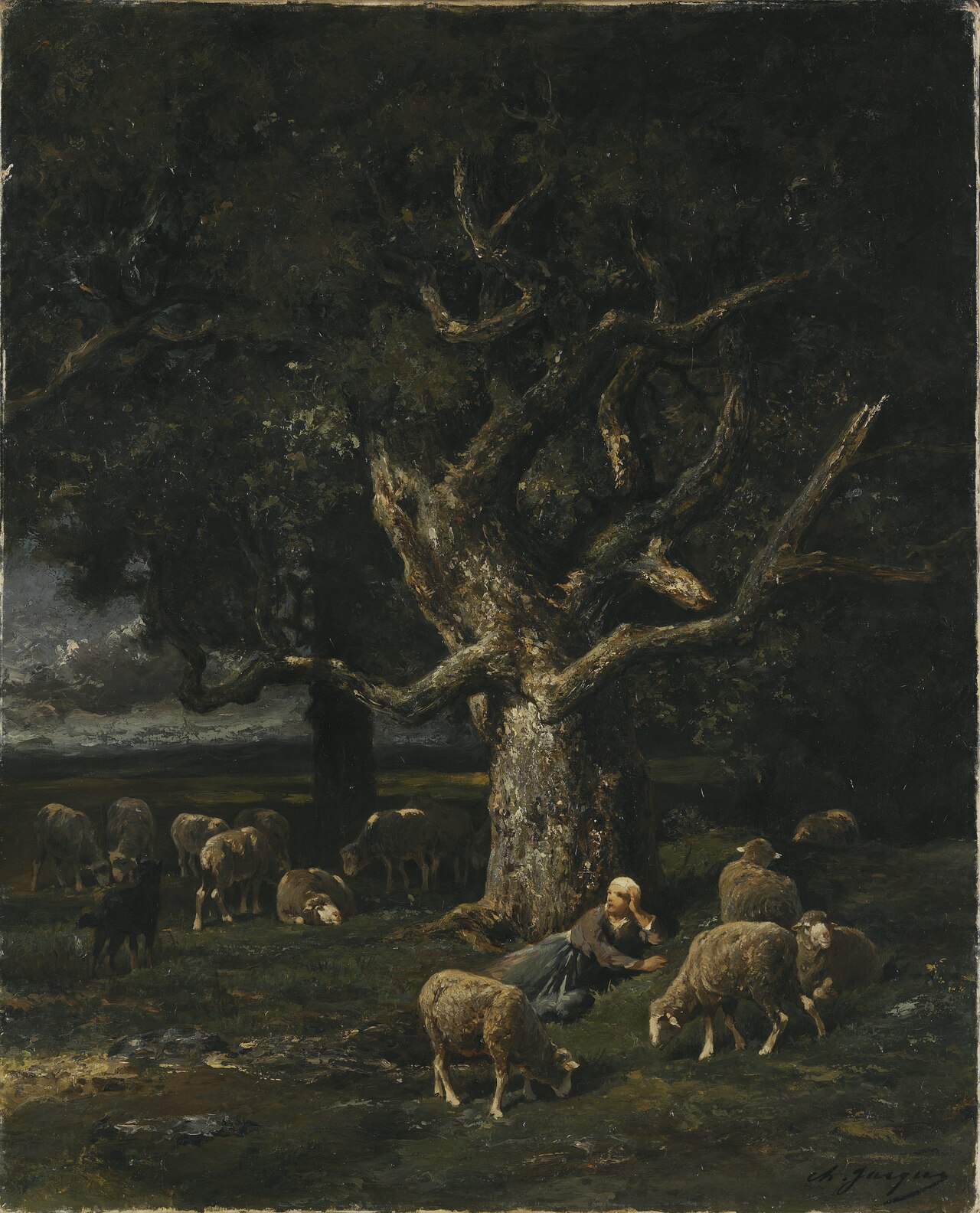
A hallmark of his approach is the use of chiaroscuro to model form. By placing his animal subjects against simple, often darkened backgrounds, he heightened the three‑dimensional quality of the birds and livestock. This technique also served a compositional purpose, drawing the viewer’s eye to the centre of the canvas where the animal’s head or torso is most detailed.
Jacque was also known for his compositional balance. He frequently arranged his subjects in rhythmic rows or clusters, creating a sense of order that reflects the routine of farm life. The placement of light—whether the soft glow of sunrise or the muted illumination of an interior—was carefully calibrated to enhance the tactile qualities of the fur, feathers and surrounding objects.
Major works * **Birds (1844)** – This early work demonstrates Jacque’s fascination with avian subjects. Rendered in oil, the painting depicts a flock of small birds perched on a branch, rendered with precise brushwork that captures the iridescence of plumage. The muted background allows the birds to dominate the composition, showcasing Jacque’s skill in rendering delicate feather structures.
* Chickens (1861) – Perhaps his most celebrated piece, *Chickens* portrays a group of domestic fowl gathered around a feed trough. The work is notable for its lively yet restrained depiction of movement; the chickens are rendered with a sense of individuality, each bird bearing distinct postures and feather patterns. The subdued lighting emphasizes the earthy tones of the feathers and the rough texture of the wooden trough.
* Poultry in a Shed, 1828 (1850) – Although the title references an earlier date, the painting was completed in 1850 and reflects Jacque’s mature style. It shows a modest farm shed interior, filled with a variety of poultry. The composition is carefully staged: the birds are arranged in layers, some perched on the loft, others pecking at the floor. The dim interior light creates deep shadows, allowing Jacque to demonstrate his mastery of chiaroscuro.
* A Shepherdess and her Sheep – In this composition, Jacque turns his attention to a human‑animal relationship. A young shepherdess is depicted gently guiding a small flock of sheep across a meadow. The work balances the soft, pastoral landscape with the tender interaction between the figure and the animals, underscoring Jacque’s interest in the everyday harmony of farm life.
* Moonlight (1888) – One of his later works, *Moonlight* captures a nocturnal scene illuminated by a silvery lunar glow. The painting features a solitary barnyard animal—often a rooster or a lone hen—bathed in moonlight, the surrounding darkness accentuating the animal’s silhouette. The piece reflects a contemplative mood and illustrates Jacque’s continued exploration of light effects late in his career.
These works collectively illustrate Jacque’s consistent focus on animal subjects, his devotion to naturalistic detail, and his evolving mastery of light and texture.
Influence and legacy Charles Jacque’s contribution to 19th‑century French art lies in his elevation of animal painting from a decorative genre to a serious, realist discipline. By treating birds and livestock with the same respect afforded to human subjects, he broadened the thematic scope of the Barbizon school and influenced subsequent generations of animal painters, both in France and abroad.
His prints were widely circulated, providing models for artists who admired his precise line work and his ability to convey texture. The clarity of his compositions and his emphasis on everyday rural scenes resonated with naturalist writers and photographers of the late 19th and early 20th centuries.
Jacque’s works are now held in several major museums, including the Musée d’Orsay and the Metropolitan Museum of Art, where they continue to be displayed as exemplars of French realism and animal genre painting. Art historians cite his paintings as key references when discussing the development of pastoral and animal subjects within the broader context of the Barbizon movement.
He died in 1894 on the boulevard de Clichy, a street that had become a hub for artists and dealers in Paris. Though his name is not as widely recognised as some of his contemporaries, his meticulous approach to rendering the natural world and his compassionate portrayal of farm life have secured his place as a pivotal figure in the history of French realism.
Frequently asked questions
Who was Charles Jacque?
Charles Jacque (1813–1894) was a French painter and engraver associated with the Barbizon school, renowned for his realistic depictions of rural animals, especially poultry.
What style or movement is he linked to?
He worked within the Barbizon school, embracing naturalistic realism and focusing on pastoral subjects while applying meticulous engraving techniques.
What are his most famous works?
His best‑known paintings include *Birds* (1844), *Chickens* (1861), *Poultry in a Shed, 1828* (1850), *A Shepherdess and her Sheep*, and *Moonlight* (1888).
Why does his work matter in art history?
Jacque elevated animal painting to a serious realist genre, influencing later French and international artists and contributing to the broader development of naturalist art.
How can I recognise a Charles Jacque painting?
Look for carefully rendered birds or livestock, a subdued colour palette, strong chiaroscuro, and compositions that highlight texture and the quiet rhythm of farm life.