Peter Binoit
1590 – 1632
In short
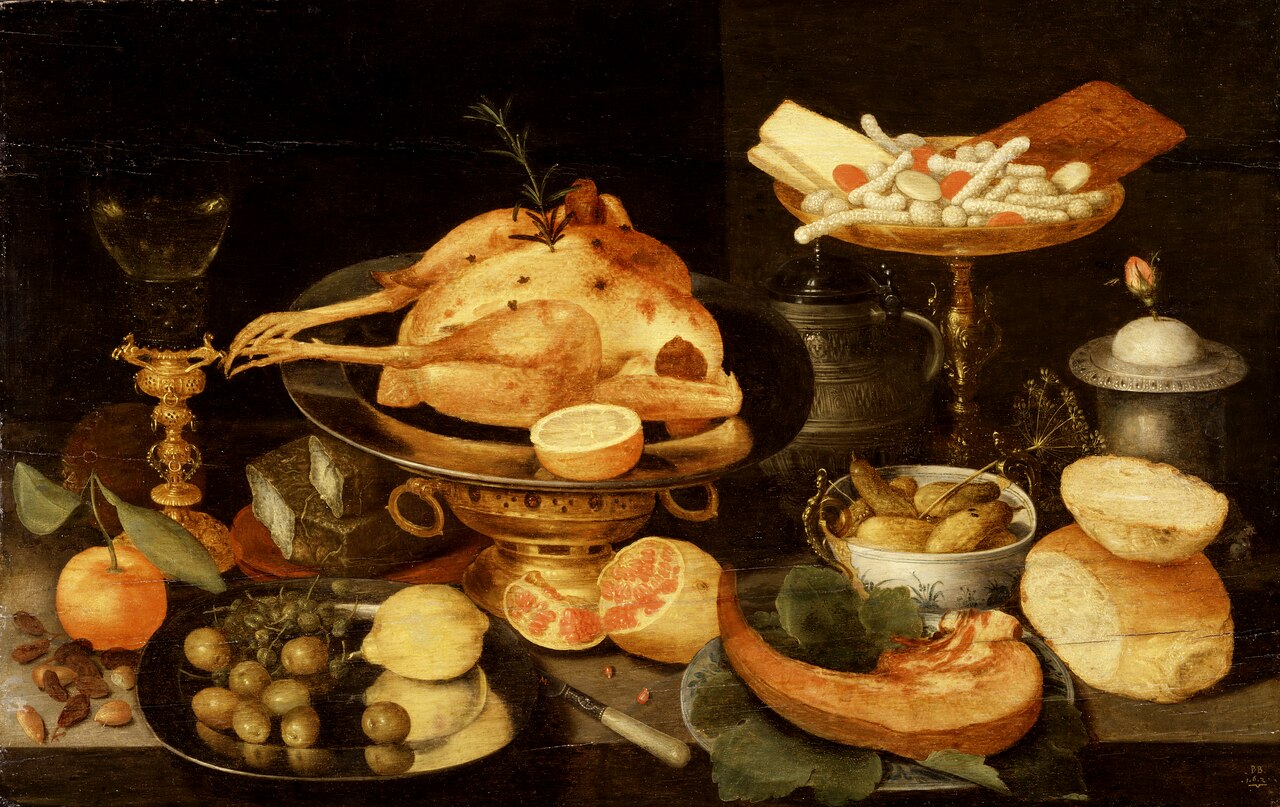
Peter Binoit (1590–1632) was a German painter who specialised in still‑life subjects during the early Baroque period. Active in Cologne and Frankfurt, he is remembered for his meticulous depictions of fruit, flowers and domestic objects, such as the Still Life with a Meal (1620).
Notable works


Early life Peter Binoit was born in 1590 in Cologne, a city that at the turn of the 17th century was a vibrant centre for trade and artistic exchange. Little is known about his family background, but archival records indicate that he received a traditional apprenticeship in a local workshop, where he would have learned the fundamentals of drawing, pigment preparation and the handling of oil paint. Cologne’s bustling markets supplied a ready visual repertoire of fresh produce, flowers and tableware, which later became the core material of Binoit’s paintings. By his early twenties he had established himself as a competent draftsman, gaining the attention of guild officials who allowed him to register as a master painter.
Career and style Around 1615 Binoit relocated to Frankfurt am Main, a commercial hub that attracted wealthy merchants and collectors. The city’s demand for decorative art, particularly detailed still‑life compositions that celebrated abundance and domestic virtue, provided a steady flow of commissions. Binoit’s work fits within the early Baroque sensibility that favoured dramatic contrasts of light and a heightened sense of realism, yet he remained largely independent of any formal artistic academy. His canvases typically present a carefully arranged still‑life scene, often centred on a table laden with fruit, flowers, pastries or everyday objects, rendered with a calm, almost scientific precision. The lack of overt allegorical symbolism suggests that Binoit aimed primarily at visual pleasure rather than moralising narrative.
Signature techniques Binoit’s paintings are distinguished by several technical hallmarks. First, he employed a subtle chiaroscuro, using a single, strong light source—usually a window‑like illumination from the left—to model forms and create a three‑dimensional effect. Second, his brushwork is exceptionally fine when depicting delicate textures such as the velvety petals of irises or the glossy skin of ripe apples; this level of detail was achieved through the use of narrow sable brushes and layered glazes. Third, Binoit favoured a restrained colour palette dominated by muted greens, warm ochres and occasional bursts of red, which together enhance the naturalistic quality of the objects. Finally, his compositional balance often relies on a triangular arrangement, guiding the viewer’s eye across the canvas and reinforcing a sense of order.
Major works - **Still Life with a Meal (1620)** – This early‑mid period work portrays a modest banquet spread across a wooden board, featuring a loaf of bread, a goblet, and a half‑peeled orange. The careful rendering of the orange’s textured rind and the reflective surface of the glass illustrate Binoit’s mastery of materiality. - **Still Life with Iris (1623)** – In this composition, a bouquet of irises dominates the foreground, their deep violet petals contrasting with a subdued background of draped cloth. The painting demonstrates Binoit’s skill in depicting botanical specimens with anatomical accuracy. - **Still Life with Tulips (1623)** – Featuring an elegant arrangement of tulips in a simple vase, this work showcases the painter’s ability to capture the subtle variations in colour and form that distinguish each bloom, while the muted tablecloth beneath adds a quiet sense of depth. - **Stil‑life with Letter Pastry (1615)** – One of his earliest dated pieces, it presents a slice of pastry shaped like a folded letter, alongside a quill and inkpot. The juxtaposition of edible and written objects hints at a playful commentary on communication and consumption. - **Still Life of Fruits (1617)** – This canvas gathers an assortment of apples, pears and grapes, each rendered with a high degree of realism. The careful placement of the fruit creates a rhythmic visual flow, highlighting Binoit’s interest in the harmonious balance of colour and form.
Influence and legacy Peter Binoit’s oeuvre, though limited in number, offers a valuable glimpse into the development of northern European still‑life painting at the dawn of the Baroque. His precise observation of everyday objects anticipates later Dutch masters such as Jan van Huysum and Willem Kalf, who would expand the genre’s symbolic potential. While Binoit never achieved the fame of his contemporaries in Italy or the Netherlands, his works are prized by collectors for their rarity and technical excellence. Modern scholarship regards him as a transitional figure who bridged the meticulous naturalism of the late Renaissance with the emerging Baroque emphasis on light and texture. Exhibitions of early 17th‑century German painting frequently include Binoit’s pieces, underscoring his enduring relevance to the study of still‑life art.
Frequently asked questions
Who was Peter Binoit?
Peter Binoit was a German still‑life painter (1590–1632) who worked in Cologne and Frankfurt during the early Baroque period.
What artistic style or movement is he associated with?
He is linked to the early Baroque style, characterised by realistic detail, strong chiaroscuro and a focus on everyday objects.
What are his most famous works?
His best‑known paintings include Still Life with a Meal (1620), Still Life with Iris (1623), Still Life with Tulips (1623), Stil‑life with Letter Pastry (1615) and Still Life of Fruits (1617).
Why is Peter Binoit important in art history?
Binoit’s meticulous rendering of fruit, flowers and domestic items helped shape the northern European still‑life tradition and anticipates the later Dutch masters.
How can I recognise a painting by Peter Binoit?
Look for a balanced still‑life composition illuminated by a single light source, fine brushwork that captures texture, and a restrained palette of earthy greens, ochres and occasional reds.