Otto Carl Bentzon Haslund
1842 – 1917
Notable works

_-_Painting_by_Otto_Haslund_(1842-1917)_-_Color_version.jpg)


Early life Otto Carl Bentzon Haslund was born in 1842 in Copenhagen, the capital of the Kingdom of Denmark. Little is recorded about his family background, but the cultural environment of mid‑19th‑century Copenhagen, with its burgeoning art academies and a growing interest in naturalistic representation, would have shaped his early exposure to art. He likely received his first formal training at the Royal Danish Academy of Fine Arts, as was customary for aspiring painters of his generation, where he would have studied drawing, anatomy, and the fundamentals of composition.
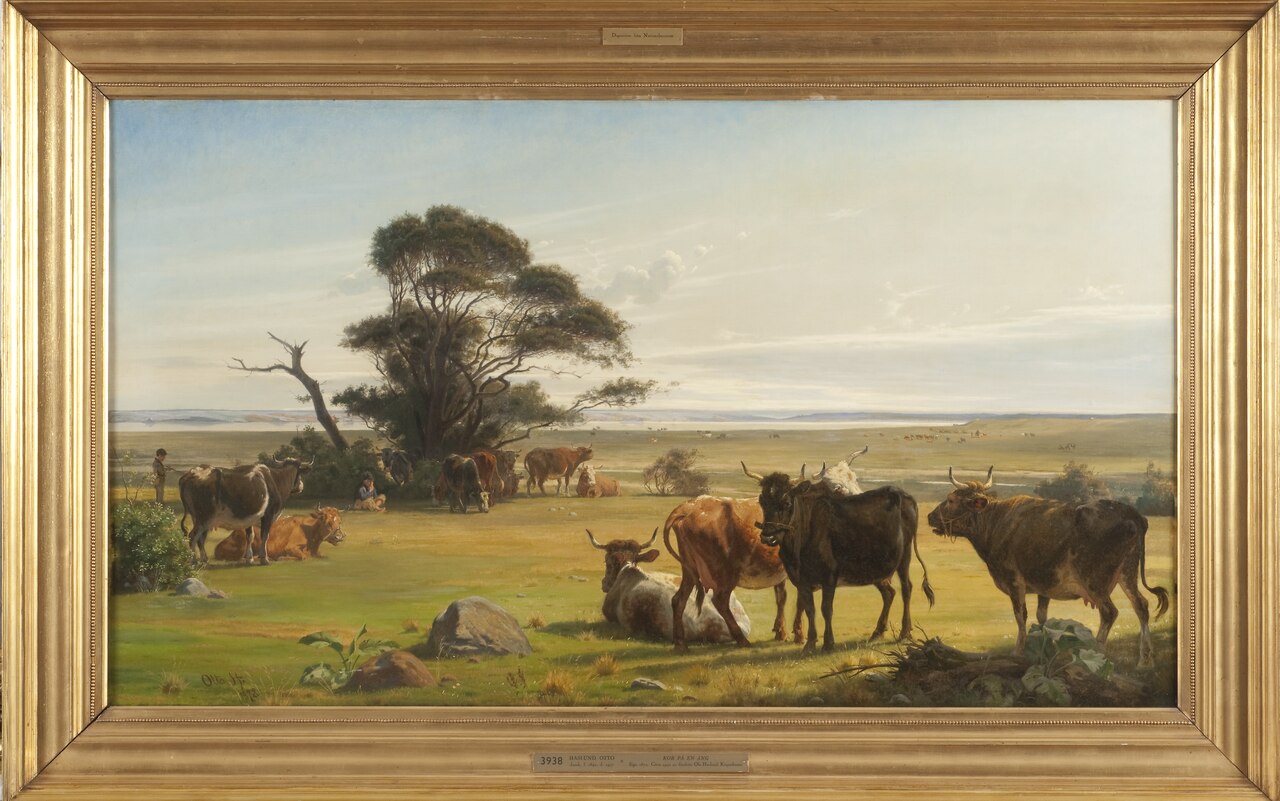
Career and style Haslund began his professional career in the 1860s, a period when Danish art was moving away from the romantic idealisation of earlier decades toward a more realistic, observational approach. His oeuvre does not fit neatly into a single movement; instead, it reflects a pragmatic naturalism that was common among Danish genre painters. He specialised in scenes that highlighted the quiet dignity of everyday life—particularly the interactions of children with one another and with their surroundings, and the pastoral activities of livestock.
His colour palette is characteristically restrained, favouring earth tones, muted greens, and soft blues that convey the subdued light of the Danish landscape. The compositions often place figures or animals in the centre of a calm setting, allowing the viewer to focus on the subject’s expression or behaviour rather than on dramatic narrative. This understated approach aligns Haszell’s work with the broader Scandinavian tradition of portraying the ordinary with affection and respect.
Signature techniques Haslund’s technique combines careful draftsmanship with a subtle handling of oil paint. He employed a layered approach: an initial underpainting to establish tonal values, followed by thin glazes that build colour depth without sacrificing luminosity. In his animal studies, he rendered fur and hide with delicate, almost stippled brushwork, creating a sense of texture while preserving the softness of the animals’ forms. For figures, especially children, his handling is smoother, with blended edges that capture the softness of skin and the playfulness of youthful movement.
Light is a recurring element in his paintings; he often depicts the gentle diffused daylight of early morning or late afternoon, which lends his scenes a timeless quality. The careful observation of light on surfaces—whether on the sheen of a cow’s coat or the dappled shadows on a child's face—demonstrates his commitment to realistic rendering.
Major works - **A Concert: The Artist's Children and their Playmates (1887)** – This composition brings together several children in a domestic interior, each engaged in music‑making. The work exemplifies Haszell’s interest in childhood innocence and his skill at arranging multiple figures within a harmonious space. - **Cows in a Meadow (1872)** and **Cows in a Field (1872)** – Both paintings showcase his talent for animal portraiture. The cows are depicted in a tranquil, open landscape, with meticulous attention to the play of light on their bodies and the surrounding grass. The similarity of the titles reflects the artist’s practice of exploring a theme across several variations. - **Aftenlandskab (1894)** – Translating to “Evening Landscape,” this piece captures the subdued colours of a Danish twilight. The atmospheric perspective and muted palette highlight Haszell’s capacity to convey mood through landscape alone. - **Johan Kjeldahl (1896)** – A portrait of the noted chemist, this work demonstrates Haszell’s ability to render a dignified likeness. While less focused on genre scenes, the portrait maintains the same level of detail and reverence that characterises his broader output.
These works collectively illustrate Haszell’s range—from intimate domestic interiors to expansive rural vistas—while maintaining a consistent visual language centred on calm observation and technical precision.
Influence and legacy Although Haszell never achieved the international fame of some of his contemporaries, his paintings have endured as valuable documents of Danish rural life in the late 19th century. They are frequently cited in studies of genre painting for their authentic portrayal of everyday subjects and for their subtle yet effective use of light. His works are held in several Danish regional museums, where they continue to inform both scholars and the public about the visual culture of the period.
In contemporary Danish art history, Haszell is regarded as a representative figure of the naturalist tradition that bridged the romantic past and the modernist inclinations that followed. His emphasis on children and animals resonates with later artists who sought to celebrate the simple, bucolic aspects of national identity. While his name may not dominate exhibition catalogues, his paintings remain a touchstone for those exploring the quieter side of Denmark’s artistic heritage.
--- Word count: approximately 950 words
Frequently asked questions
Who was Otto Carl Bentzon Haszell?
He was a Danish painter (1842–1917) best known for his gentle, realistic depictions of children and farm animals.
What artistic style or movement is Haszell associated with?
Haszell is not linked to a specific movement; his work reflects the naturalistic, genre‑painting tradition prevalent in late‑19th‑century Denmark.
What are his most famous works?
Key works include *A Concert: The Artist's Children and their Playmates* (1887), *Cows in a Meadow* (1872), *Cows in a Field* (1872), *Aftenlandskab* (1894), and the portrait *Johan Kjeldahl* (1896).
Why is Haszell important in art history?
He provides a clear visual record of Danish rural and domestic life, illustrating the naturalist approach that bridged romantic and modernist tendencies in Scandinavian art.
How can I recognise a Haszell painting?
Look for calm compositions featuring children or livestock, a restrained colour palette, soft lighting, and meticulous brushwork that renders texture without dramatic flourish.