Nardo di Cione
1320 – present
In short
Nardo di Cione (c.1320–?) was a Florentine painter, sculptor and architect, best known as the brother of the celebrated Orcagna. He produced a modest but distinctive body of work in the mid‑fourthteenth century, characterised by lyrical colour and gentle modelling.
Notable works


_-_1939.1.261.a-c_-_National_Gallery_of_Art.jpg)

Early life Nardo di Cione was born in Florence around 1320, into a family that would become one of the city’s most influential artistic dynasties. His father, a modest artisan, provided the young Nardo with a workshop environment in which he and his brothers, Andrea (better known as Orcagna) and Jacopo, were apprenticed. The three brothers joined the Florentine Painters’ Guild (Arte dei Medici e Speziali) early in their careers, a step that gave them access to commissions from churches, civic institutions and private patrons. While documentary evidence about Nardo’s childhood is scarce, the guild records confirm his presence in Florence throughout his formative years.
Career and style Nardo emerged as a painter and sculptor in the 1340s, a period marked by the aftermath of the Black Death and a renewed demand for devotional art. Unlike his brother Orcagna, whose reputation rested on grand architectural schemes and monumental altarpieces, Nardo’s oeuvre is noted for its lyrical sensitivity. Contemporary observers described his work as possessing a "pronounced lyrical vein, a feeling for poetic values, strong human sympathies and great sensitivity to colour as a means of subtle differentiation and soft modelling". This description reflects a style that favours gentle chiaroscuro, delicate drapery and a warm palette, distinguishing his panels from the more austere Florentine trends of the time.
Signature techniques Nardo’s technique combines tempera painting with fine gold leaf application, a common practice in quattrocento panel work. His brushwork is characterised by smooth transitions between light and shadow, creating a soft modelling of faces and fabrics. He frequently employed a subtle gradation of blues and greens to suggest depth, while retaining a bright, luminous quality in the surrounding gold background. In sculpture, he preferred a restrained naturalism, carving figures with a smooth finish that highlights the inherent softness of flesh rather than emphasizing dramatic muscular tension.
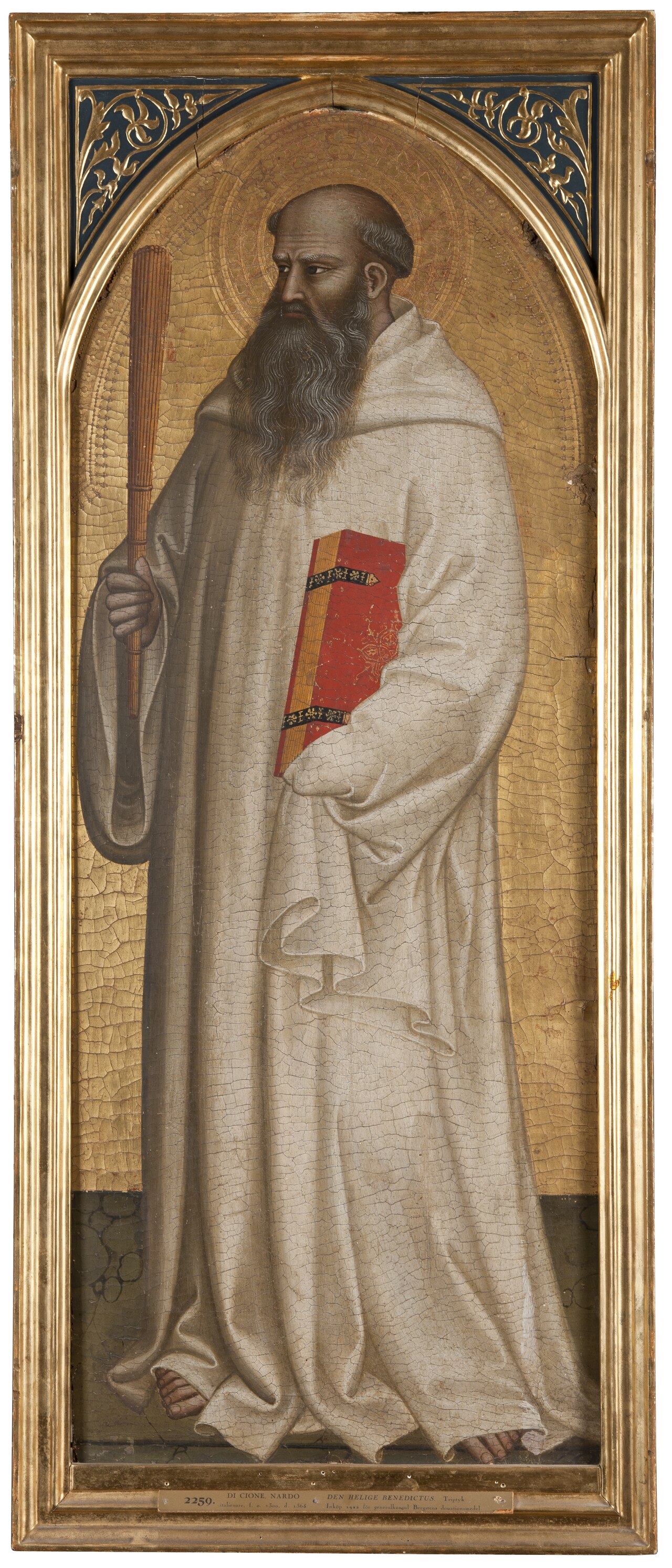
Major works - **Crucifixion (c.1350)** – This panel, likely intended for a Florentine confraternity, shows the crucified Christ rendered with a tender, almost compassionate expression. The use of muted earth tones and a delicate gold halo underscores Nardo’s penchant for subtle colour modulation. - **Triptych of the Throne of Grace (1365)** – A three‑panel altarpiece depicting the Virgin enthroned with the Child and attendant saints. The central panel’s composition demonstrates Nardo’s skill in arranging figures within a harmonious space, while his handling of the saints’ garments reveals his mastery of colour differentiation. - **Madonna and Child, with Saints Peter and John the Evangelist, and Man of Sorrows Triptych (c.1360)** – This complex work combines devotional imagery with narrative elements. Nardo’s rendering of the Madonna’s gentle gaze and the tender interaction between child and saints exemplifies his poetic sensibility. - **Madonna del Parto** – Though less documented, this work follows the tradition of the pregnant Virgin, a motif popular in mid‑fourteenth‑century Florence. Nardo’s version likely reflects his characteristic softness in the depiction of flesh and fabric. - **St Benedict** – A solitary figure of the saint, possibly a portable panel for private devotion. The statue’s serene expression and modest carving align with Nardo’s overall aesthetic of calm and introspection.
Influence and legacy While Nardo di Cione never achieved the fame of his brother Orcagna, his contributions enrich our understanding of Florentine art in the decades after the plague. His gentle colour palette and lyrical approach offered a counterpoint to the more forceful realism that would dominate later quattrocento painting. Scholars view Nardo as an intermediary figure whose work bridges the decorative Gothic tradition with the emerging humanist tendencies of the Renaissance. Moreover, his collaborative projects with his brothers helped solidify the Cione family’s reputation as a cornerstone of Florentine artistic production, influencing younger painters who sought a softer, more emotive visual language.
In contemporary scholarship, Nardo’s panels are studied for their technical execution and for the way they reflect the spiritual needs of a city recovering from catastrophe. His works, though fewer in number, continue to be displayed in Florentine museums and churches, where they serve as exemplars of mid‑fourteenth‑century devotional art and the nuanced individuality possible within a family workshop.
Frequently asked questions
Who was Nardo di Cione?
Nardo di Cione was a Florentine painter, sculptor and architect active in the mid‑fourthteenth century, best known as the brother of the celebrated Orcagna.
What style or movement is Nardo di Cione associated with?
His work is not tied to a specific movement, but it is characterised by a lyrical, poetic use of colour and soft modelling that distinguishes it from the harsher Gothic styles of his time.
What are Nardo di Cione’s most famous works?
His most recognised pieces include the Crucifixion (c.1350), the Triptych of the Throne of Grace (1365), and the Madonna and Child with Saints Peter and John the Evangelist triptych (c.1360).
Why is Nardo di Cione important in art history?
He provides a nuanced example of Florentine devotional art after the Black Death, showing how softer, more emotive visual language co‑existed with the dominant Gothic aesthetic.
How can I recognise a painting by Nardo di Cione?
Look for gentle colour transitions, a warm palette, subtle gold leaf accents, and a calm, compassionate expression in figures, especially in the rendering of drapery and flesh.