Matteo Perez d'Aleccio
1547 – 1616
In short
Matteo Perez d'Aleccio (1547–1616) was a Mannerist painter born in Alezio who spent most of his career in Peru and died in Lima. He is best known for a series of vivid, maritime‑themed works depicting the 1565 Siege of Malta.
Notable works
_-_The_Siege_of_Malta,_Capture_of_St_Elmo,_23_June_1565_-_BHC0254_-_Royal_Museums_Greenwich.jpg)
_-_The_Siege_of_Malta,_Arrival_of_the_Turkish_Fleet,_20_May_1565_-_BHC0252_-_Royal_Museums_Greenwich.jpg)
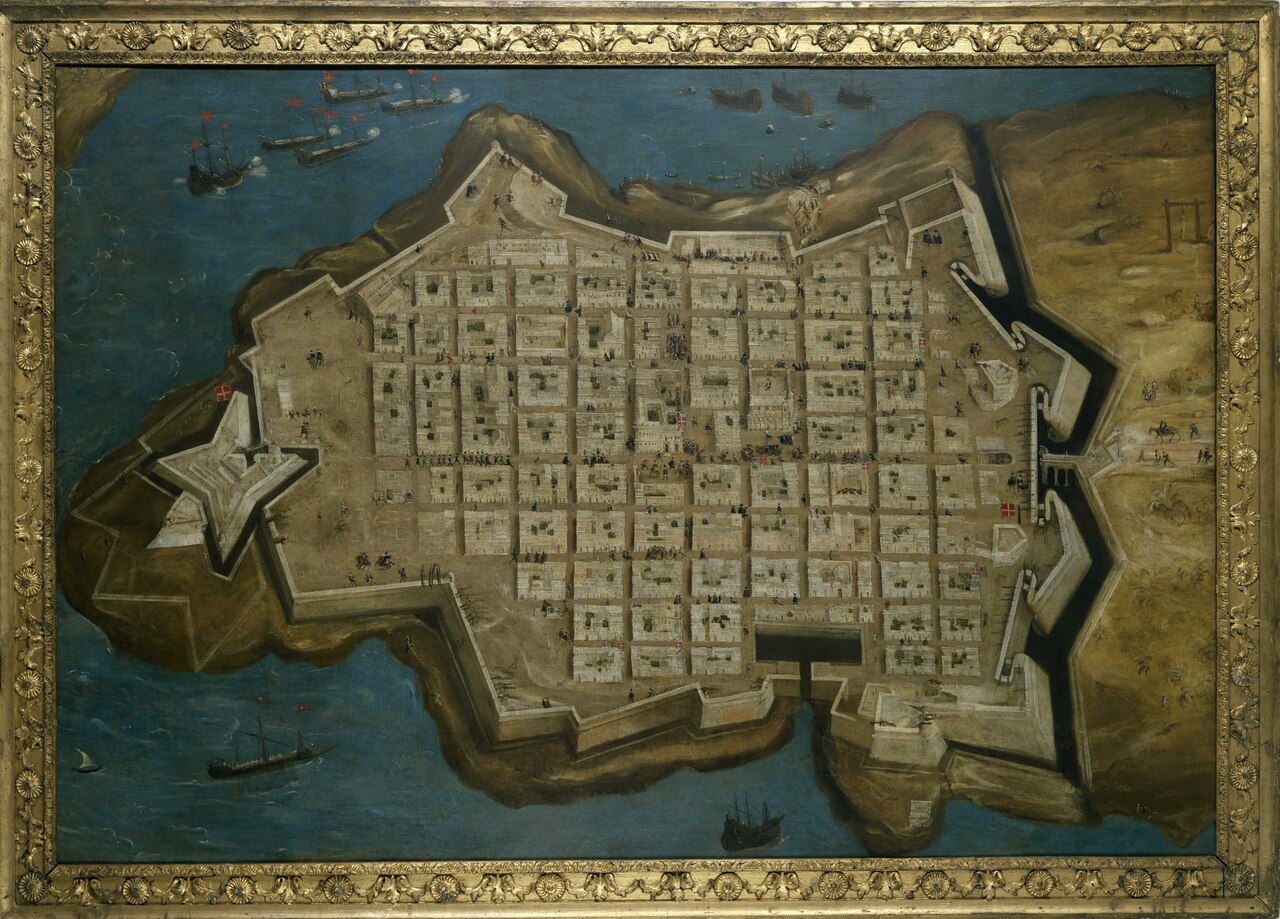
_-_The_Siege_of_Malta,_Attack_on_the_Post_of_the_Castilian_Knights,_21_August_1565_-_BHC0257_-_Royal_Museums_Greenwich.jpg)
_-_The_Siege_of_Malta,_Siege_and_Bombardment_of_Saint_Elmo,_27_May_1565_-_BHC0253_-_Royal_Museums_Greenwich.jpg)
Early life Matteo Perez d'Aleccio was born in 1547 in the town of Alezio, a small community in the southern Italian peninsula. Details of his family background and early artistic training are scarce, and his nationality is recorded as unknown, reflecting the fluid identities of many itinerant artists of the sixteenth century. Contemporary records suggest that he was exposed to the flourishing workshops of the Italian Mannerist tradition, where a heightened emphasis on artificiality, elongated forms, and complex compositions dominated the visual culture. By the time he reached his twenties, d'Aleccio had absorbed the stylistic vocabulary of the period, preparing him for a career that would soon take him far from his native region.
Career and style Around the late 1570s, d'Aleccio embarked on a journey that would define his professional life: he travelled to the Viceroyalty of Peru, a Spanish colonial territory that was emerging as a new centre for artistic production. The exact date of his arrival remains uncertain, but archival references place him in the city of Lima by the early 1580s. In Peru he found a receptive patronage network that included clergy, colonial officials, and wealthy merchants, all eager for religious and historical imagery that could reinforce both piety and imperial prestige.
His work reflects the hallmarks of Mannerism—exaggerated perspective, elegant yet somewhat distorted figures, and a vivid colour palette—while also incorporating local influences. The artist frequently employed dramatic chiaroscuro to heighten tension, a technique that resonated with the narrative intensity of his chosen subjects. D'Aleccio’s canvases often present crowded scenes where multiple episodes unfold simultaneously, a compositional strategy that encourages the viewer to explore the painting as a visual story rather than a static tableau.
Signature techniques Several technical traits identify d'Aleccio’s hand. First, he favoured a thin, almost calligraphic brushstroke for the rendering of fabrics and armor, which creates a sense of movement even within static figures. Second, his use of colour is both bold and selective: deep ultramarine and vermilion dominate the sky and sea, while flesh tones remain comparatively restrained, drawing attention to the narrative focal points. Third, the artist applied a layered glazing method, allowing underlying tones to glow through successive layers of pigment; this lends his works a luminous quality that is especially evident in depictions of fire and smoke. Finally, he often incorporated gilt detailing on weapons and architectural elements, a nod to the luxurious tastes of his elite patrons.
Major works The most documented series by d'Aleccio consists of five paintings that dramatise the 1565 Siege of Malta, each dated 1550—a curious anachronism that reflects the artist’s practice of creating historical scenes long after the events they portray. The series includes:
1. The Siege of Malta: Capture of St Elmo, 23 June 1565 – This canvas captures the moment the Knights of Malta seized the strategic fort of St Elmo. D'Aleccio emphasizes the clash of steel and the frantic motion of soldiers, using a steep diagonal composition that drives the eye toward the fort’s battered walls.
2. The Siege of Malta: Arrival of the Turkish Fleet, 20 May 1565 – Here the artist renders a fleet of Ottoman galleys approaching the island’s coastline under a storm‑filled sky. The ships are rendered with meticulous attention to rigging, and the turbulent sea is depicted through sweeping brushstrokes that convey both the power of nature and the looming threat.
3. The Siege of Malta: Valetta, 13 September 1565 – This work celebrates the eventual victory of the Knights, focusing on the fortified city of Valletta. D'Aleccio uses light to highlight the triumphal banners raised atop the city walls, while the surrounding chaos recedes into shadow, underscoring the contrast between order and disorder.
4. The Siege of Malta: Attack on the Post of the Castilian Knights, 21 August 1565 – The painting portrays a fierce melee at a forward post manned by Castilian knights. The artist’s skillful rendering of armor reflects his knowledge of contemporary military dress, and the composition is punctuated by an explosion of cannon fire that illuminates the battlefield.
5. The Siege of Malta: Siege and Bombardment of Saint Elmo, 27 May 1565 – In the final canvas, d'Aleccio returns to Saint Elmo, this time depicting the sustained bombardment that preceded its capture. The work is notable for its atmospheric treatment of smoke, with layers of semi‑transparent glaze that give the scene a hazy, almost ethereal quality.
Collectively, these paintings demonstrate d'Aleccio’s ability to fuse European historical narrative with a visual language that appealed to a colonial audience. Though the dates on the canvases pre‑date the actual events, the works were likely produced later in his career, perhaps as commissions for European patrons in Lima who desired visual records of famed battles.
Influence and legacy Matteo Perez d'Aleccio’s legacy is twofold. Within the Peruvian artistic milieu, he contributed to the development of a hybrid style that combined European Mannerist conventions with the emerging baroque sensibility that would dominate the region in the seventeenth century. His use of dramatic lighting and dynamic composition influenced a generation of local painters who adapted his techniques for religious altarpieces and civic commissions.
Beyond the Andes, the Siege of Malta series remains a key reference point for scholars studying the transmission of European historical subjects to the New World. The paintings are valuable not only for their aesthetic qualities but also for what they reveal about the cultural aspirations of colonial elites, who sought to align themselves with the heroic narratives of Europe while asserting their own place within the empire.
Although Matteo Perez d'Aleccio died in Lima in 1616, his works continue to be exhibited in museums across South America and Europe. Recent exhibitions have highlighted his role as a cultural bridge, emphasizing how his art reflects the fluid identities of artists who navigated multiple worlds during the early modern period. Contemporary art historians regard him as an exemplar of the trans‑Atlantic exchange that shaped the visual culture of the seventeenth century.
Overall, d'Aleccio’s career illustrates the capacity of Mannerist aesthetics to adapt to new contexts, and his surviving canvases provide a vivid testament to the artistic vibrancy of the Spanish colonies during a period of intense religious and political transformation.
Frequently asked questions
Who was Matteo Perez d'Aleccio?
Matteo Perez d'Aleccio (1547–1616) was a Mannerist painter born in Alezio who spent most of his artistic career in Peru and died in Lima.
What artistic movement did he belong to?
He worked within the Mannerist style, characterised by elongated figures, complex compositions and heightened colour contrasts.
What are his most famous works?
His most renowned paintings are a series of five canvases depicting the 1565 Siege of Malta, each dated 1550, including scenes such as the Capture of St Elmo and the Arrival of the Turkish Fleet.
Why is he important in art history?
D'Aleccio exemplifies the trans‑Atlantic exchange of artistic ideas, merging European Mannerist techniques with colonial Peruvian patronage and influencing subsequent local painters.
How can I recognise a Matteo Perez d'Aleccio painting?
Look for thin, calligraphic brushwork, vivid ultramarine and vermilion hues, layered glazing that creates a luminous effect, and dramatic chiaroscuro that accentuates narrative tension.