Giuseppe Arcimboldo
1527 – 1593
In short
Giuseppe Arcimboldo (1527–1593) was an Italian Mannerist painter from Milan, celebrated for his inventive portraiture that assembles heads from fruits, vegetables, books and other everyday objects.
Notable works



Early life Giuseppe Arcimboldo was born in 1527 in Milan, then part of the Duchy of Milan. Little is recorded about his family background, but archival sources indicate that he received a conventional apprenticeship in the workshop of a local painter, where he learned the fundamentals of drawing, composition and the techniques of oil painting. Milan in the early sixteenth century was a vibrant centre of trade and humanist scholarship, and the city’s environment exposed the young Arcimboldo to a wide range of material culture – from the produce of the nearby Lombard plains to the printed books that circulated in its universities.
Career and style By the 1550s Arcimboldo had established himself as a court painter. He entered the service of the Habsburg court in Vienna, and later followed Emperor Maximilian II to Prague, where he became a favourite of the imperial household. The court’s cosmopolitan atmosphere, coupled with the emperor’s interest in natural philosophy, encouraged Arcimboldo to experiment beyond the conventional boundaries of portraiture.
His style is firmly rooted in Mannerism, a movement characterised by artificiality, elongated forms and a preference for intellectual puzzles over naturalistic representation. Arcimboldo embraced these qualities, using exaggerated proportions and improbable juxtapositions to create visual riddles. Rather than seeking to reproduce the likeness of a sitter, he constructed allegorical images that conveyed moral, scientific or seasonal themes. The resulting works are simultaneously whimsical and meticulously crafted, reflecting a balance between playful imagination and the technical rigour of a trained painter.
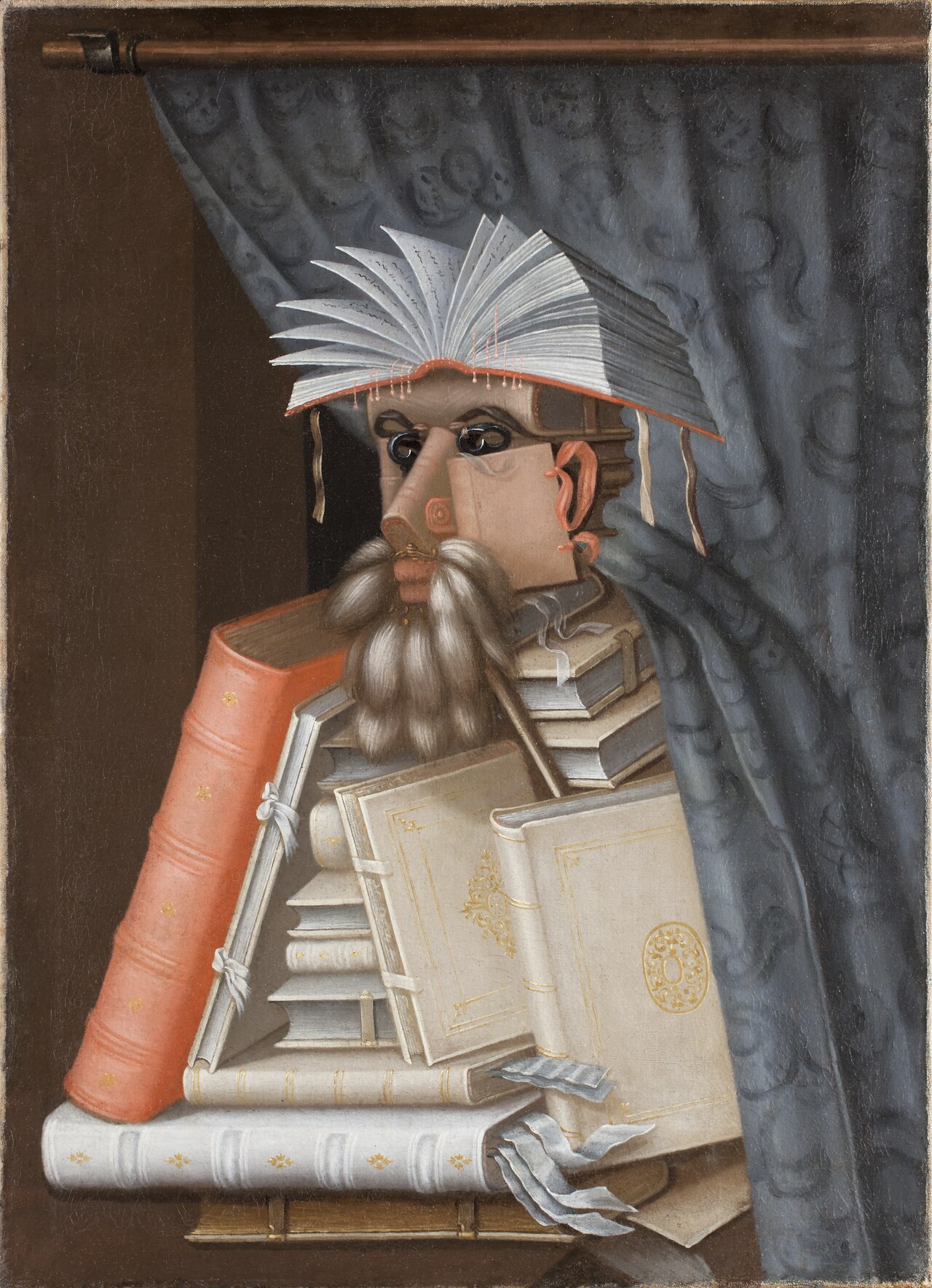
Signature techniques Arcimboldo’s signature technique involves assembling the constituent parts of a portrait from a collection of objects that bear symbolic meaning. He would sketch the overall head shape first, then populate it with items that related to the intended theme. For example, a portrait of a scholar might be built from books, ink pots and writing implements; a seasonal portrait would incorporate the fruits and vegetables that typify a particular time of year.
The artist demonstrated an acute knowledge of botanical and zoological forms, rendering each element with a level of detail that suggests direct observation. He employed a restrained palette, allowing the natural colours of the objects to dominate the composition. Light and shadow are used to model the head’s three‑dimensionality, while the surrounding background is often muted, keeping the viewer’s focus on the intricate assembly of the subject.
Major works - **Rudolf II as Vertumnus (1591)** – This portrait of the Bohemian emperor depicts him as the Roman god of seasons and change, Vertumnus. Arcimboldo constructed the emperor’s face from an assortment of fruits, vegetables, and flowers that change with the seasons, underscoring Rudolf’s interest in alchemy and the natural world. The painting was displayed in the imperial collection and remains a prime example of the artist’s ability to merge portraiture with allegory.
- The Four Seasons (1563) – A series of four composite heads, each representing a season. Spring is formed from blossoms and herbs, Summer from ripe fruits, Autumn from grapes and nuts, and Winter from roots and winter vegetables. The series not only showcases Arcimboldo’s skill in arranging disparate objects into a coherent likeness, but also reflects contemporary Renaissance ideas about the cyclical nature of time.
- The Librarian (1556) – In this work, the sitter’s visage is composed entirely of books, scrolls, and writing tools. The portrait functions as a visual pun on scholarly erudition, suggesting that the subject’s identity is inseparable from the knowledge he holds. The careful rendering of leather‑bound volumes and the delicate play of light across spines demonstrate Arcimboldo’s technical mastery.
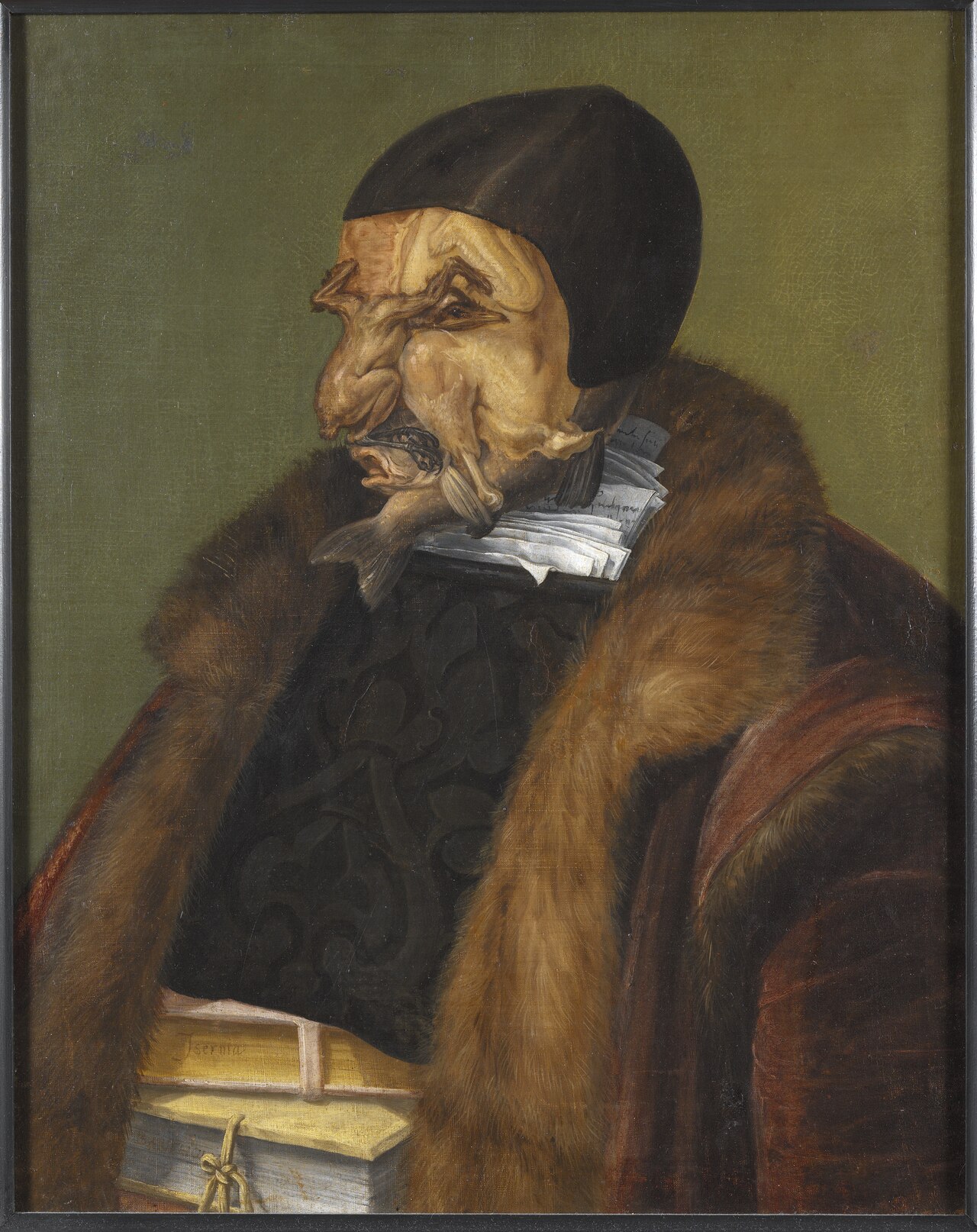
- The Jurist (1566) – Similar in concept to The Librarian, this portrait assembles legal texts, parchment rolls and a quill to form the head of a learned lawyer. The work comments on the intellectual authority of the legal profession, while also providing a witty visual metaphor for the idea that a jurist’s thoughts are literally bound in law books.
- The Four Elements (1566) – This quartet portrays Earth, Water, Air and Fire through composite heads made from symbolic materials: rocks and minerals for Earth, shells and fish for Water, birds and clouds for Air, and flames and volcanic rock for Fire. The series reflects the Renaissance fascination with the classical elements and demonstrates Arcimboldo’s capacity to translate abstract concepts into tangible visual forms.
Influence and legacy Arcimboldo’s imaginative approach fell out of favour after his death in 1593, as the Baroque style favoured dramatic realism over intellectual puzzles. Nevertheless, his work resurfaced in the nineteenth century, influencing the Symbolist and Surrealist movements. Artists such as Salvador Dalí and René Magritte cited Arcimboldo as a precursor, admiring his capacity to merge the ordinary with the uncanny.
In contemporary culture, Arcimboldo’s portraits are frequently reproduced on postcards, textbooks and popular media, attesting to their enduring visual appeal. His method of constructing meaning from everyday objects anticipates modern practices in collage, assemblage and even digital image manipulation. Scholars continue to study his paintings as examples of Renaissance allegory, scientific curiosity and the playful side of Mannerist art.
Arcimboldo died in Milan in 1593, leaving behind a body of work that challenges the boundaries between portraiture, still‑life and conceptual art. His legacy endures as a testament to the power of imagination within the disciplined framework of Renaissance painting.
Frequently asked questions
Who was Giuseppe Arcimboldo?
Giuseppe Arcimboldo (1527–1593) was an Italian Mannerist painter from Milan, best known for creating portrait heads assembled from fruits, vegetables, books and other objects.
What artistic movement did Arcimboldo belong to?
He worked within the Mannerist movement, which favoured artificial composition, elongated forms and intellectual puzzles over naturalistic representation.
What are Arcimboldo's most famous works?
His most celebrated paintings include Rudolf II as Vertumnus, The Four Seasons, The Librarian, The Jurist and The Four Elements.
Why is Arcimboldo important in art history?
Arcimboldo pioneered a unique form of allegorical portraiture that blends still‑life and symbolism, influencing later Symbolist and Surrealist artists and prefiguring modern collage and assemblage techniques.
How can I recognise an Arcimboldo painting?
Look for portrait heads composed entirely of recognizable objects—fruits, vegetables, books or animals—rendered with realistic detail, often forming seasonal or thematic allegories.