Marie-Gabrielle Capet
1761 – 1818
In short
Marie‑Gabrielle Capet (1761–1818) was a French Neoclassical portraitist who trained under Adélaïde Labille‑Guiard in Paris. She is noted for her oil, watercolour and miniature portraits, including a self‑portrait (1783) and several distinguished commissions for the French elite.
Notable works


Early life Marie‑Gabrielle Capet was born in 1761 in Lyon, a city with a vibrant artistic community but far from the principal centres of French academic art. Little is known about her family background or her earliest artistic education, and contemporary records do not detail any formal apprenticeship before she moved to Paris. The scant evidence suggests that she came from a modest, perhaps bourgeois, household that was able to support her relocation to the capital in pursuit of artistic training.
Career and style In 1781 Capet entered the studio of Adélaïde Labille‑Guiard, one of the few women artists who had achieved official recognition at the Académie royale de peinture et de sculpture. Labille‑Guiard’s workshop was notable for its openness to female pupils and for its emphasis on the emerging Neoclassical aesthetic, which prized clarity of line, restrained colour, and moral seriousness derived from classical antiquity. Under Labille‑Guiard’s mentorship, Capet honed her technical skills and absorbed the prevailing Classicist ideals.
Capet quickly distinguished herself as a portrait painter. The late eighteenth‑century French art market placed a high premium on portraiture, both as a means of asserting social status and as a vehicle for the dissemination of personal and political identities. Capet’s clientele comprised members of the educated bourgeoisie and, after the Revolution, a number of newly ennobled individuals. Her works demonstrate a measured compositional balance, a muted palette that favours earth tones and soft whites, and a focus on the sitter’s character rather than overt theatricality. Though she worked within the Neoclassical vocabulary, her portraits retain a delicate sensitivity that reflects the influence of Labille‑Guiard’s own lyrical approach.
Signature techniques Capet’s oeuvre spans oil painting, watercolour, and miniature portraiture, each medium demanding a distinct set of technical solutions. In oil works she employed a thin, glaze‑like layering of pigments, allowing subtle modelling of facial features and the rendering of fine fabrics. Her handling of light is restrained; she often illuminated the face from a single, diffused source, producing a gentle chiaroscuro that enhances the sitter’s natural expression.
When working in watercolour, Capet favoured a wet‑on‑wet technique that produced soft transitions of colour, ideal for rendering delicate skin tones. She combined this with precise, dry‑brush detailing for hair and accessories, achieving a contrast between the ethereal background and the crisp rendering of the subject’s attire.
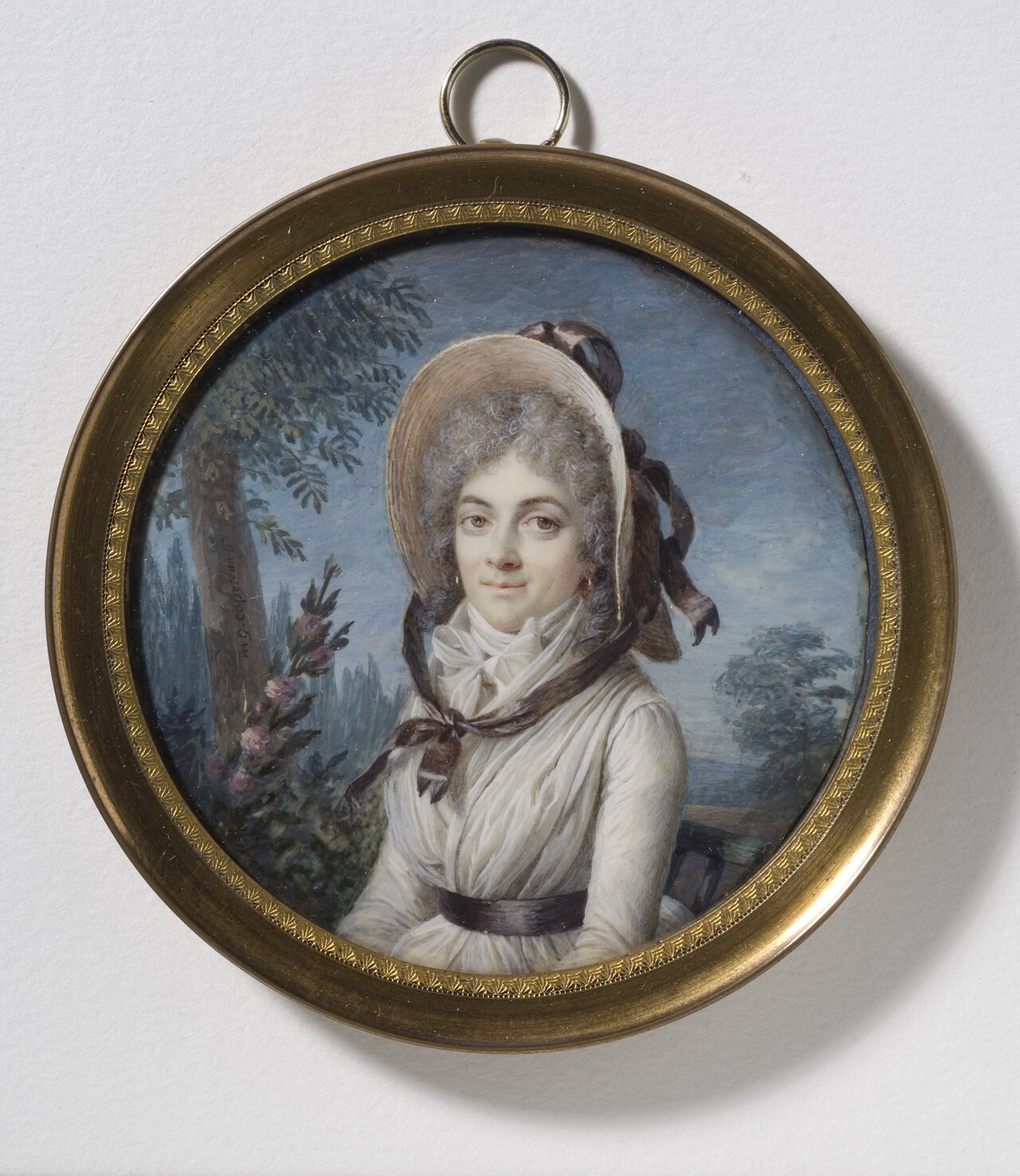
Miniature portraits required an even higher level of precision. Capet painted on ivory or vellum using gouache and fine brushes, achieving luminous effects through the translucent quality of the substrate. Her miniatures are characterised by meticulous brushwork, an economy of detail that nevertheless conveys the sitter’s individuality, and a subtle use of gold leaf or metallic pigments to highlight jewellery and other ornaments.
Major works Capet’s most celebrated pieces highlight both her technical versatility and her capacity to capture the social milieu of her time.
- Self‑portrait (1783) – Executed in oil, this work presents the artist with a calm, introspective gaze. The composition is simple, with a plain background that draws attention to Capet’s face and the delicate rendering of her hair and clothing. The portrait underscores her confidence as a professional woman artist in a male‑dominated field.
- Portrait of Joseph Benoît Suvée (1799) – A striking oil portrait of the young painter who would later become a prominent academician. Capet renders Suvée with a thoughtful expression, his hands clasped, and a subdued palette that accentuates the intellectual atmosphere of the studio.
- Portrait of Anne‑Félicité Grésille (1763‑1826) (1785) – This watercolour portrait captures the elegance of the Parisian salonnière. The delicate wash of colour and the finely detailed rendering of the sitter’s lace collar demonstrate Capet’s command of the medium.
- Portrait of the Late Madame Vincent (Studio Scene) (1808) – In this oil composition, Capet portrays the deceased Madame Vincent surrounded by studio paraphernalia, a homage to the artistic community. The work is notable for its narrative quality, integrating symbols of the painter’s craft within a solemn tribute.
- Miniature portrait of Stéphanie‑Félicité Ducrest de St Aubin (1798) – Executed on ivory, this miniature exemplifies Capet’s mastery of the format. The sitter’s refined features and the subtle play of light across the miniature’s surface reveal Capet’s meticulous attention to detail and her ability to convey personality within a very limited scale.
These works collectively illustrate Capet’s adaptability across media and her nuanced approach to portraiture, balancing the ideals of Classicism with a personal sensitivity.
Influence and legacy Although Marie‑Gabrielle Capet never attained the renown of some of her male contemporaries, her career offers valuable insight into the opportunities and constraints faced by women artists in late‑eighteenth‑ and early‑nineteenth‑century France. Her successful navigation of the Parisian art world, facilitated by her apprenticeship with Labille‑Guiard, demonstrates how mentorship and networks could enable women to practice professionally.
Capet’s portraits serve as documentary records of the social elite during a period of profound political change, from the Ancien Régime through the Revolution and into the Napoleonic era. Art historians regard her work as an example of the subtle, restrained aesthetic that characterised French Neoclassicism, while also appreciating the empathetic portrayal of her subjects, which anticipates the more intimate portraiture of the early nineteenth century.
In recent decades, scholarship on women artists has revived interest in Capet’s oeuvre, leading to exhibitions that re‑exhibit her miniatures and oil portraits alongside those of her teacher Labille‑Guiard. Her legacy endures in the study of gender dynamics within the French Academy, the development of portraiture, and the technical achievements of women working across multiple mediums.
Capet died in Paris in 1818, leaving behind a modest but significant body of work that continues to inform our understanding of Neoclassical portraiture and the role of women artists in shaping the visual culture of their time.
Frequently asked questions
Who was Marie‑Gabrielle Capet?
She was a French Neoclassical portrait painter (1761–1818) who trained under Adélaïde Labille‑Guiard and worked mainly in oil, watercolour and miniature formats.
What artistic movement did she belong to?
Capet painted in the Classicist, or Neoclassical, style that emphasized clear lines, restrained colour and moral seriousness derived from antiquity.
What are her most famous works?
Her best‑known pieces include the Self‑portrait (1783), Portrait of Joseph Benoît Suvée (1799), Portrait of Anne‑Félicité Grésille (1785), Portrait of the Late Madame Vincent (1808) and a miniature of Stéphanie‑Félicité Ducrest de St Aubin (1798).
Why is she important in art history?
Capet exemplifies the professional opportunities and artistic contributions of women in late‑18th‑century France, and her portraits provide valuable visual documentation of the era’s social elite.
How can I recognise a Capet painting?
Look for a restrained palette, smooth modelling of faces, delicate handling of fabrics, and a calm, introspective mood—often with fine brushwork in miniatures and a subtle, single‑light source in oils.