Lucas van Valckenborch
1535 – 1597
In short
Lucas van Valckenborch (1535–1597) was a Flemish Baroque painter from the Habsburg Netherlands, renowned for his detailed landscapes and occasional portraiture. He served as court painter to Archduke Matthias and later worked in Austria and Germany, leaving a legacy that helped shape Northern European landscape painting.
Notable works



Early life Lucas van Valckenborch was born in 1535 in the university town of Leuven, in what is now Belgium. He came from a family of artists; his father and several brothers were active painters, providing an environment rich in artistic training. Although the exact details of his apprenticeship are not documented, it is clear that Lucas absorbed the techniques and visual language of the Flemish tradition from an early age, learning to render both figures and natural settings with a high degree of realism.
Career and style In the 1560s Lucas moved to Brussels, where he entered the service of Archduke Matthias, the governor of the Spanish Netherlands. The court appointment gave him access to a wide range of patronage and allowed him to travel extensively. By the early 1580s he had established a reputation as a skilled landscape painter, a genre that was gaining popularity among the northern elite. After the Archduke’s death, van Valckenborch relocated to Austria, joining several members of his extended family who had fled the Low Countries for religious reasons. He later settled in Frankfurt, where he continued to work until his death in 1597.
His paintings combine the meticulous observation of nature typical of the Flemish tradition with a burgeoning Baroque sense of drama. Van Valckenborch’s landscapes often feature expansive vistas, dramatic skies, and a careful balance between naturalistic detail and idealised composition. While he remained rooted in the Northern realist approach, his work anticipates the more theatrical lighting and dynamic arrangements that would become hallmarks of the Baroque.
Signature techniques Van Valckenborch’s technique is characterised by several recurring elements:
* Atmospheric perspective – He used gradations of colour and clarity to convey depth, making distant hills appear bluish‑grey while foreground elements retain vivid greens and earth tones. * Detailed foliage and rockwork – His trees, shrubs, and rock formations are rendered with fine brushwork, reflecting a close study of the natural world. * Complex architectural motifs – In works such as *The Tower of Babel* he integrates monumental architecture into the landscape, using linear perspective to create a sense of scale. * Narrative insertions – Small groups of figures – peasants, merchants, or travelers – are inserted into the scenery, providing a human narrative that animates the environment. * Controlled lighting – He often employs a strong, directional light source that highlights architectural elements or foliage, creating contrast that enhances the three‑dimensional effect.
These techniques together give his paintings a layered, almost cinematic quality, allowing viewers to wander through the scene while appreciating the artist’s compositional skill.
Major works
* The Tower of Babel (1594) – This large oil on canvas depicts the biblical tower as an imposing, spiralling structure set within a bustling construction site. Van Valckenborch uses precise linear perspective to convey the tower’s height, while a crowd of workers, merchants, and onlookers populate the lower levels. The painting reflects both his interest in grand allegorical subjects and his mastery of architectural rendering.
* Zicht op Antwerpen met de bevroren Schelde (1593) – Translating to “View of Antwerp with the Frozen Scheldt,” this work captures a winter scene of the river frozen over, with skaters and merchants moving across the ice. The composition balances the cold, shimmering surface with the warm glow of town lights, demonstrating van Valckenborch’s ability to depict seasonal atmospheres.
* Mountainous landscape (1582) – In this earlier piece, the artist presents a rugged, imagined mountain range populated by shepherds and travelers. The work showcases his skill in rendering rock textures and atmospheric depth, and it foreshadows later Baroque landscape conventions.
* Peasant Wedding. The Wedding Dance in the Open Air (1574) – This genre scene portrays a rustic wedding celebration set in a meadow, with musicians, dancers, and a lively crowd. Though the focus is on human activity, the surrounding countryside remains integral, illustrating van Valckenborch’s talent for integrating narrative figures within an expansive natural setting.
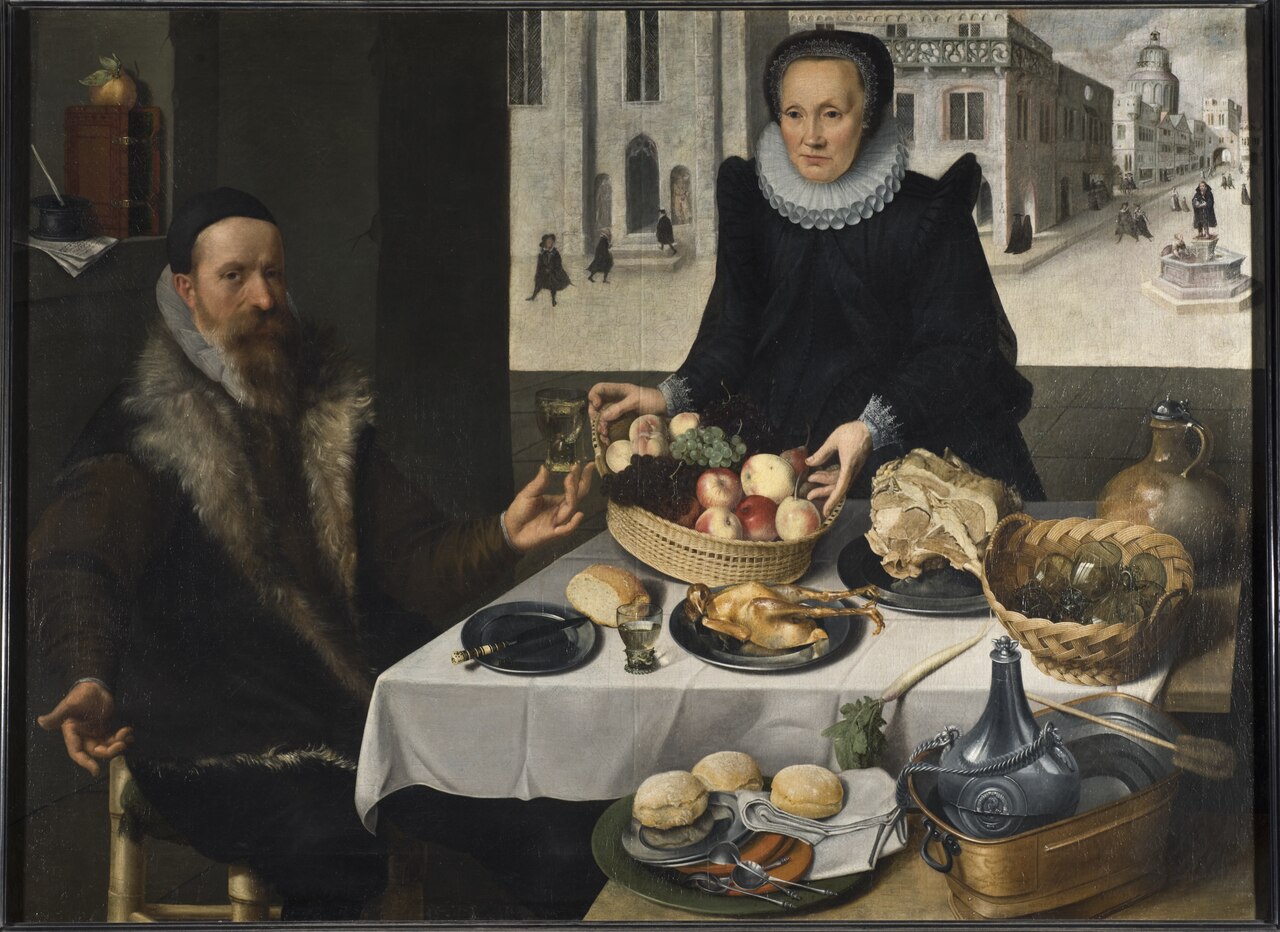
* Double Portrait of an Elderly Couple (1600) – Dated slightly after the artist’s death, this portrait is generally attributed to his workshop or to a follower who completed the commission using van Valckenborch’s design. The painting shows an elderly couple seated before a modest interior, rendered with the same careful attention to texture and light that characterises his larger works.
Influence and legacy Lucas van Valckenborch played a pivotal role in the development of the Northern European landscape tradition. By combining the detailed observation of Flemish realism with the emerging Baroque sensibility, he helped bridge the gap between the early Renaissance landscape and the more dramatic scenes of the 17th century. His works were collected by aristocratic patrons across the Habsburg territories, and his stylistic innovations were passed on through his brothers, nephews and later generations of German and Austrian painters.
The emphasis on atmospheric depth and architectural integration found in his paintings influenced artists such as Jan Brueghel the Elder and later landscape specialists like Joos de Momper. Moreover, his movement between the Low Countries, the Austrian court, and Frankfurt created a cultural conduit that facilitated the exchange of artistic ideas between the north and the central European baroque centres.
Today, van Valckenborch is recognised not only for his prolific output but also for the way his paintings capture the transition from a purely descriptive landscape to a more expressive, narrative-driven genre. His surviving works, housed in major European museums, continue to be studied for their technical mastery and for the insight they provide into the visual culture of the late 16th century.
Frequently asked questions
Who was Lucas van Valckenborch?
Lucas van Valckenborch (1535–1597) was a Flemish Baroque painter from the Habsburg Netherlands, best known for his detailed landscapes and occasional portrait and allegorical works.
What artistic movement is he associated with?
He is associated with Flemish Baroque painting, a style that blends the realism of the Northern Renaissance with the dramatic lighting and dynamic compositions of the Baroque.
What are his most famous works?
His most renowned pieces include *The Tower of Babel* (1594), *Zicht op Antwerpen met de bevroren Schelde* (1593), *Mountainous landscape* (1582), *Peasant Wedding. The Wedding Dance in the Open Air* (1574), and the attributed *Double Portrait of an Elderly Couple* (1600).
Why is Lucas van Valckenborch important in art history?
He helped shape the Northern European landscape tradition, introducing atmospheric perspective and integrating architectural elements, influencing later Baroque landscape painters across the Habsburg lands.
How can I recognise a painting by Lucas van Valckenborch?
Look for meticulous foliage, strong directional light, expansive vistas with detailed rockwork, and often small narrative figures set within a carefully rendered natural environment.