Joseph Stallaert
1825 – 1903
In short
Joseph Stallaert (1825–1903) was a Belgian painter and art educator whose work specialised in Classicist, academic scenes from antiquity, modelled on the French neoclassical tradition of Jacques‑Louis David.
Notable works


.jpg)
Early life Joseph Stallaert was born in 1825 in the small Flemish town of Merchtem, situated in the province of Brabant. Little is recorded about his family background, but the cultural milieu of early‑19th‑century Belgium offered a growing network of academies and salons that nurtured artistic talent. Stallaert’s formative years coincided with the consolidation of the Belgian state (1830) and a renewed interest in classical education, both of which would shape his later artistic direction.
Career and style Stallaert pursued his artistic training within the academic system that dominated Belgian art schools in the mid‑1800s. Immersed in the rigorous curriculum of drawing from the antique, life‑model studies, and compositional theory, he absorbed the principles of the French neoclassical tradition, especially the legacy of Jacques‑Louis David. This influence is evident in his preference for historical and mythological subjects, rendered with a clear, orderly composition, restrained colour palette, and a focus on idealised anatomy.
After completing his studies, Stallaert established himself as a professional painter in Brussels, the cultural heart of Belgium. He also took on teaching responsibilities, becoming a respected instructor at the Royal Academy of Fine Arts. His dual role as practitioner and educator allowed him to disseminate the academic style to a new generation of Belgian artists, reinforcing the classicist current that coexisted with the emerging realism and impressionist tendencies of the late 19th century.
Stallaert’s oeuvre remained firmly rooted in the academic tradition throughout his career. He eschewed the avant‑garde experiments of his younger contemporaries, preferring instead the timeless narrative power of antiquity. His works often depict dramatic moments drawn from Greek and Roman mythology, treated with a moralising tone that reflected the didactic aims of academic art.
Signature techniques Stallaert’s technique is characterised by meticulous draftsmanship and a polished finish. He employed a layered approach, beginning with a precise underdrawing that defined anatomical accuracy and spatial relationships. His handling of chiaroscuro—subtle gradations of light and shadow—creates a sculptural quality, giving his figures a sense of three‑dimensionality against often austere backgrounds.
His palette typically favours muted earth tones punctuated by selective highlights of warm reds or golden hues, a strategy that draws the viewer’s eye to focal points such as a heroine’s face or a pivotal gesture. Stallaert also demonstrated a refined use of glazing, allowing colour to build up gradually and achieve the luminous effect prized by academic painters.
Major works - **Death of Dido (1872)** – This canvas portrays the tragic end of the Carthaginian queen, a theme popular among neoclassical painters. Stallaert captures the emotional intensity of Dido’s final moments through a restrained composition, with the queen positioned centrally, illuminated against a darkened interior. The work reflects his mastery of narrative drama and his commitment to classical subject matter.
- Polyxena Sacrificed on Achilles' Pyre (1875) – In this earlier rendition of the Polyxena myth, Stallaert presents the heroine about to be offered as a sacrifice. The painting demonstrates his skill in arranging complex groupings of figures while maintaining clarity of action. The muted colour scheme and careful lighting underscore the solemnity of the scene.
- Polyxena on Achilles' Stake (1881) – A later treatment of the same legend, this version shows a more mature handling of atmosphere. Stallaert deepens the psychological tension through subtle facial expressions and a more dynamic composition, suggesting a shift towards greater emotional nuance within his academic framework.
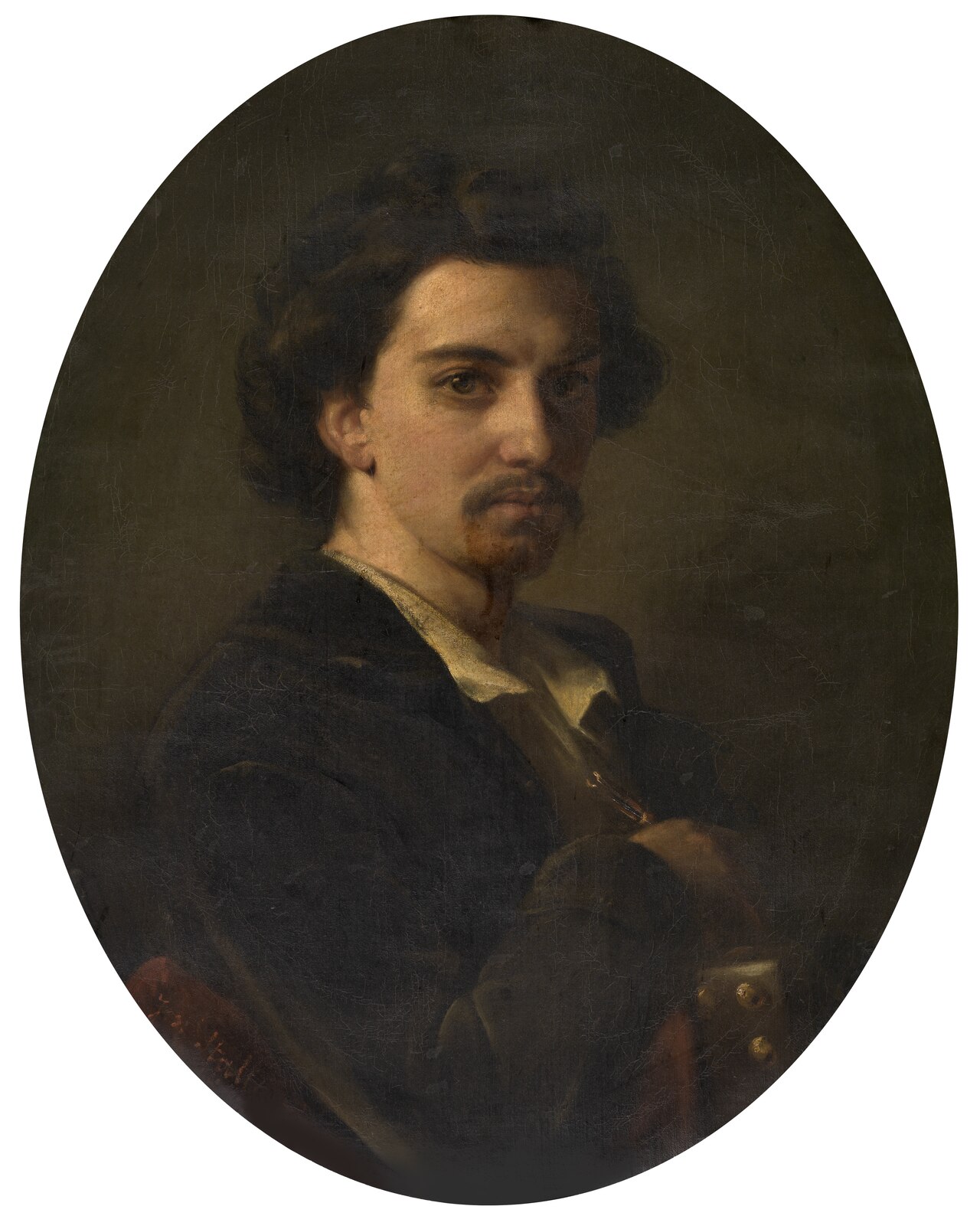
- Self Portrait (1881) – The artist’s self‑portrait offers insight into his personal aesthetic. Rendered with a smooth finish, the work reveals a dignified, contemplative sitter, framed by a modest background that foregrounds his visage. The portrait underscores Stallaert’s confidence in his technical abilities and his alignment with the academic tradition of self‑representation.
- The Painter Constant Wauters (1847) – Although the date predates Stallaert’s mature period, this portrait of fellow Belgian painter Constant Wauters reflects his early interest in capturing fellow artists. The composition is restrained, focusing on the sitter’s thoughtful expression, and showcases Stallaert’s capacity to convey character through subtle modelling.
Influence and legacy Joseph Stallaert’s legacy rests on two pillars: his contributions to Belgian academic painting and his role as an educator. By consistently championing the classicist idiom, he provided a counterbalance to the burgeoning realist and impressionist movements that would later dominate Belgian art. His paintings, though not as widely exhibited today as those of his more avant‑garde peers, remain valuable exemplars of the 19th‑century academic tradition.
As a teacher at the Royal Academy, Stallaert influenced a cohort of artists who carried forward the principles of careful drawing, compositional balance, and narrative clarity. While the tide of modernism eventually eclipsed academic painting, his dedication to technical excellence helped preserve a lineage of skill that continued to inform Belgian art education into the early 20th century.
Stallaert died in Ixelles, a Brussels suburb, in 1903. Posthumously, his works have been reassessed by scholars interested in the interplay between Belgian and French neoclassicism. Contemporary exhibitions occasionally feature his paintings alongside those of his French counterparts, highlighting the cross‑cultural dialogue that shaped European academic art. Though not a household name, Joseph Stallaert remains a notable figure for those studying the persistence of classicist ideals in a period of rapid artistic change.
Frequently asked questions
Who was Joseph Stallaert?
Joseph Stallaert (1825–1903) was a Belgian painter and art teacher renowned for his Classicist, academic depictions of mythological and historical subjects.
What style or movement is he associated with?
He worked within the neoclassical academic tradition, drawing inspiration from the French master Jacques‑Louis David and emphasizing idealised forms, clear composition, and moralising narratives.
What are his most famous works?
His best‑known paintings include *Death of Dido* (1872), *Polyxena Sacrificed on Achilles' Pyre* (1875), *Polyxena on Achilles' Stake* (1881), his 1881 *Self Portrait*, and the portrait *The Painter Constant Wauters* (1847).
Why does Joseph Stallaert matter in art history?
Stallaert exemplifies the persistence of Classicist academic painting in Belgium during a time of shifting artistic trends, and his teaching helped transmit rigorous academic techniques to subsequent generations of Belgian artists.
How can I recognise a painting by Joseph Stallaert?
Look for polished, smooth surfaces, meticulous draftsmanship, a restrained colour palette, and subjects drawn from antiquity presented with clear, balanced compositions and subtle chiaroscuro.