Adriaen van Stalbemt
1580 – 1662
In short
Adriaen van Stalbemt (1580–1662) was a Flemish painter and printmaker from Antwerp, recognised for his landscape paintings that blend religious, mythological and allegorical scenes, and for providing figure staffage in the works of his contemporaries.
Notable works


.jpg)

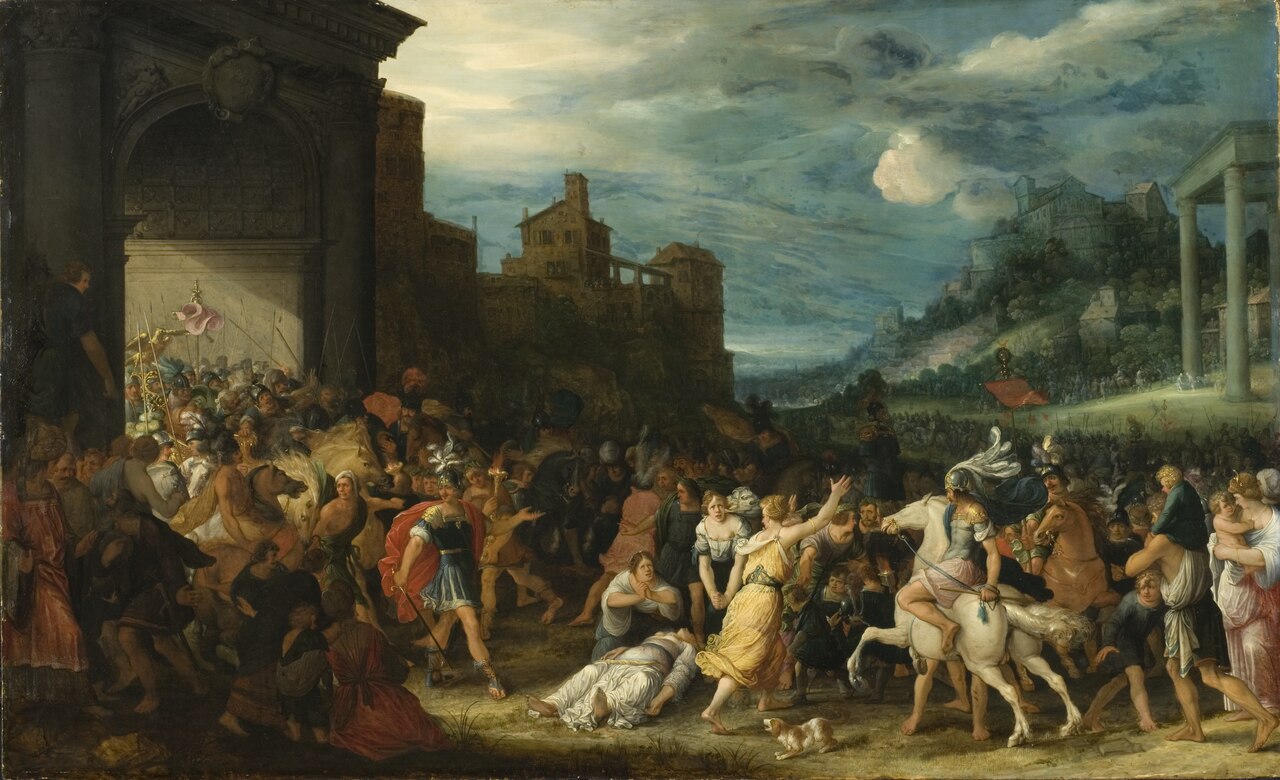
Early life Adriaen van Stalbemt was born in Antwerp in 1580, a city that was a thriving centre of artistic production in the Habsburg Netherlands. Little is known about his family background, but the typical route for a young artist in Antwerp involved an apprenticeship with an established master, often organised through the Guild of Saint Luke. It is therefore reasonable to assume that van Stalbemt received formal training within this guild system, learning the fundamentals of drawing, composition and the handling of oil paint. The city’s vibrant market for religious commissions and the growing demand for decorative landscapes would have provided a fertile environment for his artistic development.
Career and style Van Stalbemt’s professional career unfolded almost entirely in Antwerp, where he was active from the early decades of the seventeenth century until his death in 1662. He built a reputation as a versatile painter, equally comfortable with pure landscape and with narrative subjects that required a sophisticated integration of figures. His work reflects the broader Flemish Baroque sensibility: a strong emphasis on naturalistic detail, dramatic lighting and a balanced, often theatrical composition. While he did not align himself with a specific avant‑garde movement, his paintings sit comfortably within the tradition of Flemish landscape painting established by artists such as Jan Brueghel the Elder and later refined by contemporaries like Joos de Momper. Van Stalbemt was also regularly invited to contribute staffage—the human and animal figures that populate a landscape—to the compositions of other painters, a testament to his skill as a figure draughtsman.
Signature techniques Several technical hallmarks allow van Stalbemt’s work to be distinguished from that of his peers. He employed a layered approach to atmospheric perspective, using progressively cooler and less saturated colours to convey depth in distant scenery. His foliage is rendered with meticulous attention to leaf shape and vein structure, often achieved through fine brushwork that gives a tactile quality to trees and shrubs. In his figure work, van Stalbemt favoured a compact, yet expressive modelling of the human form, using subtle chiaroscuro to suggest volume without overwhelming the surrounding landscape. The integration of staffage is particularly seamless; figures appear to inhabit the space rather than being superimposed, indicating a careful planning of perspective lines during the compositional stage. His palette typically includes earth tones, ochres and muted greens, punctuated by occasional bright reds or blues to highlight garments or symbolic objects.
Major works The surviving oeuvre of Adriaen van Stalbemt includes several works that illustrate the breadth of his subject matter. **The Sciences and Arts (1650)** is an allegorical composition where the personifications of Knowledge and the Liberal Arts are set within a cultivated garden, underscoring the intellectual aspirations of the period. The painting demonstrates his ability to blend symbolic figures with a lush, orderly landscape. **Paul and Barnabas are worshiped as gods in Lystra (1650)** depicts a biblical episode from the Acts of the Apostles, rendered with a dramatic sense of space that places the missionary figures against a rocky, sun‑lit terrain. The work exemplifies his skill in integrating narrative drama within a natural setting.
In the realm of pure landscape, Wooded landscape with traveller on a road and buildings beyond (1628) presents a winding path that leads the eye through dense trees toward a distant settlement. The traveller, rendered in modest detail, serves as a focal point that anchors the composition while inviting the viewer to imagine the journey ahead. Mountainous landscape (1620) showcases van Stalbemt’s early engagement with topographical variation; the painting features craggy peaks and a sky rendered with delicate gradations of light, reflecting an interest in the sublime aspects of nature.
Finally, The Horatii Entering Rome (1613) illustrates a classical narrative in which the Roman brothers, after their victorious combat, are welcomed by a crowd. Though the subject is historical rather than religious, the work retains van Stalbemt’s characteristic integration of figures within a spacious, architecturally suggestive environment. Across these works, a consistent concern with the harmonious relationship between human activity and the surrounding landscape emerges.
Influence and legacy Adriaen van Stalbemt occupies a modest yet distinctive niche in the history of Flemish art. His contributions to the development of landscape painting, particularly his skill in marrying narrative content with naturalistic settings, helped to broaden the thematic possibilities of the genre in the early modern Netherlands. By providing staffage for other artists, he also facilitated a collaborative culture that was common in Antwerp workshops, influencing the visual vocabulary of his peers. Although he did not found a school or movement, his works have been retained in a number of European collections, where they continue to inform scholars about the interplay of allegory, religion and nature in seventeenth‑century Flemish painting. Modern appreciation of his paintings rests on their technical proficiency, compositional balance and the subtle way they reflect the intellectual currents of their time.
Overall, van Stalbemt’s legacy endures as an example of an artist who successfully navigated the demands of patronage, collaborative practice and personal artistic expression within the vibrant artistic milieu of Antwerp.
Influence and legacy Adriaen van Stalbemt’s work remains a point of reference for scholars studying the evolution of landscape painting in the Low Countries. His careful synthesis of narrative and natural elements anticipates later developments in the genre, and his staffage contributions illustrate the collaborative dynamics that characterised Antwerp’s artistic community. Contemporary exhibitions and catalogues continue to feature his paintings, reinforcing his status as a competent and adaptable figure within the broader Flemish Baroque tradition.
Frequently asked questions
Who was Adriaen van Stalbemt?
Adriaen van Stalbemt (1580–1662) was a Flemish painter and printmaker from Antwerp, known for his landscape paintings that combine religious, mythological and allegorical subjects, and for providing figure staffage in the works of other artists.
What artistic style or movement is he associated with?
He worked within the Flemish Baroque tradition, producing naturalistic landscapes with integrated narrative figures, though he is not tied to a specific avant‑garde movement.
What are his most famous works?
Key works include *The Sciences and Arts* (1650), *Paul and Barnabas are worshiped as gods in Lystra* (1650), *Wooded landscape with traveller on a road and buildings beyond* (1628), *Mountainous landscape* (1620) and *The Horatii Entering Rome* (1613).
Why is Adriaen van Stalbemt important in art history?
He helped expand the scope of Flemish landscape painting by seamlessly integrating narrative content, and his staffage work exemplifies the collaborative practices of Antwerp’s artistic community.
How can I recognise a van Stalbemt painting?
Look for detailed foliage, a balanced use of atmospheric perspective, modest yet expressive figures that appear naturally within the landscape, and a muted earth‑tone palette punctuated by occasional bright accents.