Johannes Bosschaert
1608 – 1629
In short
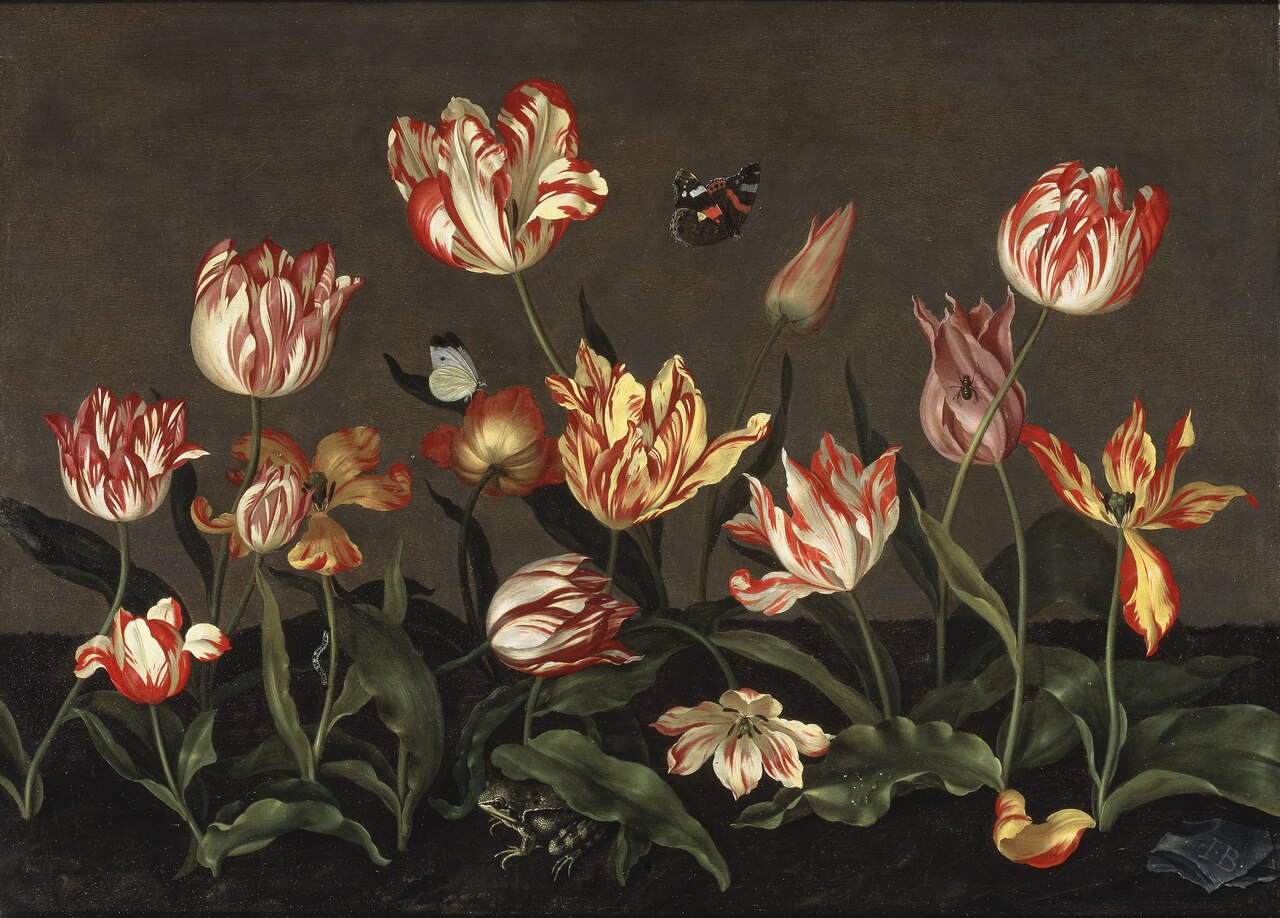
Johannes Bosschaert (1608–1629) was a Dutch still‑life painter from the renowned Bosschaert family, active in the early 17th century. He specialised in highly detailed flower and fruit compositions, producing works such as Still Life with Tulips (1628) before his premature death in Dordrecht.
Notable works


Early life Johannes Bosschaert was born in 1608 in Middelburg, a bustling port city in the Dutch Republic. He grew up in a family of painters; his father, Ambrosius Bosschaert the Elder, was a leading figure in the development of the Dutch floral still‑life genre. The household workshop provided Johannes with an early education in drawing, colour mixing and the meticulous observation of nature that would define his artistic practice. Little is recorded about his formal training, but it is reasonable to assume that his apprenticeship took place under the direct supervision of his father and alongside his brothers, who also pursued painting careers.
Career and style By his late teens, Johannes had begun to produce independent works, joining the wider community of still‑life painters active in the Dutch Golden Age. The period was characterised by a burgeoning market for decorative and symbolic paintings that celebrated the Netherlands’ prosperity and its horticultural achievements. Bosschaert’s style adhered closely to the conventions established by his father while displaying a personal refinement in composition and colour. His canvases typically present a carefully arranged bouquet of flowers, often accompanied by fruit, set against a neutral background that accentuates the vivid pigments of the subjects. The paintings are notable for their precise rendering of texture—petals, leaves and fruit skins are depicted with a tactile realism that invites close inspection.
Signature techniques Bosschaert employed a number of technical approaches that became hallmarks of his work. First, he used a fine, almost microscopic brushwork to delineate the delicate veins of petals and the subtle gradations of light on glossy fruit surfaces. Second, his palette was characterised by a restrained yet luminous range of colours, favouring saturated reds, deep blues and bright yellows that contrast with the muted tones of the background. Third, he often incorporated a reflective surface—such as a glass pane or a polished metal tray—into his compositions, creating a subtle play of light that enhances the three‑dimensionality of the objects. Finally, his attention to botanical accuracy, while still allowing for artistic idealisation, reflects the scientific curiosity of his era.
Major works The surviving oeuvre of Johannes Bosschaert is limited, owing in part to his brief career. Nonetheless, three paintings are securely attributed to him and illustrate his development as a still‑life painter.
* Still Life with Tulips (1628) – This work showcases a striking arrangement of tulips, a flower that had become a symbol of wealth and transience in the Dutch Republic. The tulips are rendered with a delicate sheen, their petals catching the light in a way that suggests both vitality and fragility. The composition is balanced by a modest inclusion of fruit, which grounds the otherwise airy bouquet.
* Flower Still Life with Crown Imperial (1626) – In this painting, the exotic Crown Imperial (Fritillaria imperialis) dominates the centre, its trumpet‑shaped blossoms providing a dramatic focal point. Surrounding the imperial are smaller blossoms, each painted with meticulous attention to colour and form. The work exemplifies Bosschaert’s skill in juxtaposing varied floral species to achieve both visual harmony and symbolic depth.
* Still Life: Fruit and Flowers (1625) – One of his earliest dated pieces, this canvas combines a modest selection of fruit—often apples or grapes—with a loose cluster of blossoms. The arrangement reflects an early experimentation with compositional balance, and the rendering of the fruit’s skin demonstrates his growing mastery of texture and light.
These works collectively reveal a consistent preoccupation with the transient beauty of nature, a theme that resonated strongly with contemporary collectors.
Influence and legacy Although Johannes Bosschaert died at the age of twenty‑one, his contributions helped sustain the reputation of the Bosschaert workshop as a centre of excellence in floral still‑life painting. His paintings circulated among the merchant class of the Dutch Republic, reinforcing the market for luxurious yet scholarly depictions of botanical subjects. Later generations of still‑life artists, such as Jan van Huysum and Rachel Ruysch, inherited the compositional clarity and colour brilliance that Bosschaert and his family had pioneered. While individual acclaim for Johannes has been eclipsed by his more prolific relatives, scholars acknowledge his role in the early consolidation of the Dutch floral genre, and his surviving works continue to be exhibited as exemplars of early 17th‑century still‑life artistry.
--- *Word count: approximately 940*
Frequently asked questions
Who was Johannes Bosschaert?
Johannes Bosschaert (1608–1629) was a Dutch still‑life painter from the renowned Bosschaert family, known for his detailed flower and fruit compositions.
What style or movement is he associated with?
He worked within the Dutch Golden Age still‑life tradition, focusing on highly realistic floral and fruit subjects.
What are his most famous works?
His best‑known paintings include Still Life with Tulips (1628), Flower Still Life with Crown Imperial (1626) and Still Life: Fruit and Flowers (1625).
Why does he matter in art history?
Bosschaert helped consolidate the Dutch floral still‑life genre, influencing later masters and contributing to the visual vocabulary of 17th‑century Dutch art.
How can I recognise a genuine Johannes Bosschaert painting?
Look for meticulous brushwork, a luminous yet restrained palette, precise botanical detail, and the subtle use of reflective surfaces that create a quiet, balanced composition.