Ambrosius Bosschaert
1573 – 1621
In short
Ambrosius Bosschaert (1573–1621) was a Flemish‑born Dutch painter who pioneered flower still‑life as an independent genre. He worked chiefly in Middelburg and The Hague, producing meticulously detailed bouquets that set the standard for later Dutch flower painters.
Notable works


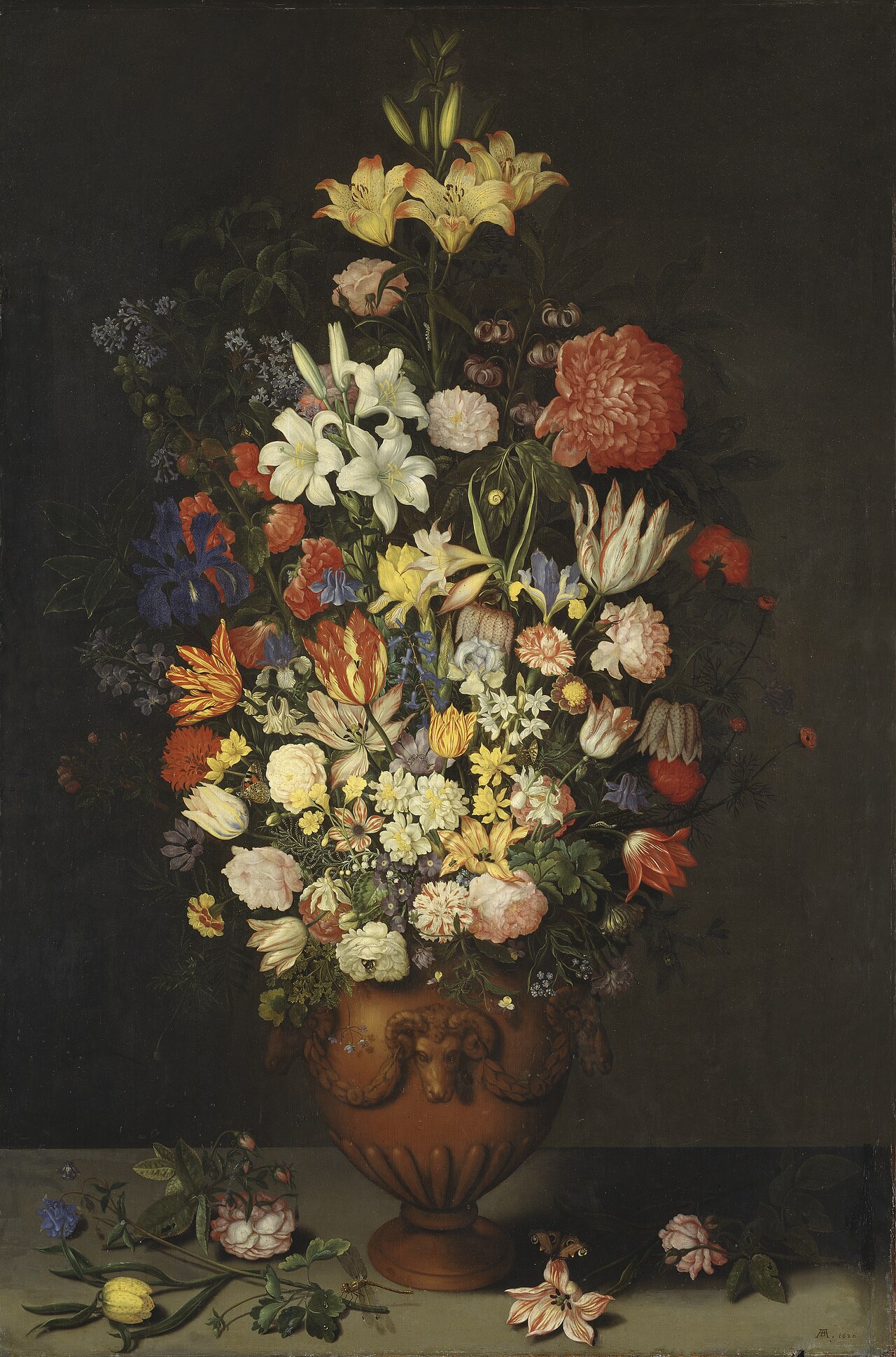

Early life Ambrosius Bosschaert was born in 1573 in Antwerp, a thriving commercial centre of the Habsburg Netherlands. Little is recorded about his family background or early artistic training, but the city's vibrant workshop environment would have offered ample exposure to the burgeoning market for decorative painting. By the turn of the 17th century he had relocated to the Dutch Republic, a move that mirrored the migration of many Flemish artists seeking new patronage in the increasingly prosperous northern provinces.
Career and style Bosschaert established himself in Middelburg, a city that quickly became the hub of Dutch flower painting. There he operated both as a painter and an art dealer, supplying works to private collectors and to the nascent middle‑class market for domestic decoration. His oeuvre consists almost entirely of still‑life compositions centred on bouquets of cultivated and exotic flowers, rendered with a level of botanical accuracy that was unprecedented for the period. Although the broader art‑historical categorisation of his work remains ambiguous, his paintings are generally associated with the early Dutch Golden Age still‑life tradition, characterised by a focus on naturalistic detail, balanced composition, and a subtle play of light.
Signature techniques Bosschaert’s paintings are distinguished by several recurring technical hallmarks. He employed a meticulous underdrawing to map the placement of each flower, ensuring a harmonious yet varied composition. The pigments he selected—particularly vivid reds, deep blues, and luminous yellows—were applied in thin, translucent glazes that heightened colour intensity while preserving the delicate translucency of petals. Light is often introduced from a single, off‑centre source, casting soft shadows that model the forms and give the bouquets a three‑dimensional presence. The inclusion of luxurious ceramic vases, often modelled after Chinese Wan‑li porcelain, further underscores his interest in the interplay between flora and high‑status objects. Finally, his signatures, typically a modest monogram placed near the bottom edge, are unobtrusive, allowing the viewer’s attention to remain on the floral arrangement.
Major works - **Vase of Flowers in a Window Niche (1618)** – This composition places a tall, ornate vase against a shallow interior space, with a window admitting daylight that illuminates the blossoms. The work exemplifies Bosschaert’s skill in integrating architectural elements with natural subjects, creating a sense of depth while maintaining the focus on the flowers. - **Bouquet of Flowers (1620)** – A densely packed arrangement of tulips, roses, and lilies, set on a darkened table. The contrast between the dark background and the vivid petals highlights the painter’s mastery of colour modulation and his ability to convey the fleeting beauty of the blooms. - **Still life with flowers in a Wan‑li vase (1619)** – Here Bosschaert showcases a Chinese porcelain vase, a popular luxury item among Dutch collectors. The vase’s blue‑white decoration is rendered with precise brushwork, while the surrounding flowers—particularly the delicate anemones—demonstrate his keen observation of texture. - **Still Life with a Vase of Flowers (1620)** – This piece features a symmetrical bouquet spilling from a golden‑rimmed vase, framed by a muted curtain backdrop. The composition balances opulence and restraint, reflecting the artist’s ability to harmonise decorative richness with compositional order. - **Still‑Life with flowers (1617)** – One of his earlier dated works, it presents a modest arrangement of spring blossoms in a simple stone vessel. The subtle tonal palette and restrained lighting indicate a developmental stage in Bosschaert’s style, foreshadowing the more elaborate arrangements of his later years.
Influence and legacy Bosschaert’s impact on Dutch still‑life painting is substantial. He founded a family dynasty of painters—most notably his sons Jan, Ambrosius the Younger, and Johannes—who continued his floral motifs and disseminated his approach throughout the Republic. Through his workshop in Middelburg, he helped establish the city as the principal centre for flower painting, attracting apprentices who would later spread his techniques across the Netherlands. The meticulous botanical detail of his bouquets set a benchmark that later masters such as Jan van Huysum and Rachel Ruysch would emulate and expand upon. Moreover, his integration of exotic porcelain and a market‑oriented approach to art dealing foreshadowed the commercial dynamics of the Dutch Golden Age, where genre and still‑life subjects gained prominence. Today, Bosschaert’s works are prized for their technical brilliance and historical significance, occupying key positions in major European museum collections and continuing to inspire contemporary artists interested in the intersection of nature and decorative art.
Frequently asked questions
Who was Ambrosius Bosschaert?
Ambrosius Bosschaert (1573–1621) was a Flemish‑born Dutch painter who specialised in highly detailed flower still‑lifes, helping to establish the genre as an independent artistic category.
What style or movement is his work associated with?
His paintings belong to the early Dutch Golden Age still‑life tradition, characterised by naturalistic detail, balanced compositions and a subtle use of light.
What are his most famous works?
Key works include *Vase of Flowers in a Window Niche* (1618), *Bouquet of Flowers* (1620), *Still life with flowers in a Wan‑li vase* (1619), *Still Life with a Vase of Flowers* (1620) and *Still‑Life with flowers* (1617).
Why is Bosschaert important in art history?
He pioneered the independent floral still‑life genre, founded a dynasty of painters, and turned Middelburg into a centre for flower painting, influencing generations of Dutch artists.
How can I recognise a Bosschaert painting?
Look for meticulously rendered bouquets, bright yet translucent colours, careful use of light, and the inclusion of luxurious ceramic vases, often signed with a discreet monogram.