Thomas Willeboirts Bosschaert
1613 – 1654
In short
Thomas Willeboirts Bosschaert (1613–1654) was a Flemish Baroque painter born in Bergen op Zoom who worked mainly in Antwerp. He is noted for his history paintings, religious compositions and still‑lifes, blending Rubensian dynamism with a refined colour palette.
Notable works


Early life Thomas Willeboirts Bosschaert was born in 1613 in the fortified town of Bergen op Zoom, then part of the Spanish Netherlands (now the Netherlands). Little is recorded about his family, but the region’s thriving artistic climate provided ample opportunity for a young talent to encounter the visual arts. He likely received his first training locally before moving to Antwerp, the commercial and artistic hub of the Southern Netherlands, where he could study under established masters.
Career and style By his early twenties Willeboirts Bosschaert had entered the workshop of Gerard Seghers, a leading Antwerp painter who had himself absorbed the influence of Peter Paul Rubens. Under Seghers, Willeboirts refined his drawing skills and learned the dramatic compositions that characterised the Baroque style. He quickly attracted commissions from churches, civic institutions and private patrons, many of whom were eager to display the opulent visual language that marked the Counter‑Reformation aesthetic.
Willeboirts’ style is firmly rooted in the Flemish Baroque tradition. He adopted Rubens’ vigorous movement, rich colour harmonies and sensuous modelling of flesh, while also developing a more delicate handling of decorative elements such as garlands, fruit and ornamental cartouches. His works often balance a theatrical narrative with a meticulous attention to surface detail, a duality that appealed to both ecclesiastical clients seeking devotional intensity and secular patrons desiring display pieces.
Signature techniques Willeboirts Bosschaert is distinguished by several recurring technical choices. First, he employed a luminous palette dominated by deep reds, golds and blues, which he layered to achieve a glowing flesh tone and a sense of three‑dimensionality. Second, his brushwork combines fluid, sweeping strokes for drapery with finer, almost stippled touches when rendering foliage, flowers or textiles. Third, he frequently incorporated decorative cartouches—often shaped as scrolls, roses or fruit‑laden wreaths—into the compositional framework, using them to separate foreground action from background architecture. Finally, chiaroscuro is used sparingly yet effectively, heightening the drama of key figures while allowing peripheral details to retain clarity.
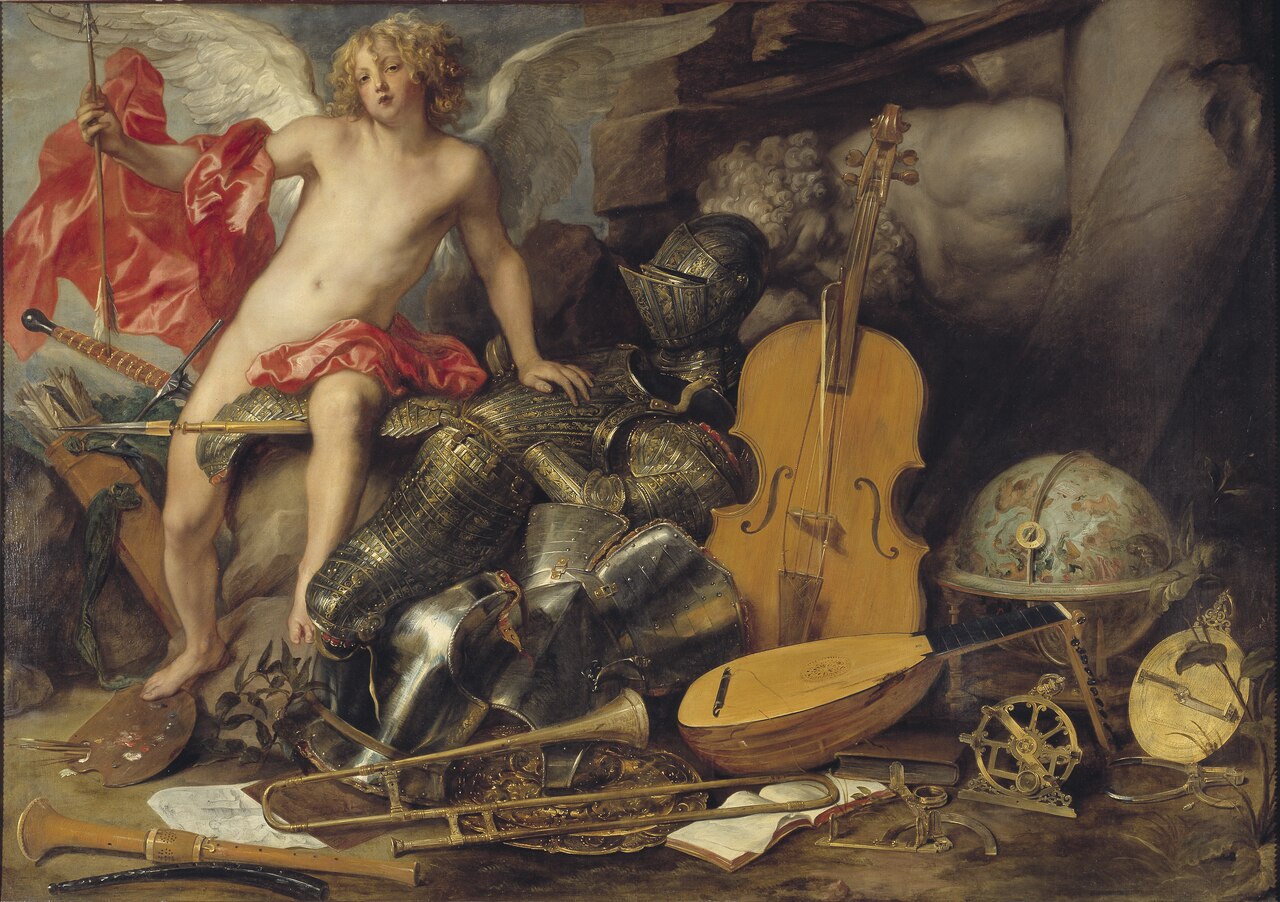
Major works - **Triumphant Cupid among Emblems of Art and War (1645)** – This allegorical canvas juxtaposes the mischievous Cupid with symbols of artistic achievement and martial power. The painting showcases Willeboirts’ skill in rendering both the soft flesh of the deity and the metallic sheen of weapons, while the surrounding emblems are framed by a lush garland of roses, a motif he favoured.
- Chalice and Host in a Niche, within a Cartouche of Roses and Fruit (1648) – A devotional still‑life that places the Eucharistic chalice and host in a recessed niche, surrounded by a sumptuous cartouche of roses, grapes and figs. The work demonstrates his mastery of reflective surfaces—especially the polished metal of the chalice—and his ability to imbue inanimate objects with spiritual resonance.
- The Meal in Peril. Still Life with Black Servant and Parrot (1641) – An unusual genre scene that combines a banquet setting with a figure of a Black servant and an exotic parrot. The composition is notable for its narrative tension; the servant appears poised to protect the meal, while the vivid plumage of the parrot adds a splash of colour. Willeboirts’ handling of the bird’s feathers and the servant’s skin tone reflects his attentiveness to texture.
- Garland of Flowers surrounding a Sculpture of the Virgin Mary (1645) – Here Willeboirts frames a marble Virgin Mary statue with a profusion of blossoms, creating a dialogue between the sacred figure and the natural world. The delicate rendering of petals and the subtle play of light on the sculpture illustrate his capacity to merge sculptural and painterly concerns.
- The Virgin Crowned by the Infant Christ (1640) – A classic devotional image in which the infant Christ places a crown upon Mary’s head. The work is characterised by a gentle, intimate interaction between mother and child, set against a backdrop of softly illuminated clouds. The delicate modelling of the infant’s hair and the tender expression on Mary’s face reveal Willeboirts’ sensitivity to emotive nuance.
Influence and legacy Thomas Willeboirts Bosschaert occupied a central position among mid‑17th‑century Flemish painters, bridging the grandiose ambitions of Rubens with a more refined, decorative sensibility. His paintings were widely collected in Antwerp and exported to the Dutch Republic and beyond, helping to disseminate the Baroque aesthetic across Northern Europe. Although he never achieved the fame of his contemporary Rubens, his works were admired for their technical polish and their ability to translate religious fervour into visually compelling narratives. Modern scholarship recognises Willeboirts as a key figure in the transition from the high Baroque to the more delicate, still‑life‑focused approaches that emerged later in the century. His legacy endures in museum collections across Europe, where his paintings continue to exemplify the sophisticated synthesis of narrative drama and decorative elegance that defined Flemish Baroque art.
Frequently asked questions
Who was Thomas Willeboirts Bosschaert?
Thomas Willeboirts Bosschaert (1613–1654) was a Flemish Baroque painter born in Bergen op Zoom who worked mainly in Antwerp, producing history paintings, religious works and still‑lifes.
What artistic movement did he belong to?
He worked within the Baroque movement, adopting Rubensian dynamism, rich colour, and dramatic composition while adding his own decorative flourishes.
What are his most famous works?
Key works include *Triumphant Cupid among Emblems of Art and War* (1645), *Chalice and Host in a Niche* (1648), *The Meal in Peril* (1641), *Garland of Flowers surrounding a Sculpture of the Virgin Mary* (1645) and *The Virgin Crowned by the Infant Christ* (1640).
Why is Willeboirts Bosschaert important in art history?
He helped spread the Flemish Baroque style beyond Antwerp, blending Rubens’ grandiosity with a refined decorative approach that influenced later still‑life and genre painters.
How can I recognise a Willeboirts Bosschaert painting?
Look for vibrant reds and golds, smooth modelling of flesh, decorative garlands or cartouches framing the scene, and a careful balance between dramatic narrative and detailed surface textures.